Free printable practice
Adapting Habitats Practice Activities
Grade 2 science worksheets that help children connect animal body parts and behaviors to the habitats where they survive.
Free printable worksheet PDFs
Preview every available page, then download the free worksheet PDF for home, homeschool, tutoring, or classroom practice.
Preview the exact activity before downloading it.
 Adapting Habitats — Sort and ClassifyGrade 2 science worksheets that help children connect animal body parts and behaviors to the habitats where they survive. This sort and classify worksheet provides a distinct, age-appropriate way to practise the same lesson.Grade 2Free PDF preview
 Adapting Habitats — Label and ModelGrade 2 science worksheets that help children connect animal body parts and behaviors to the habitats where they survive. This label and model worksheet provides a distinct, age-appropriate way to practise the same lesson.Grade 2Free PDF preview
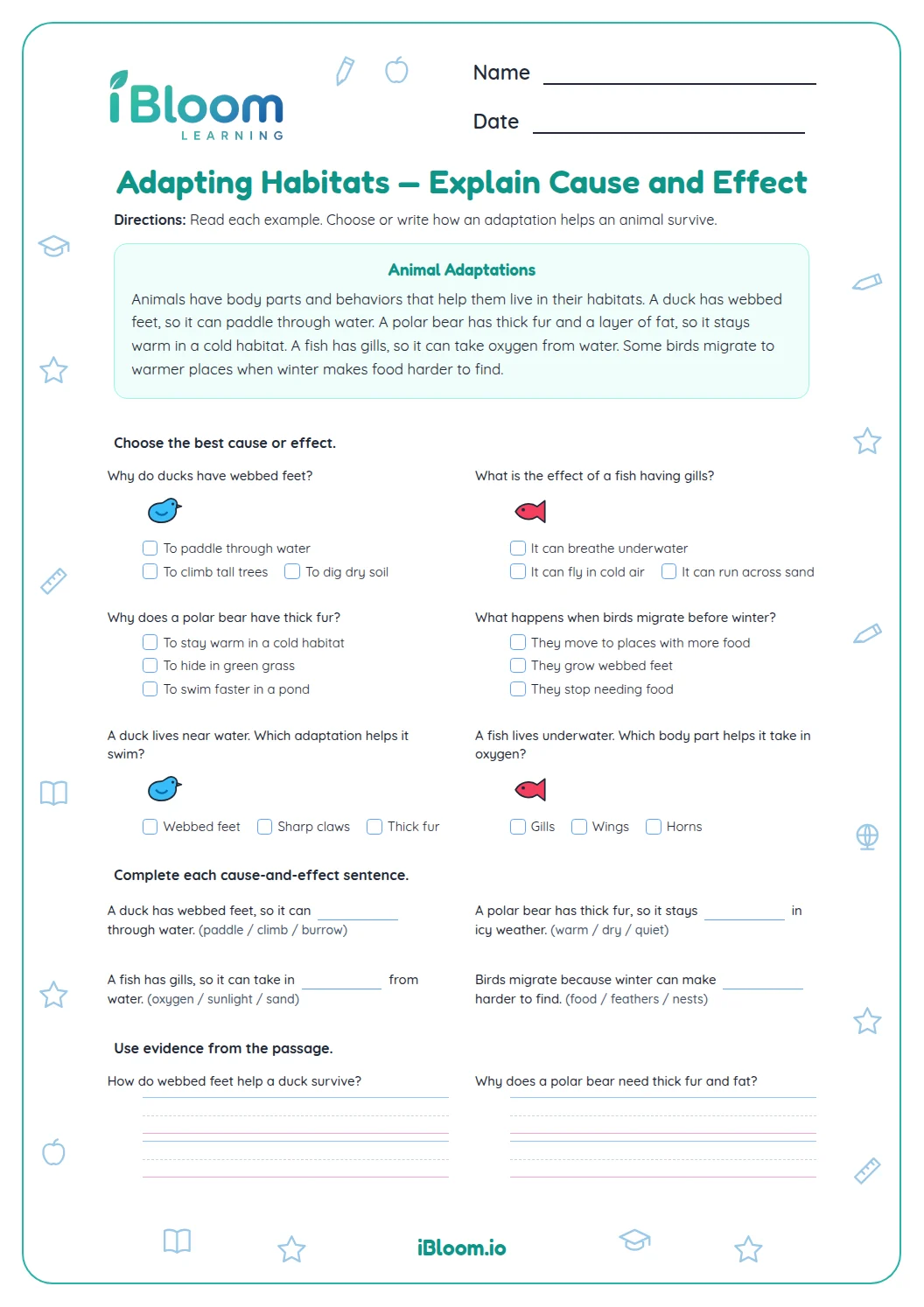 Adapting Habitats — Explain Cause and EffectGrade 2 science worksheets that help children connect animal body parts and behaviors to the habitats where they survive. This explain cause and effect worksheet provides a distinct, age-appropriate way to practise the same lesson.Grade 2Free PDF preview
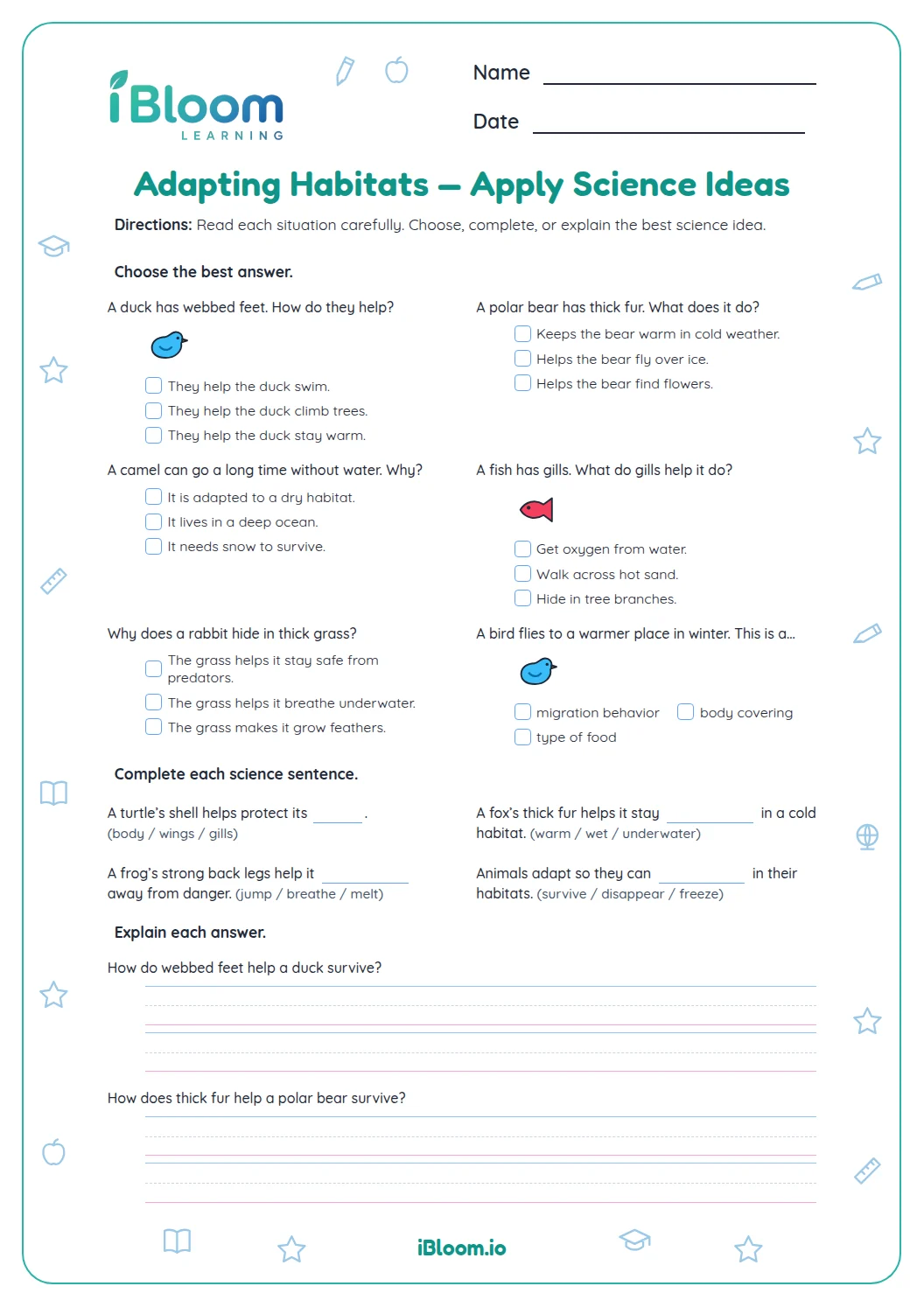 Adapting Habitats — Apply Science IdeasGrade 2 science worksheets that help children connect animal body parts and behaviors to the habitats where they survive. This apply science ideas worksheet provides a distinct, age-appropriate way to practise the same lesson.Grade 2Free PDF preview
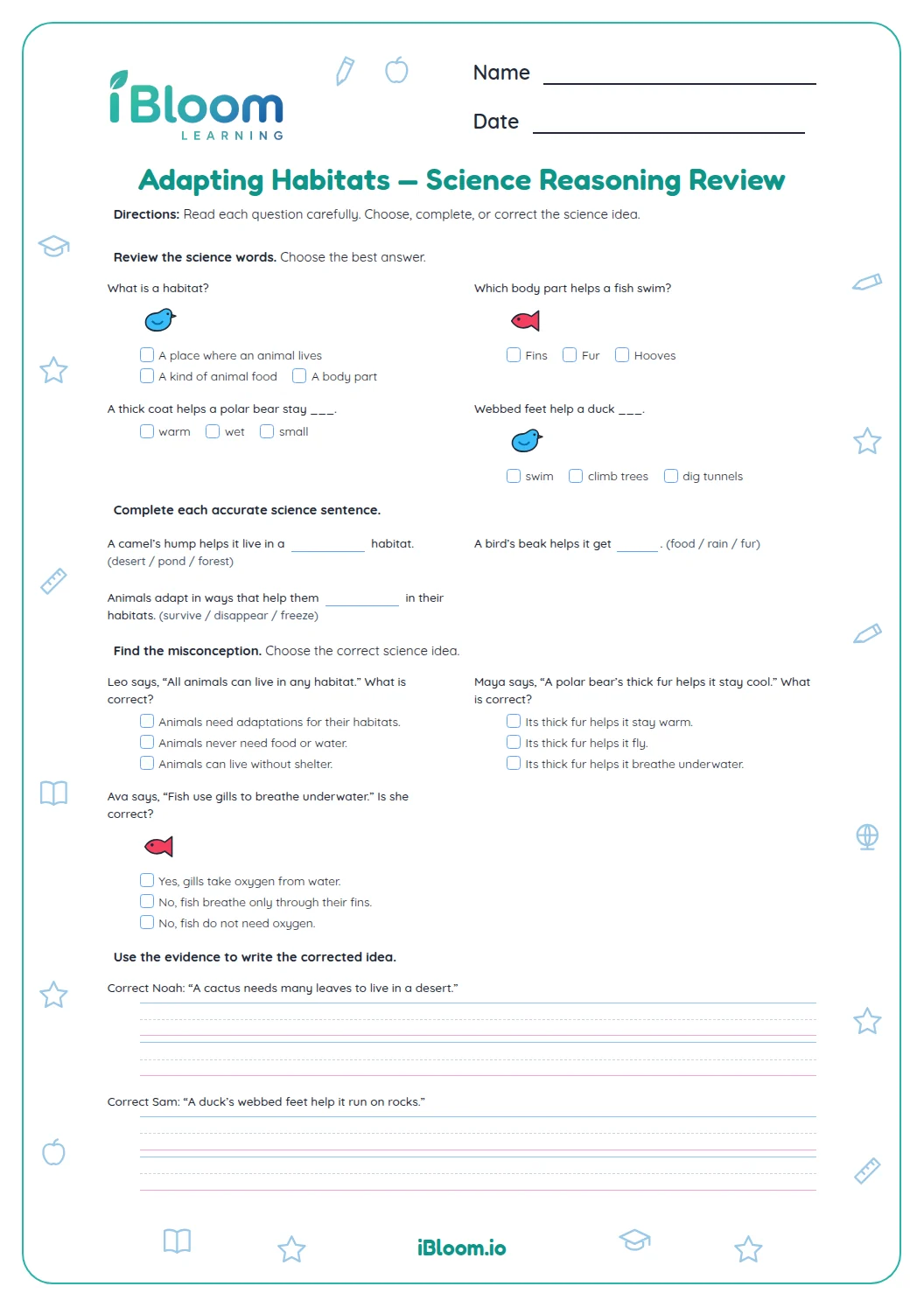 Adapting Habitats — Science Reasoning ReviewGrade 2 science worksheets that help children connect animal body parts and behaviors to the habitats where they survive. This science reasoning review worksheet provides a distinct, age-appropriate way to practise the same lesson.Grade 2Free PDF preview
Practice that builds confidence
What “adapting to habitats” means
In these Grade 2 science worksheets, children practice explaining how animals are suited to their habitats. They look at features such as fur, beaks, feet, shells, body color, and behaviors, then connect each adaptation to survival needs like food, shelter, movement, and protection.
The printable activities include matching, sorting, labeling, short-response prompts, and habitat comparison tasks. Students work with familiar habitats such as forests, deserts, ponds, oceans, and cold regions while building careful science vocabulary.
Children learn that a habitat is the place where an animal lives and gets what it needs. An adaptation is a body part or behavior that helps an animal survive there. A duck’s webbed feet help it swim, a camel’s thick eyelashes help protect its eyes in blowing sand, and a polar bear’s thick fur helps it stay warm in icy places.

Skill progression in the worksheets
The practice moves from recognizing habitats to explaining relationships. Early pages may ask students to match animals to homes or choose which body part helps an animal move, eat, or stay safe. Later questions ask for simple evidence: “The fish has gills, so it can breathe in water.” This supports Grade 2 students as they shift from naming facts to giving reasons.
Parent routine for at-home practice
Choose one animal from a book, video, or backyard observation. Ask three questions: Where does it live? What body part or behavior helps it there? What might be hard for it in a different habitat? After the worksheet, have your child draw one animal and label two helpful features, such as claws, camouflage, fins, or a beak.

Classroom uses for teachers
These printables work well in science centers, animal unit review, small-group reading connections, or notebook follow-up after a habitat lesson. Teachers can use sorting pages for discussion, short-answer pages for formative checks, and comparison tasks to help students explain why the same adaptation may not help in every habitat.

Common errors to watch for
Students may say an animal “chooses” a feature because it wants one. Guide them toward the idea that animals already have traits that help them live in certain places. Another common error is matching by appearance only, such as placing any white animal in snow. Encourage children to look for function: warmth, hiding, swimming, climbing, digging, or getting food.
Free printable PDF download
Use this grade 2 adapting habitats worksheet page to preview the activity, print it, or download it as a PDF for quick practice. It works well for homework, homeschool lessons, tutoring, morning work, revision, and classroom centers.
Answers and answer key support
After the child completes the worksheet independently, parents and teachers can use the answer support or answer key information to check the work, review mistakes, and choose the next practice step.
Why iBloom worksheets help
The activities use clear examples, simple visuals, and repeated question patterns so children can connect vocabulary with evidence. A child-friendly strategy is: “Name the habitat, spot the helpful part, tell how it helps.” This keeps explanations short, scientific, and easy to check.
Helpful answers
Frequently asked questions
What do Grade 2 students learn in adapting habitats worksheets?
They learn to connect animal features and behaviors to the places animals live, such as how fins help fish swim or thick fur helps animals stay warm.
Do these worksheets cover both body parts and behaviors?
Yes. Children practice with physical adaptations like claws, beaks, shells, and gills, as well as behaviors such as hiding, migrating, digging, or building shelters.
Which habitats are useful to review before using the worksheets?
It helps to review familiar habitats such as forests, deserts, ponds, oceans, grasslands, and cold regions, focusing on what animals need in each place.
How can I help my child write better adaptation explanations?
Use a simple sentence frame: “A ___ has ___ because it helps the animal ___ in its habitat.” For example, “A duck has webbed feet because they help it swim in a pond.”
What is a common misconception about animal adaptations?
Many children think animals choose or grow adaptations because they want them. Guide them to understand that helpful traits allow animals to survive better in certain habitats.
Is this grade 2 adapting habitats worksheet free?
Yes. You can preview it for free and use the printable worksheet for home or classroom practice.
Can I download this grade 2 adapting habitats worksheet as a PDF?
Yes. Use the worksheet download option to save a printable PDF, or print the worksheet directly from the page.
Does this grade 2 adapting habitats worksheet include answers or an answer key?
When the activity has fixed answers, iBloom includes answer support so parents and teachers can check the completed worksheet.