Free printable practice
Animal Habitats Practice Activities
Grade 2 science worksheets that help children identify animal habitats and explain how animals meet their needs where they live.
Free printable worksheet PDFs
Preview every available page, then download the free worksheet PDF for home, homeschool, tutoring, or classroom practice.
Preview the exact activity before downloading it.
 Animal Habitats — Sort and ClassifyGrade 2 science worksheets that help children identify animal habitats and explain how animals meet their needs where they live. This sort and classify worksheet provides a distinct, age-appropriate way to practise the same lesson.Grade 2Free PDF preview
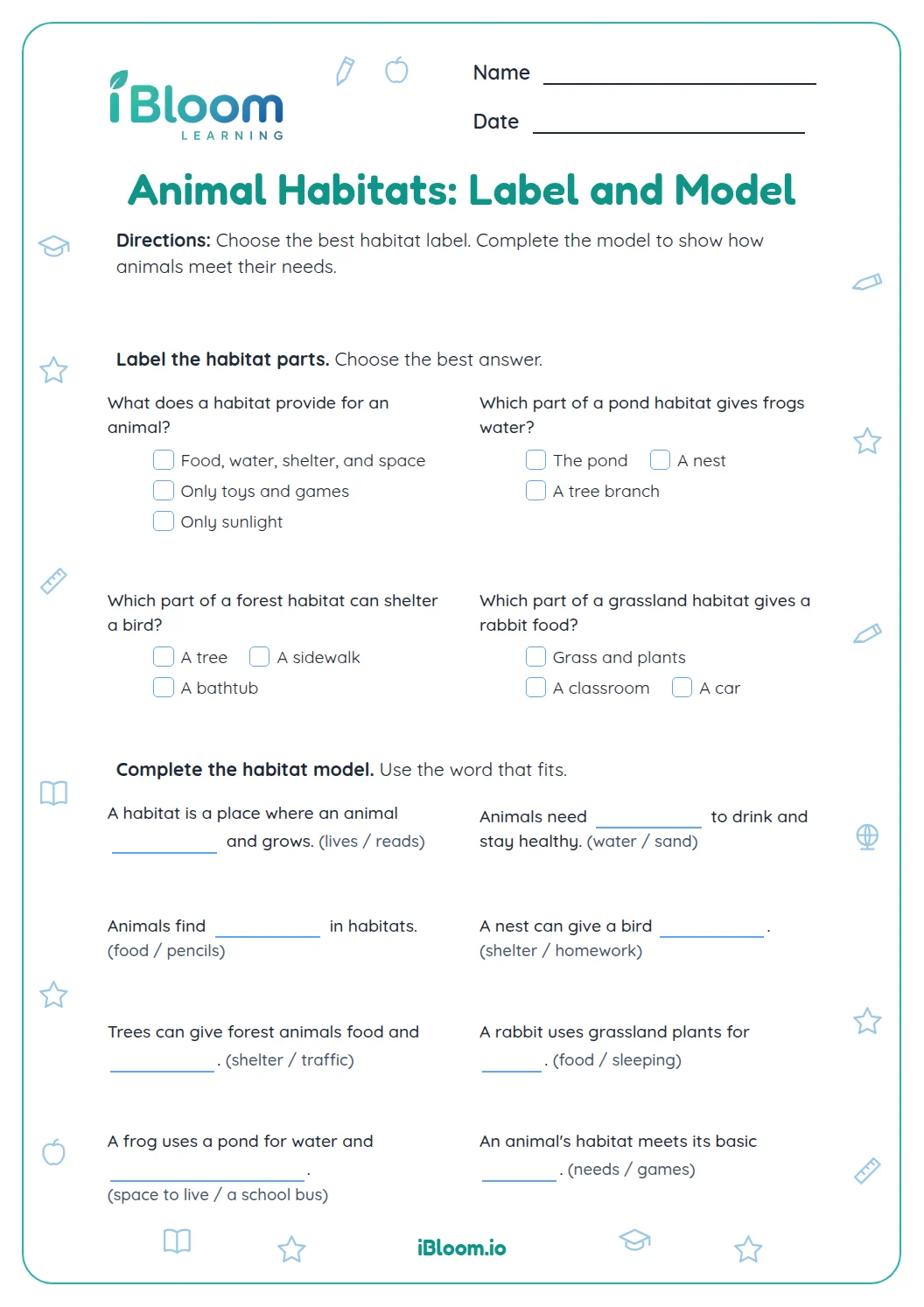 Animal Habitats — Label and ModelGrade 2 science worksheets that help children identify animal habitats and explain how animals meet their needs where they live. This label and model worksheet provides a distinct, age-appropriate way to practise the same lesson.Grade 2Free PDF preview6 pages
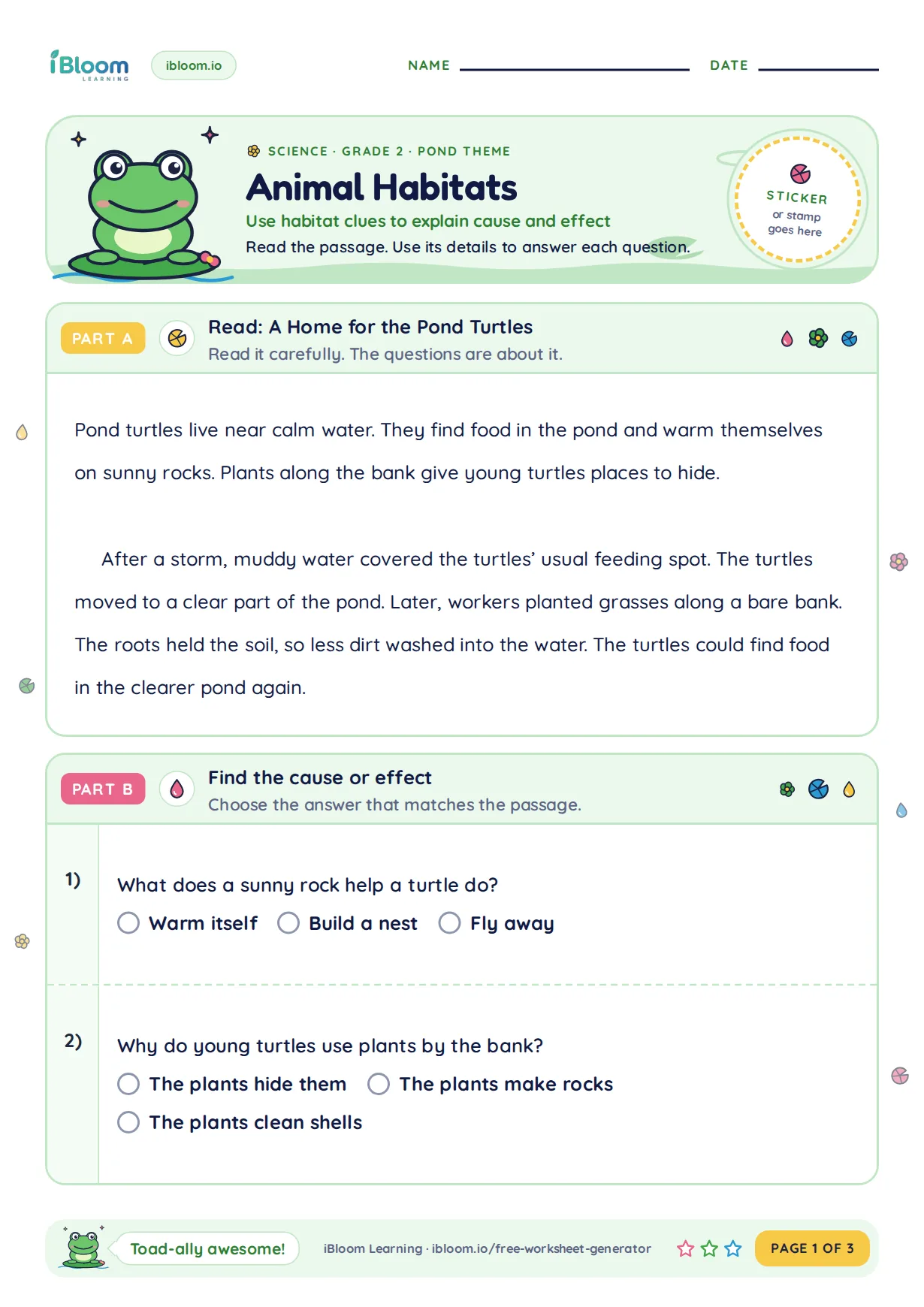 Animal Habitats — Explain Cause and EffectGrade 2 science worksheets that help children identify animal habitats and explain how animals meet their needs where they live. This explain cause and effect worksheet provides a distinct, age-appropriate way to practise the same lesson.Grade 2Free PDF preview
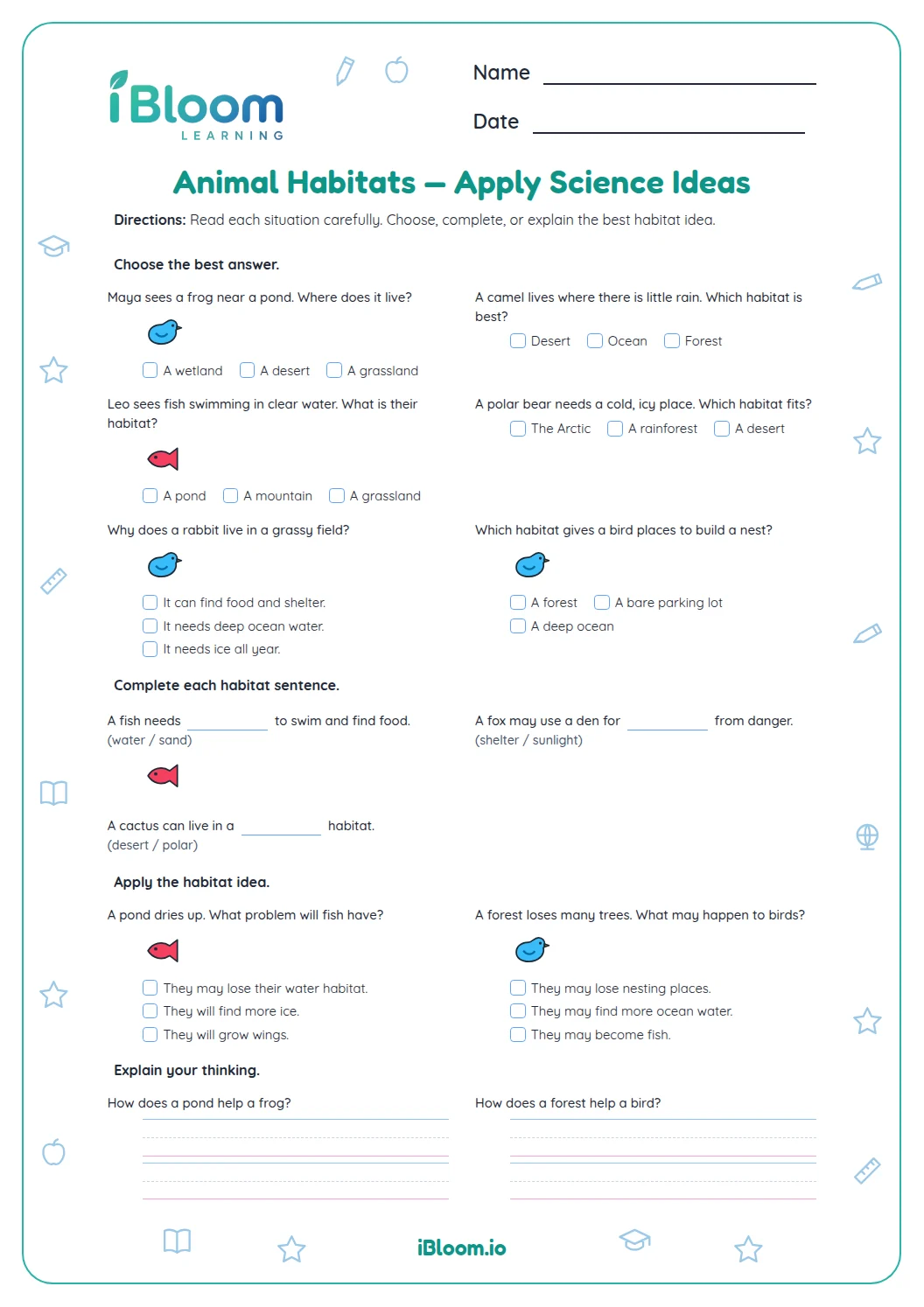 Animal Habitats — Apply Science IdeasGrade 2 science worksheets that help children identify animal habitats and explain how animals meet their needs where they live. This apply science ideas worksheet provides a distinct, age-appropriate way to practise the same lesson.Grade 2Free PDF preview
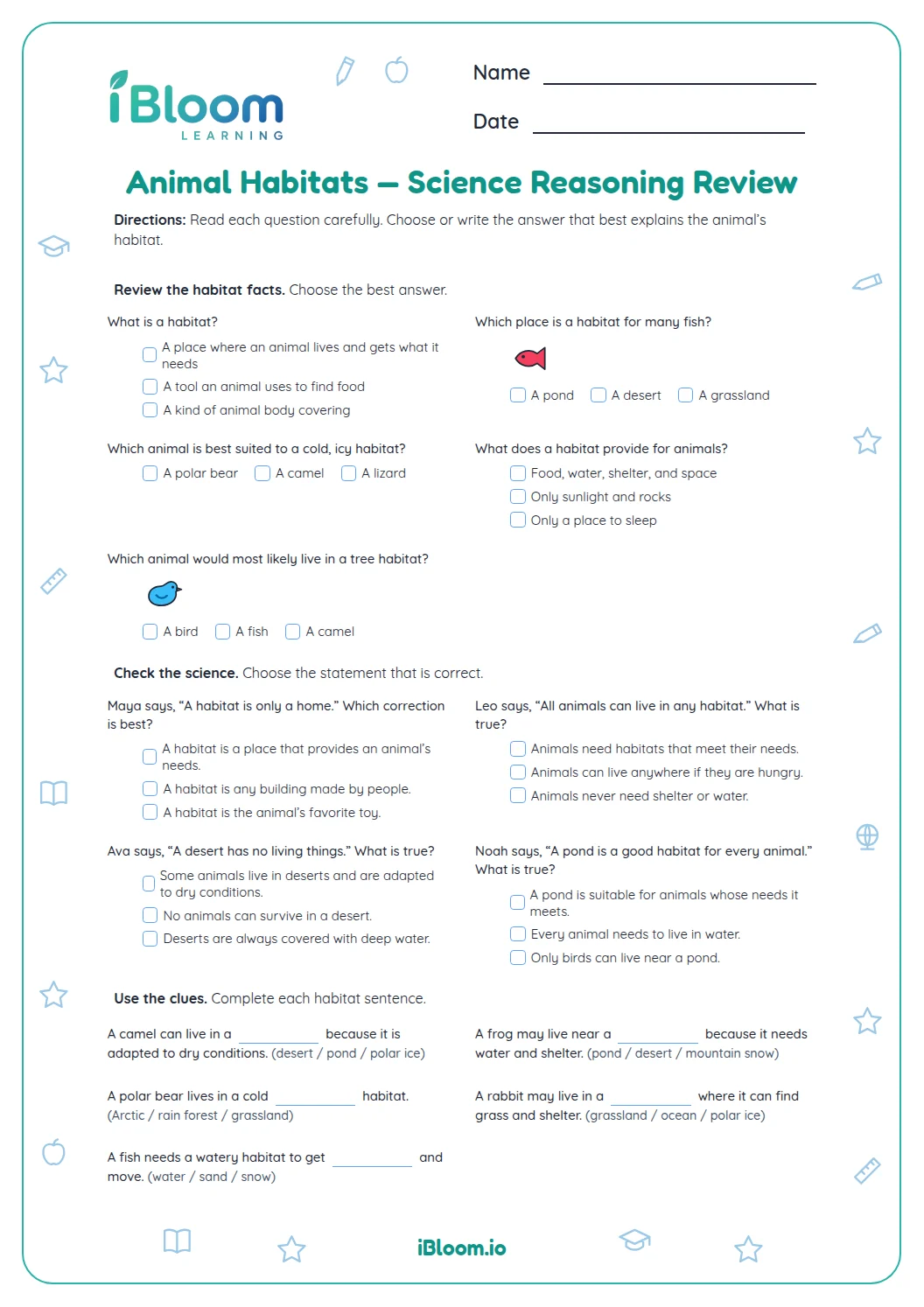 Animal Habitats — Science Reasoning ReviewGrade 2 science worksheets that help children identify animal habitats and explain how animals meet their needs where they live. This science reasoning review worksheet provides a distinct, age-appropriate way to practise the same lesson.Grade 2Free PDF preview
Practice that builds confidence
What Grade 2 children learn
These Grade 2 animal habitats worksheets help children connect animals to the places where they can find food, water, shelter, and space. Students practise describing how a habitat supports living things and why different animals are suited to different environments.
The printable activities may include habitat matching, sorting animals by environment, labeling habitat features, reading short science prompts, and writing simple explanations using words such as forest, desert, ocean, pond, grassland, shelter, and survival.
Animal habitats are more than “where an animal lives.” Children learn that a habitat provides the things an animal needs to survive. A frog may live near a pond because it needs water and insects; a camel is suited to a dry desert; a fish needs water to breathe and move. The focus is on making sensible connections between an animal’s body, behavior, and environment.

Building from naming to explaining
The worksheets move children beyond naming a habitat. They practise matching animals to forests, oceans, deserts, grasslands, ponds, or other familiar environments, then explain why the match makes sense. A stronger answer might say, “A polar bear lives in a cold habitat and has thick fur,” rather than only “ice.” This supports early science reasoning with evidence.
A simple parent routine
Choose one worksheet and ask your child to circle the habitat clues before answering. Then use a two-sentence routine: “This animal lives in ____. I know because ____.” For extra practice, look out a window, open a picture book, or discuss a pet’s needs: Where does it sleep? What does it eat? What would change if it lived somewhere else?

Classroom uses for teachers
Teachers can use these printables in science centers, small-group review, early finisher folders, or as a follow-up to a read-aloud about animals. The pages also support vocabulary development because students must use habitat words in context. For partner work, one student can choose an animal while the other names the habitat and gives a reason.

Common errors to watch for
Some children match animals to places they like rather than places the animal can survive. Others confuse a habitat with a single shelter, such as calling a nest the whole habitat. Encourage them to think about food, water, shelter, air, and space. Also watch for overgeneralizing, such as putting every large animal in a forest.
Free printable PDF download
Use this grade 2 animal habitats worksheet page to preview the activity, print it, or download it as a PDF for quick practice. It works well for homework, homeschool lessons, tutoring, morning work, revision, and classroom centers.
Answers and answer key support
After the child completes the worksheet independently, parents and teachers can use the answer support or answer key information to check the work, review mistakes, and choose the next practice step.
Why iBloom worksheets help
The activities are designed to feel concrete and visual for second graders while still asking for real science thinking. Matching, sorting, labeling, and short written responses help children move from observation to explanation. A child-friendly strategy is: “Look for the need, then choose the place.”
Helpful answers
Frequently asked questions
What should a Grade 2 student understand about animal habitats?
A Grade 2 student should understand that a habitat is a place where an animal gets what it needs to live, including food, water, shelter, and space. They should also begin explaining why an animal fits a particular habitat.
Do these worksheets only ask children to match animals and habitats?
No. Matching is often included, but the activities also encourage children to label habitat features, sort animals, read short prompts, and write simple reasons for their answers.
How can I help my child explain habitat answers better?
Use the sentence frame, “This animal lives in ____ because ____.” Encourage your child to mention a need or feature, such as water for a fish, thick fur for a cold place, or shade and water needs in a dry habitat.
What are common habitat examples for second graders?
Common examples include forests, deserts, oceans, ponds, grasslands, and cold regions. The goal is not to memorize every habitat, but to connect animals with the conditions they need to survive.
Can these animal habitat worksheets be used in science centers?
Yes. They work well for centers because children can match, sort, label, and explain independently or with a partner after the class has discussed basic habitat vocabulary.
Is this grade 2 animal habitats worksheet free?
Yes. You can preview it for free and use the printable worksheet for home or classroom practice.
Can I download this grade 2 animal habitats worksheet as a PDF?
Yes. Use the worksheet download option to save a printable PDF, or print the worksheet directly from the page.
Does this grade 2 animal habitats worksheet include answers or an answer key?
When the activity has fixed answers, iBloom includes answer support so parents and teachers can check the completed worksheet.