








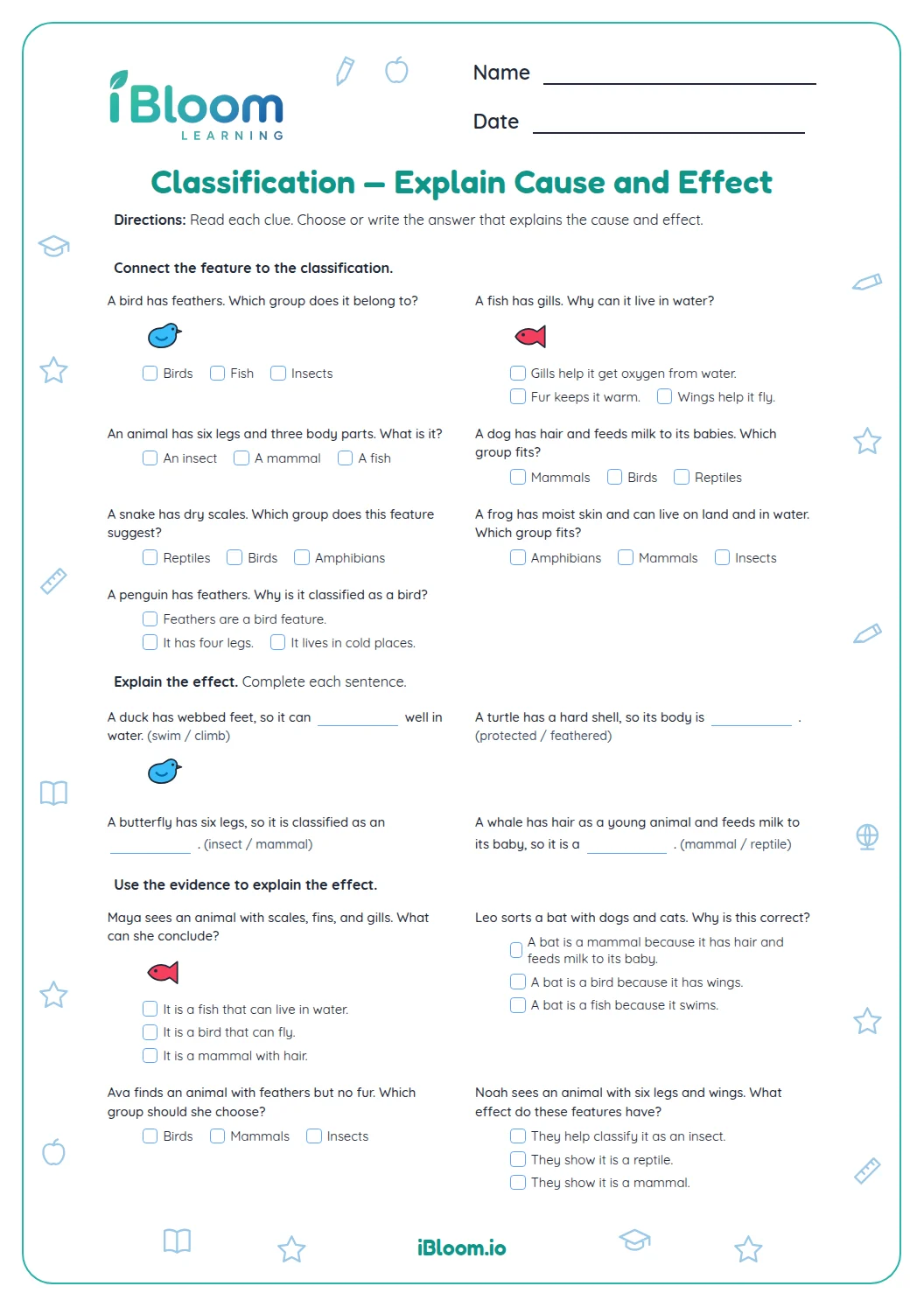

About this worksheet
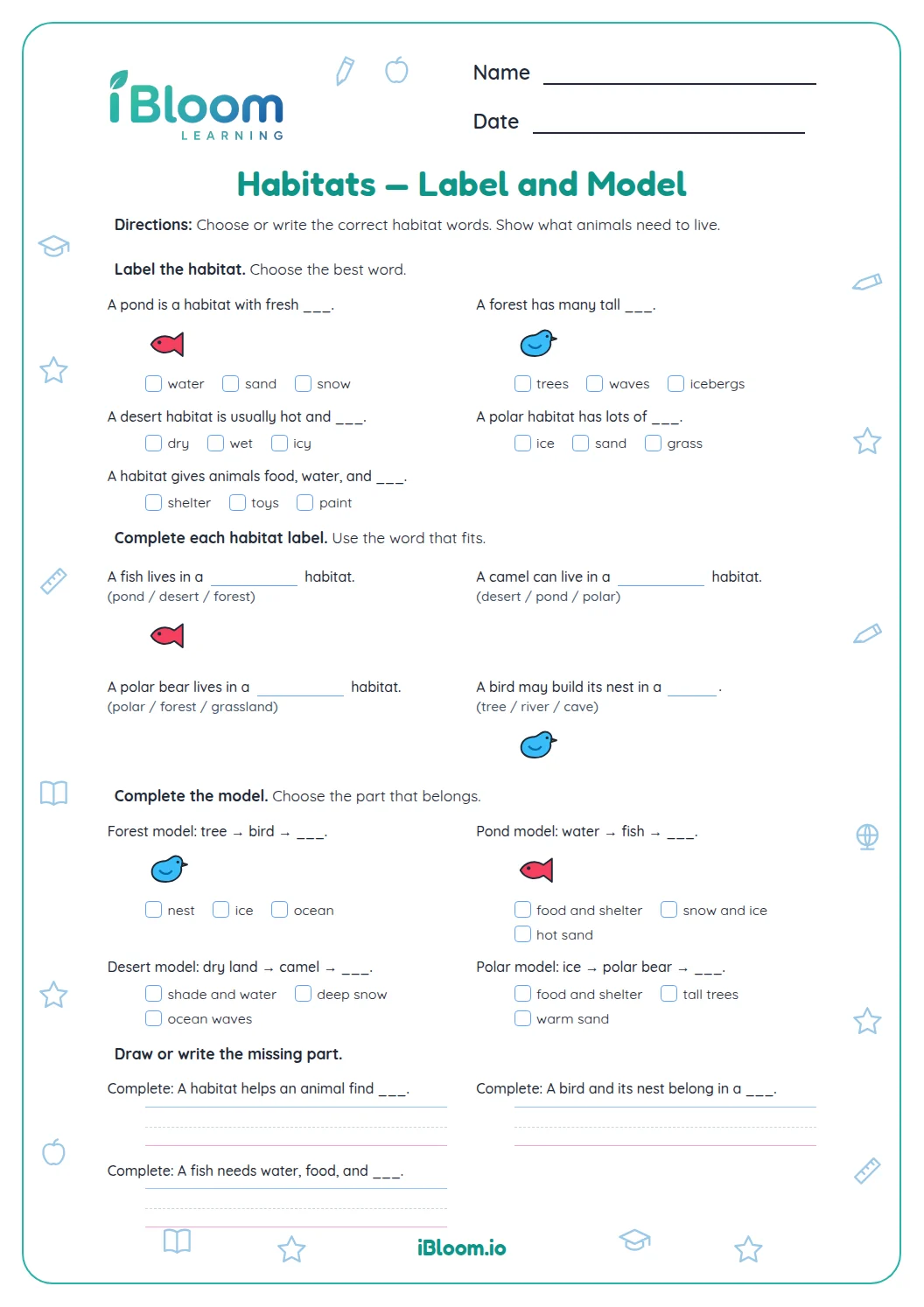
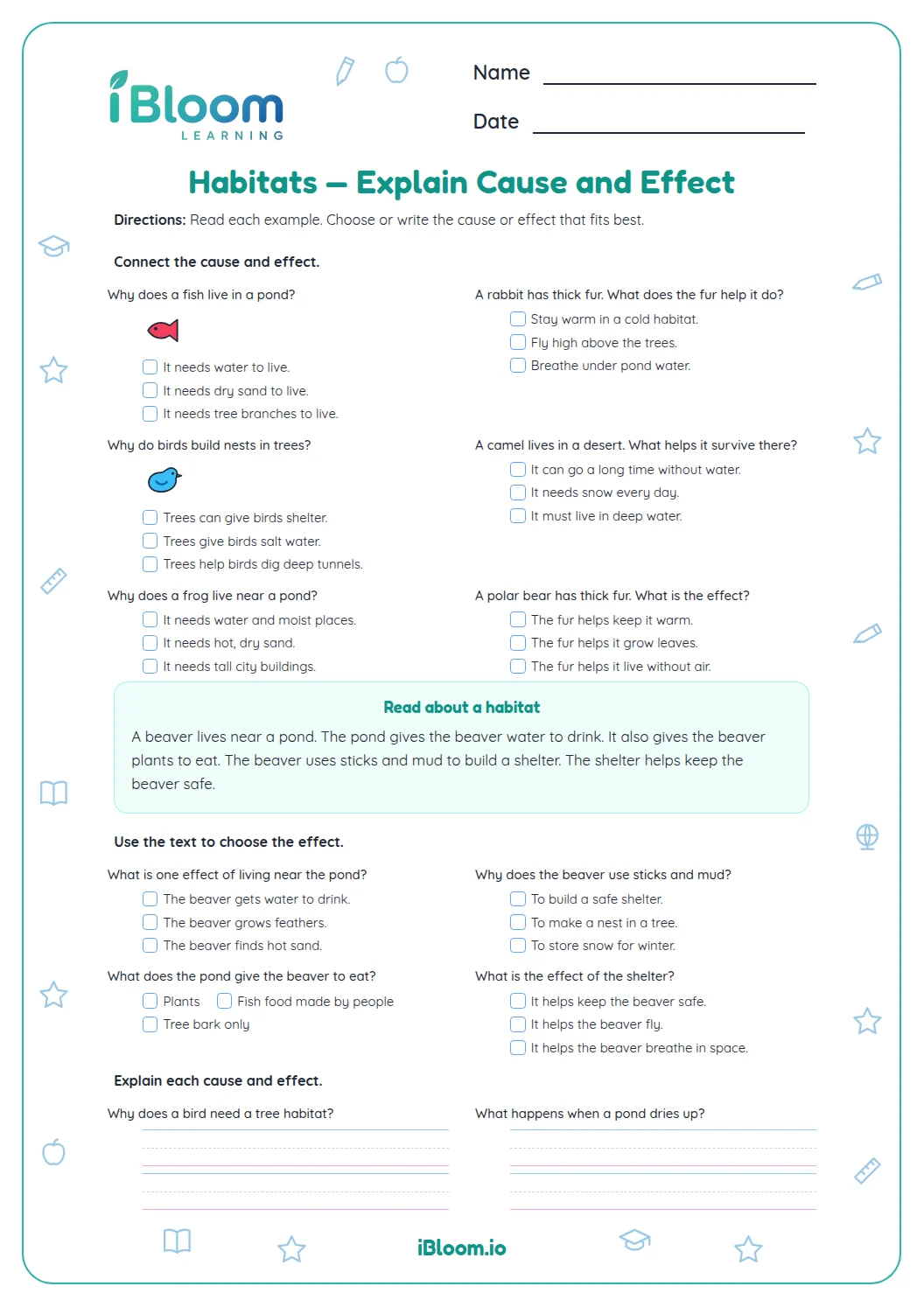
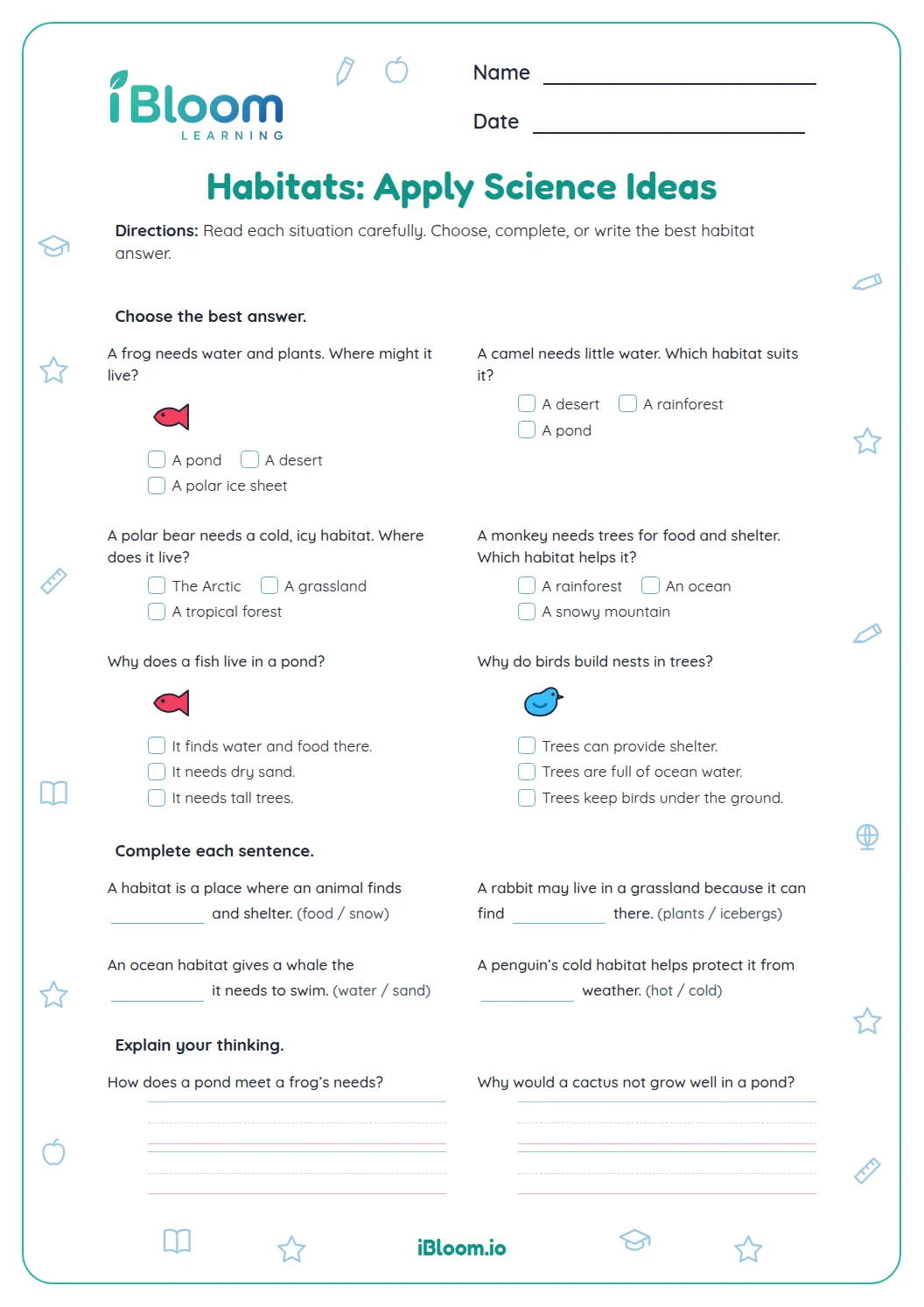
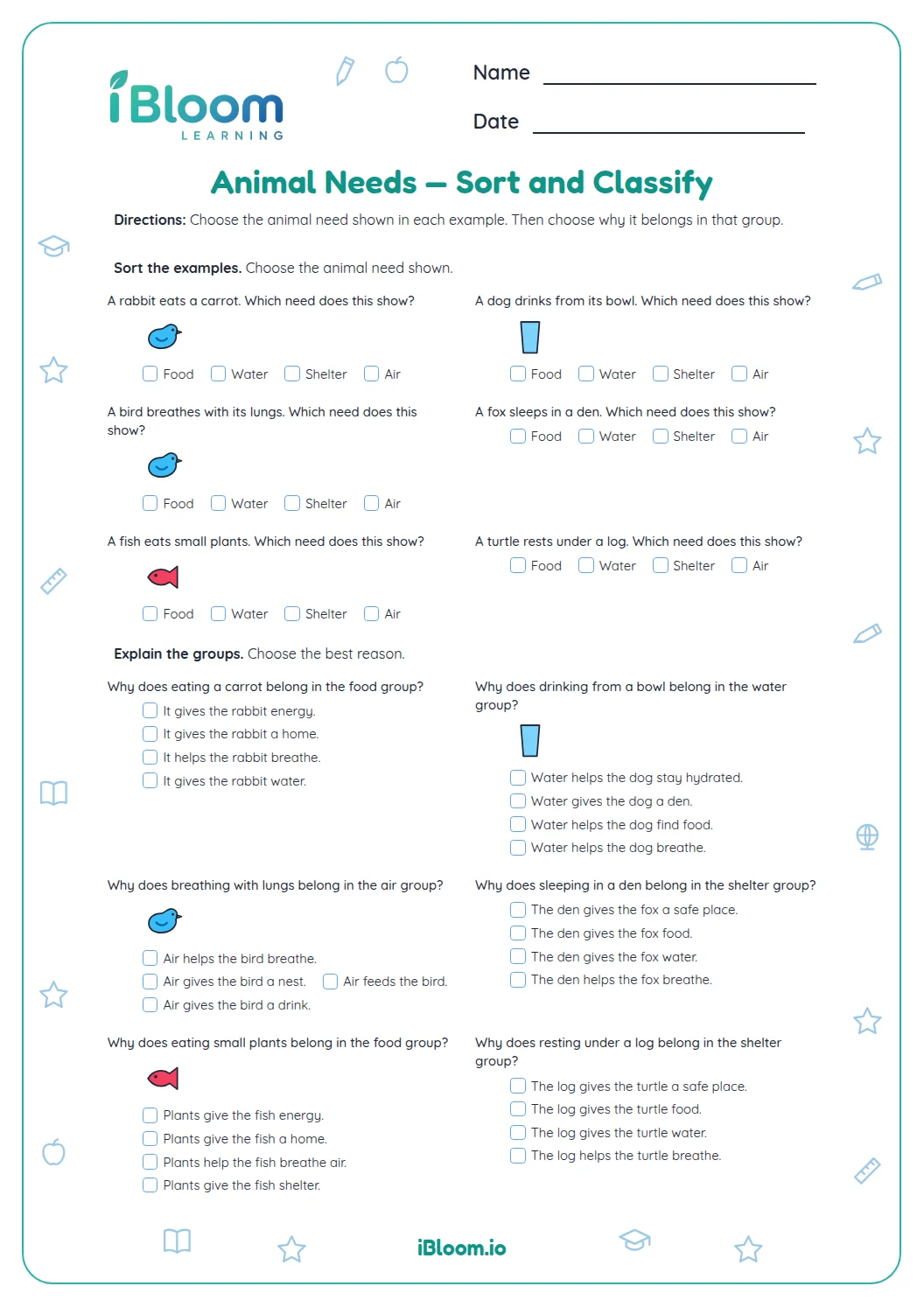
This free printable worksheet gives Grade 2 students practice sorting animals by the habitat where they live. In Part A they look at a picture of an animal and choose its habitat: ocean, desert, forest, pond, or cold ice and snow. In Part B they pick the animal that lives in a named habitat, and in Part C they choose the reason an animal can live there. It matches NGSS 2-LS4-1, comparing the plants and animals in different habitats. A two-page answer key shows every correct choice.
Aligned to 2-LS4-1
What is a habitat?
A habitat is the place where an animal lives and finds what it needs, such as food, water and shelter. An ocean, a desert, a forest and a pond are different habitats, and each one has different animals. Students see this when they compare a whale in the ocean with a camel in the desert.
The sheet uses five habitats students are likely to know: ocean, desert, forest, pond, and cold ice and snow. Each question gives three choices, and only one fits the animal.
How do students sort animals by habitat?
Ask what the animal needs and which place gives it. A frog needs fresh water nearby, so a pond fits. A squirrel needs trees for nests and nuts, so a forest fits. A shark swims in salt water, so the ocean fits.
Students can then check each choice. If the answer were desert, could the shark find water to swim in? Saying why a choice does not fit is as useful as picking the right one.
- 1Where does a camel live? Choices: ocean, desert, pond
- 2A camel is a land animal, so ocean and pond do not fit.
- 3A camel can go days without water, which fits a dry desert.
- 4Answer: desert
What is on this worksheet?
Part A shows six animals, one at a time: camel, whale, frog, squirrel, penguin and shark. Students color the habitat for each one. Part B shows three animals in each question and asks which one lives in the ocean and which lives in a pond. Part C asks why, with three reasons each.
The Part C questions connect a body part or habit to a habitat. A fish can live in water because it has gills. A penguin stays warm in the cold because its feathers keep it warm. A camel can live in the desert because it can go days without water.
- Part A: 6 questions, picture of an animal, choose the habitat
- Part B: 2 questions, choose the animal for a habitat
- Part C: 3 questions, choose the reason it can live there
How does an animal's body fit its habitat?
Animals have body parts and habits that help them in the place they live. Gills let a fish breathe underwater. Feathers help a penguin stay warm in ice and snow. A camel can go a long time without a drink, which helps in a place with little water. Part C asks students to pick these reasons, which prepares them to explain a sort in their own words: "A fish lives in water because it has gills."
How to use this worksheet at home or in class
- 1Ask students what a habitat is and let them name a few they know, such as a pond or forest.
- 2Do question 1 together and say why the other two choices do not fit the camel.
- 3Let students finish Part A on their own, then talk about any animal that was hard to place.
- 4Do Part B by looking at the three animals and asking, "Could this one live there?"
- 5For Part C, read each reason aloud and ask which one fits the animal's habitat.
- 6Check with the answer key and ask students to tell one reason they picked an answer.
Common mistakes and quick fixes
The mistake
Choosing the ocean for a frog or a duck because it also lives near water.
The fix
Compare the two places. An ocean is huge and salty, and a pond is small and has fresh water. Frogs and ducks live in ponds.
The mistake
Picking "Needs water every hour" for the camel because most animals need water often.
The fix
Talk about the desert, where water is hard to find. A camel can go days without a drink, and that helps it live there.
The mistake
Explaining a habitat by repeating it, such as "A fish lives in water because it lives in water."
The fix
Ask what the animal's body can do. Gills let a fish breathe underwater, so the reason is the gills.
Science standard
This sheet supports the Grade 2 life science standard on habitats.
Compare the animals that live in different habitats, such as an ocean, a desert and a pond.
On this sheet: Students match animals to five habitats and compare why a camel, a fish and a penguin each fit where they live.
Show the official wordingHide the official wording
Make observations of plants and animals to compare the diversity of life in different habitats.
What to practice next
Make more practice
Further reading
Questions parents and teachers ask
What is a habitat for second graders?
A habitat is the place where an animal lives and finds what it needs, such as food, water and shelter. Examples on this sheet are the ocean, a desert, a forest, a pond, and cold ice and snow. Each habitat suits some animals and not others, which is why a whale, a camel and a frog live in different places.
Which habitats are on the worksheet?
The five habitats are ocean, desert, forest, pond, and cold ice and snow. Part A uses all of them in its choices, Part B uses the ocean and a pond, and Part C covers the desert, water and the cold. The animals are a camel, whale, frog, squirrel, penguin, shark, octopus, duck and a fish.
Can an animal live in more than one habitat?
Yes. Some frogs live in forests as well as ponds, and some penguins live where it is warmer. Each question here gives three choices where only one fits, so there is one answer. If a student suggests another habitat, praise the thinking and ask what the animal would need to find there.
What are the answers to the sheet?
Part A is desert, ocean, pond, forest, cold ice and snow, and ocean. Part B is the octopus and the duck. Part C is goes days without water, it has gills for water, and feathers keep it warm. The answer key shows each correct choice colored in for all 11 questions.
Which science standard does this match?
It supports NGSS 2-LS4-1, which asks students to compare the diversity of life in different habitats. Students do this by seeing which animals live in the ocean, a desert, a forest, a pond and on ice, then thinking about why. A walk outside to look at a real habitat is a good follow-up.
Is there an answer key, and how long does the sheet take?
Yes. The two-page answer key shows the correct choice colored in for all 11 questions. Plan on about 15 minutes. Every question is multiple choice and the animals are pictured, so a student who reads slowly can have a grown-up read the questions aloud and still do the thinking.