







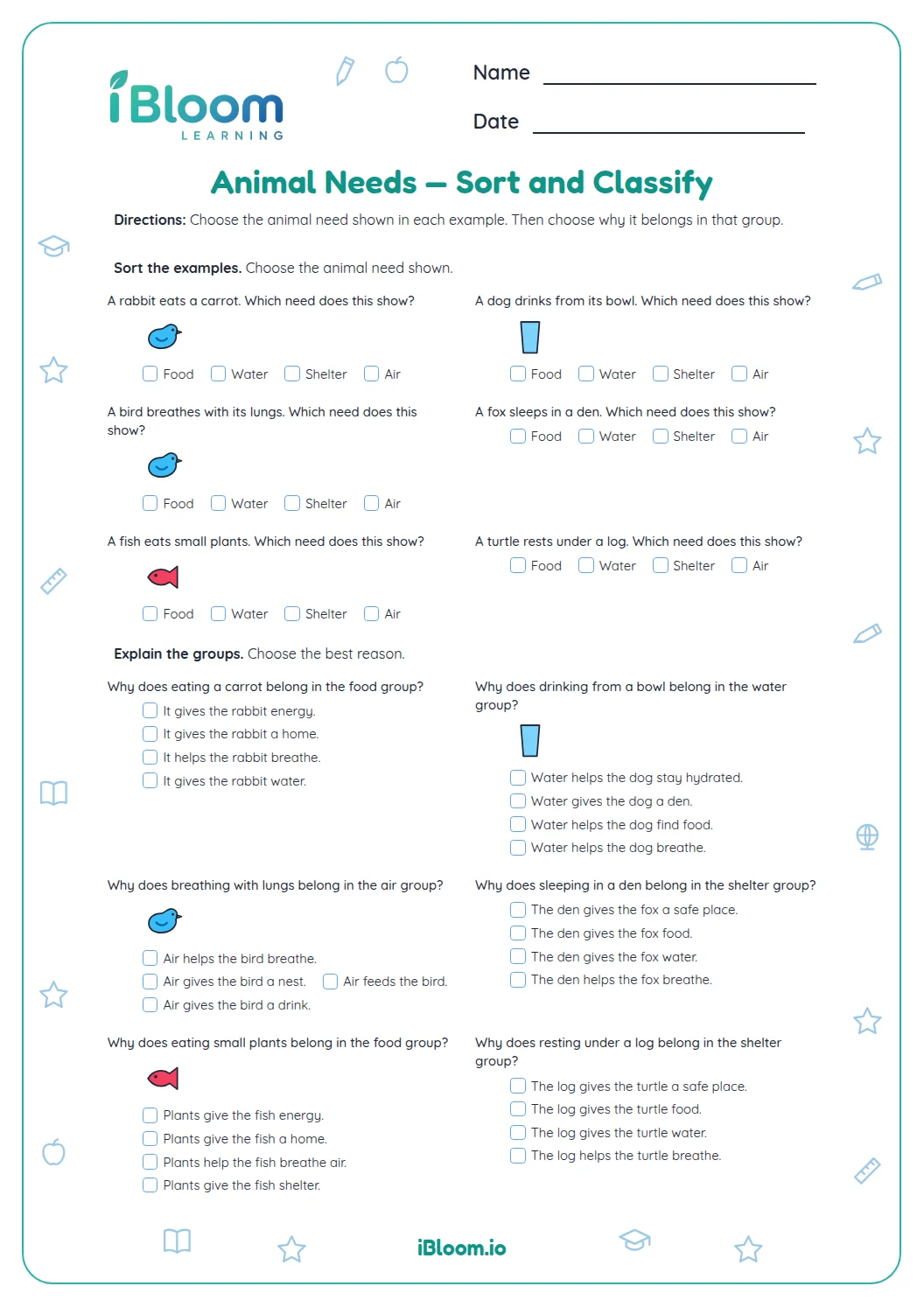


About this worksheet
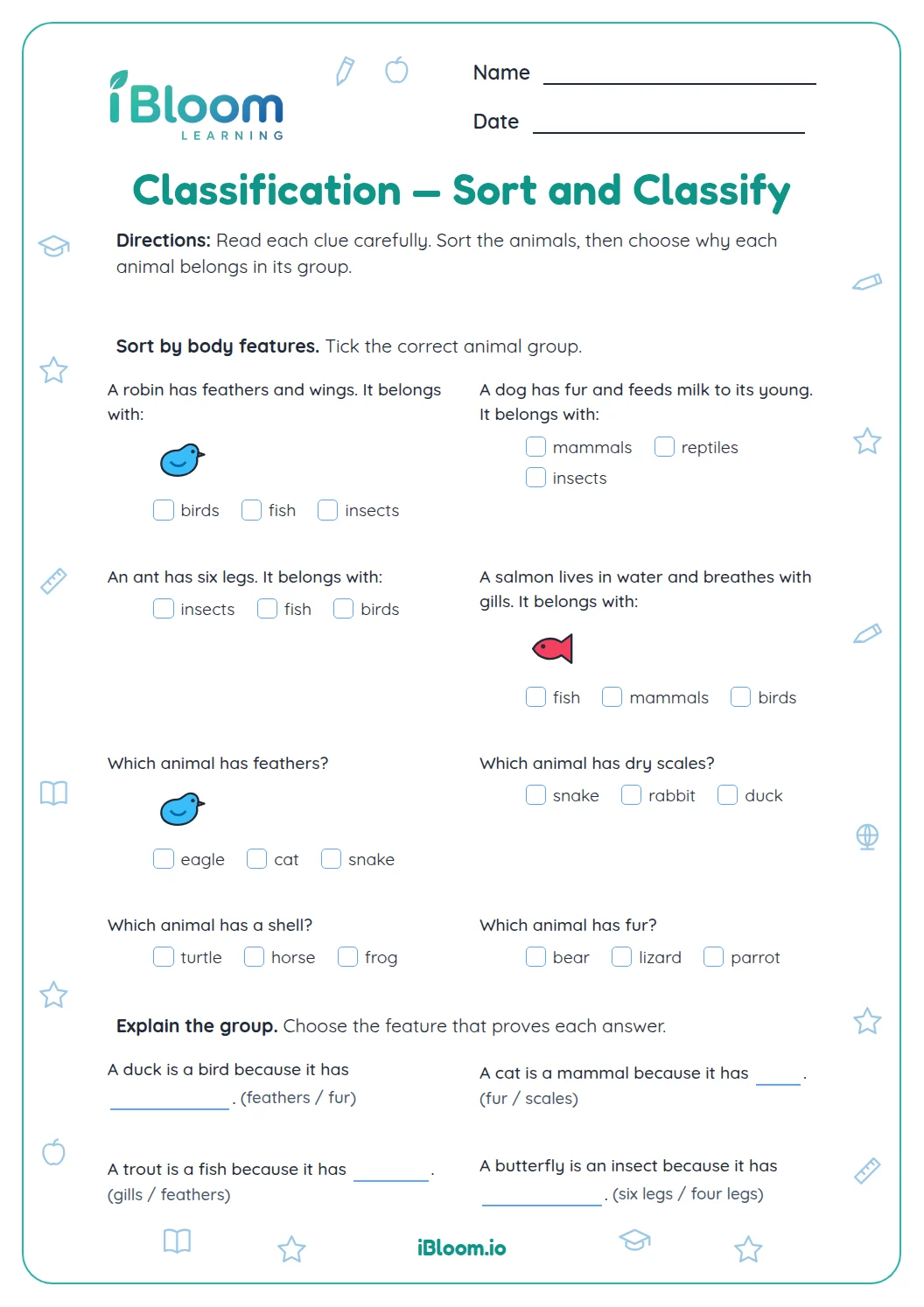
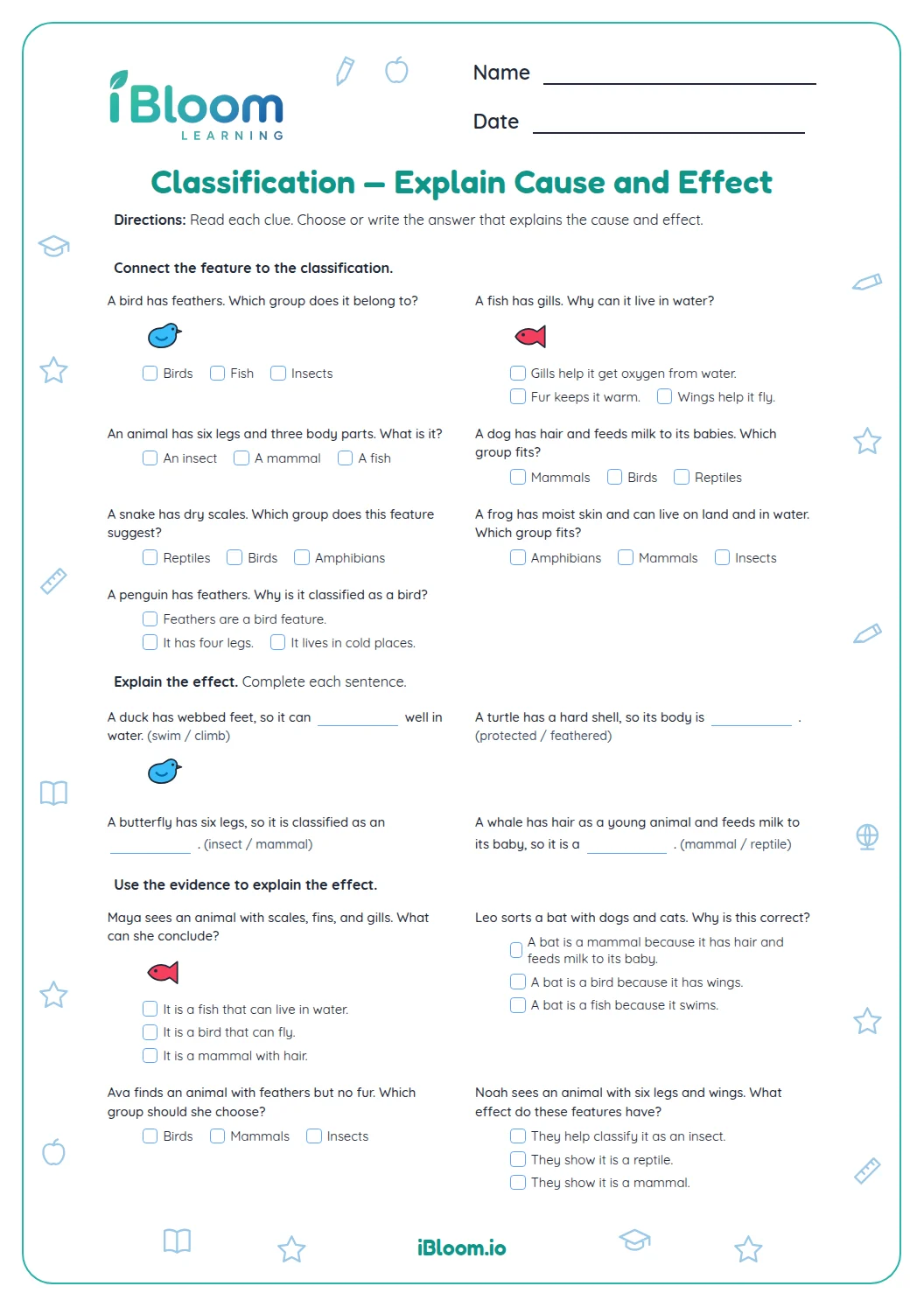
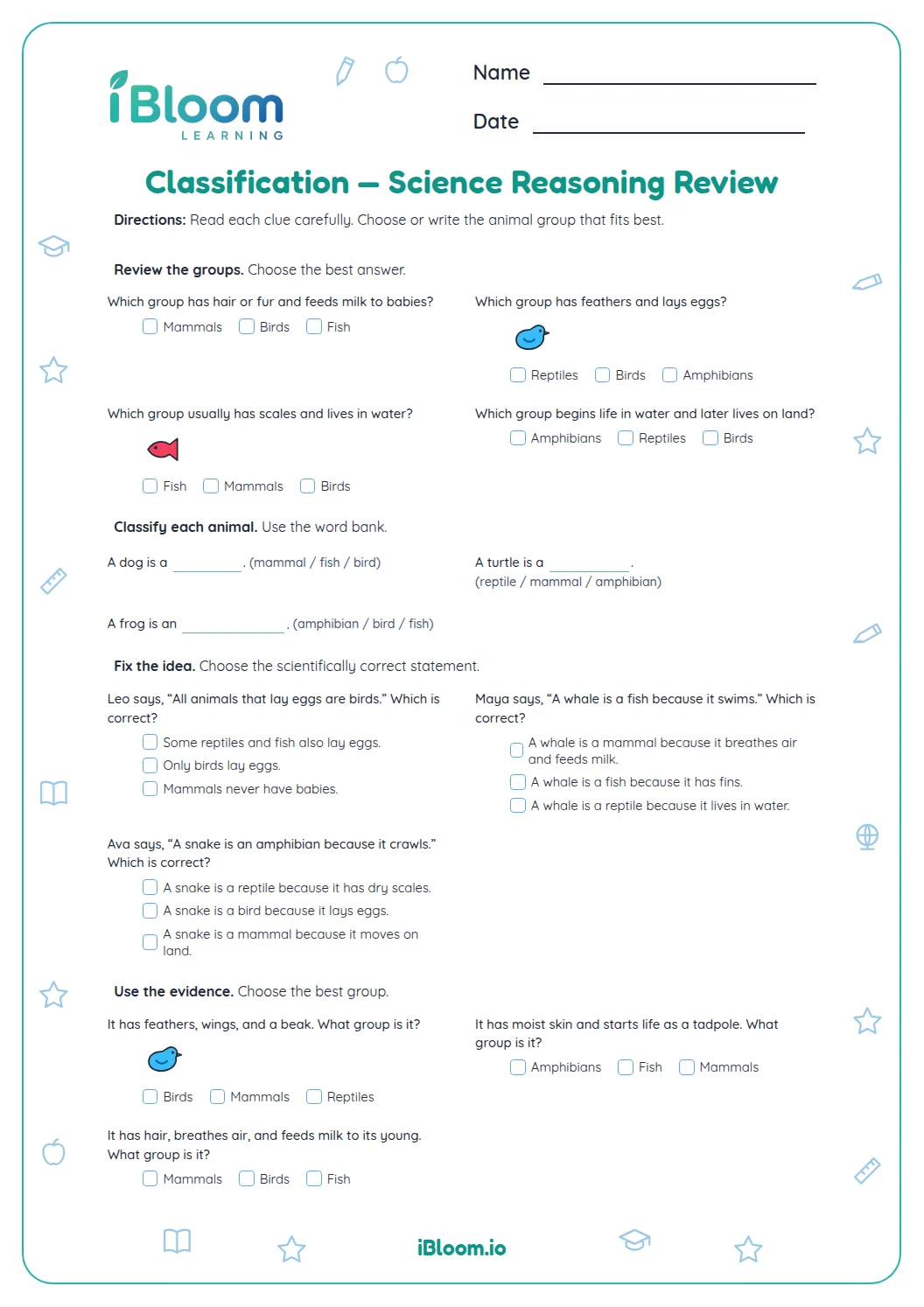
This printable Grade 2 science sheet helps children classify animals by observable features. Picture choices ask about feathers, fur, scales, habitat, and legs; fill-in items name animal groups and traits; short responses explain a grouping rule. A separate answer key includes sample explanations.
What features help us sort animals?
Scientists sort animals by observable traits. Feathers point to birds, six legs to insects, and gills to many fish. Look for the stated feature rather than choosing an animal just because it lives in a familiar place.
- 1Bird, fish, or frog?
- 2A bird has feathers.
- 3Answer: bird
How can one animal fit a group?
A group can be described with a shared feature, such as “has feathers.” Some traits identify broad groups; others describe one animal. Use the feature named in each prompt to choose or complete the classification.
How can observations compare animal variety?
Compare the animals carefully: a dolphin breathes air and feeds milk to its young, so it is a mammal even though it lives in water. A turtle and snake both have scales, but that one shared trait does not make them the same species.
How to work through the sheet
- 1Look closely at the animal or read its name.
- 2Name a feature you can observe or know.
- 3Compare that feature across the animals.
- 4Group animals that share the feature.
- 5Explain the rule.
Common slips and fixes
The mistake
Grouping by a feature only one animal has.
The fix
Check that every group member shares the rule.
The mistake
Calling every water animal a fish.
The fix
Dolphins are mammals.
The mistake
Naming a group without its rule.
The fix
State the feature that connects the animals.
What to practice next
Make more practice
Questions parents and teachers ask
What features do children use to classify animals?
The picture choices and prompts focus on visible or familiar features such as feathers, fur, scales, gills, and six legs. Children select an animal or complete a statement using the feature named in each question. A strong response names the feature and connects it clearly to the animal in the prompt.
Why is a dolphin classified as a mammal?
A dolphin breathes air and feeds milk to its young, which are mammal traits. Living in water does not make it a fish. Question 14 asks children to explain this classification, and the key provides a short sample response. A strong response names the feature and connects it clearly to the animal in the prompt.
How many questions are included?
The worksheet has 16 questions in three parts: six picture choices, five feature or animal-group blanks, and five short explanations. A separate answer key gives the choices, words, and sample responses. A strong response names the feature and connects it clearly to the animal in the prompt.
What does the grouping question ask?
Children describe a rule that can sort bird, fish, and bear, such as grouping by body covering and naming each animal’s covering. The key gives one sample; another accurate grouping explanation can also work. A strong response names the feature and connects it clearly to the animal in the prompt.
Do animals in one group all look alike?
No. A classification uses one shared feature, while animals can differ in many other ways. For example, two mammals may have different body shapes or live in different places. The worksheet asks children to name a feature that supports a group.
What should I accept for the short responses?
Accept clear, accurate examples that answer the prompt. For instance, bear and dog share the mammal group, while turtle and snake both have scales. The key labels these as sample answers because children can express a correct idea in different words.