






About this worksheet
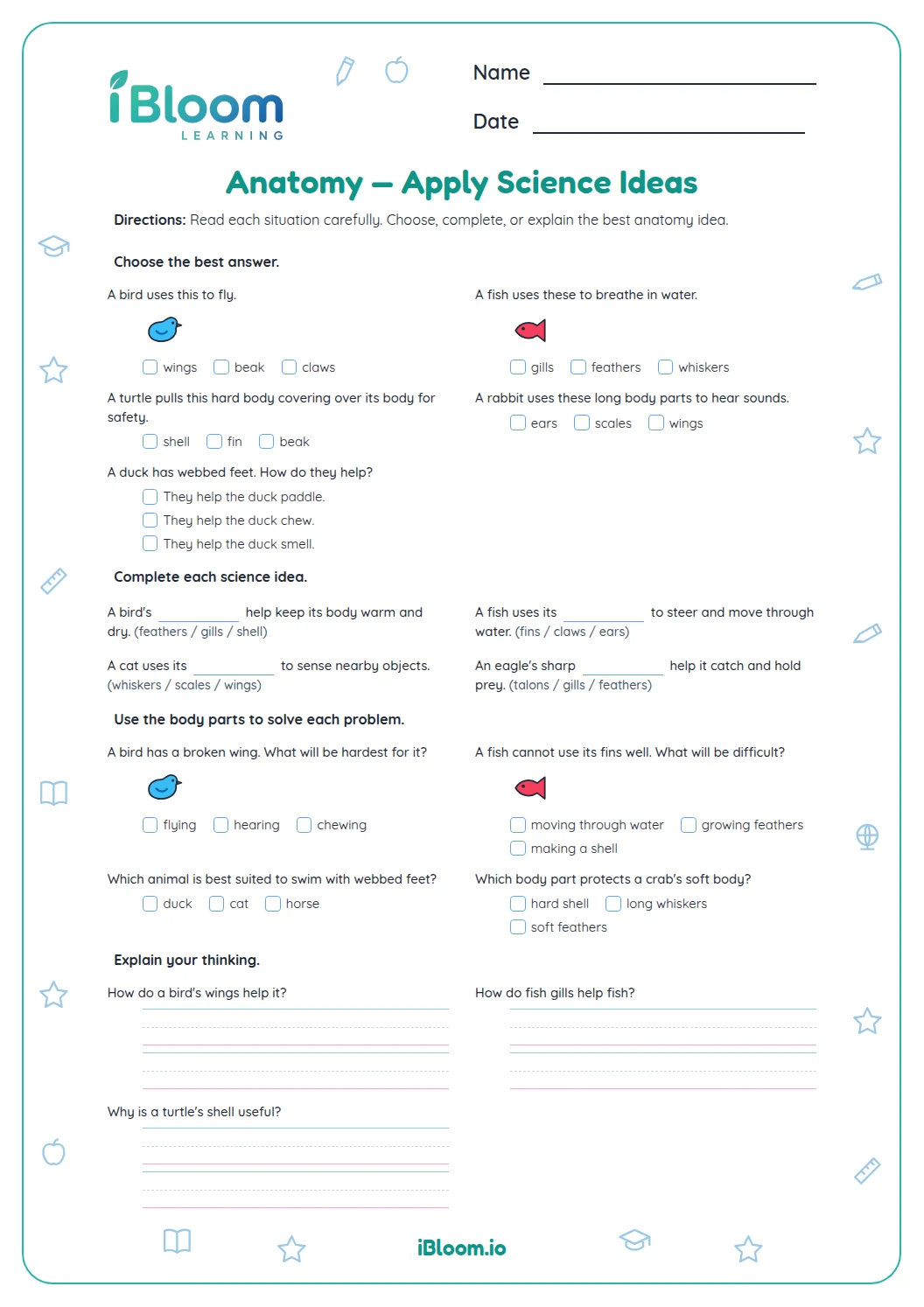
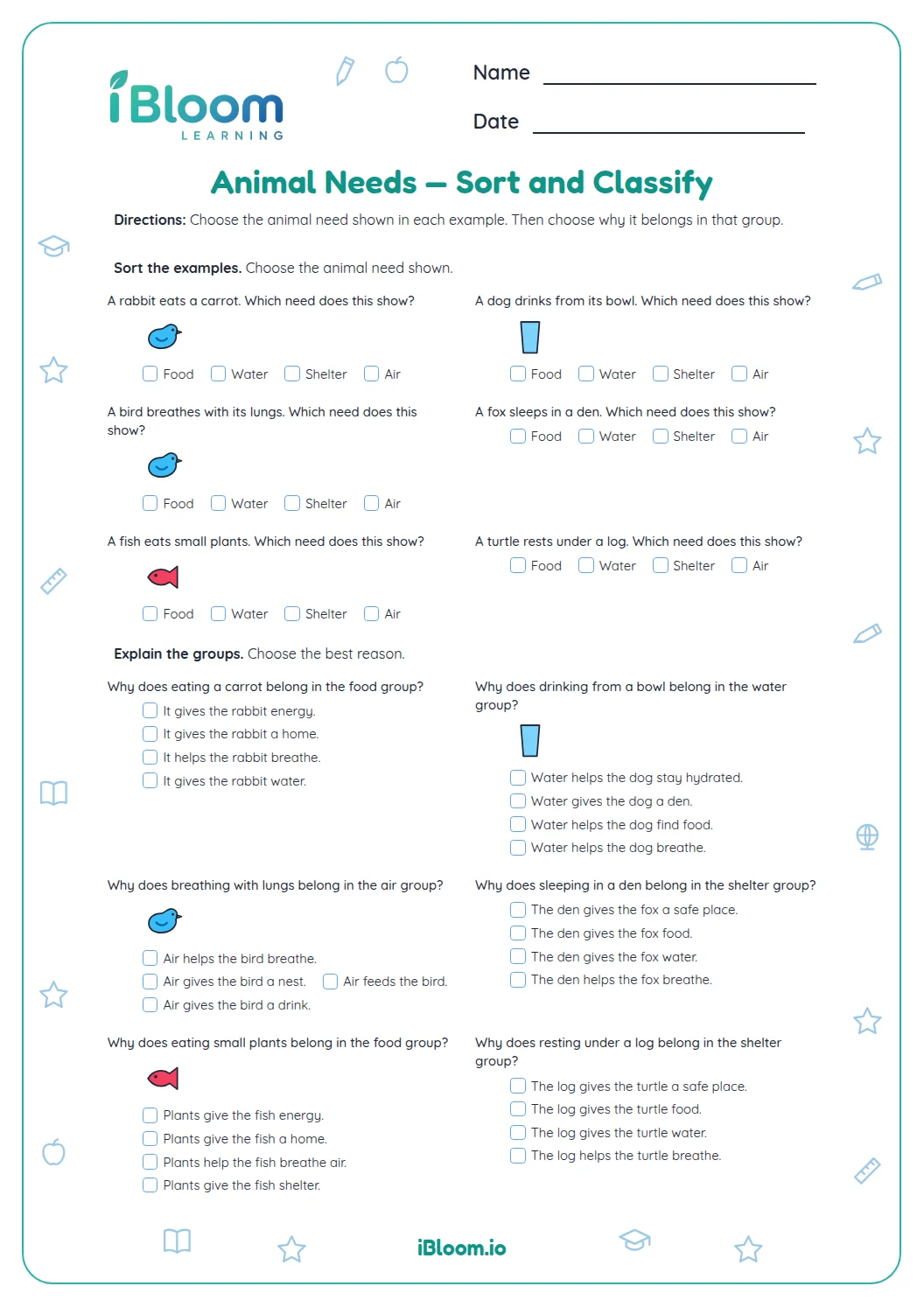
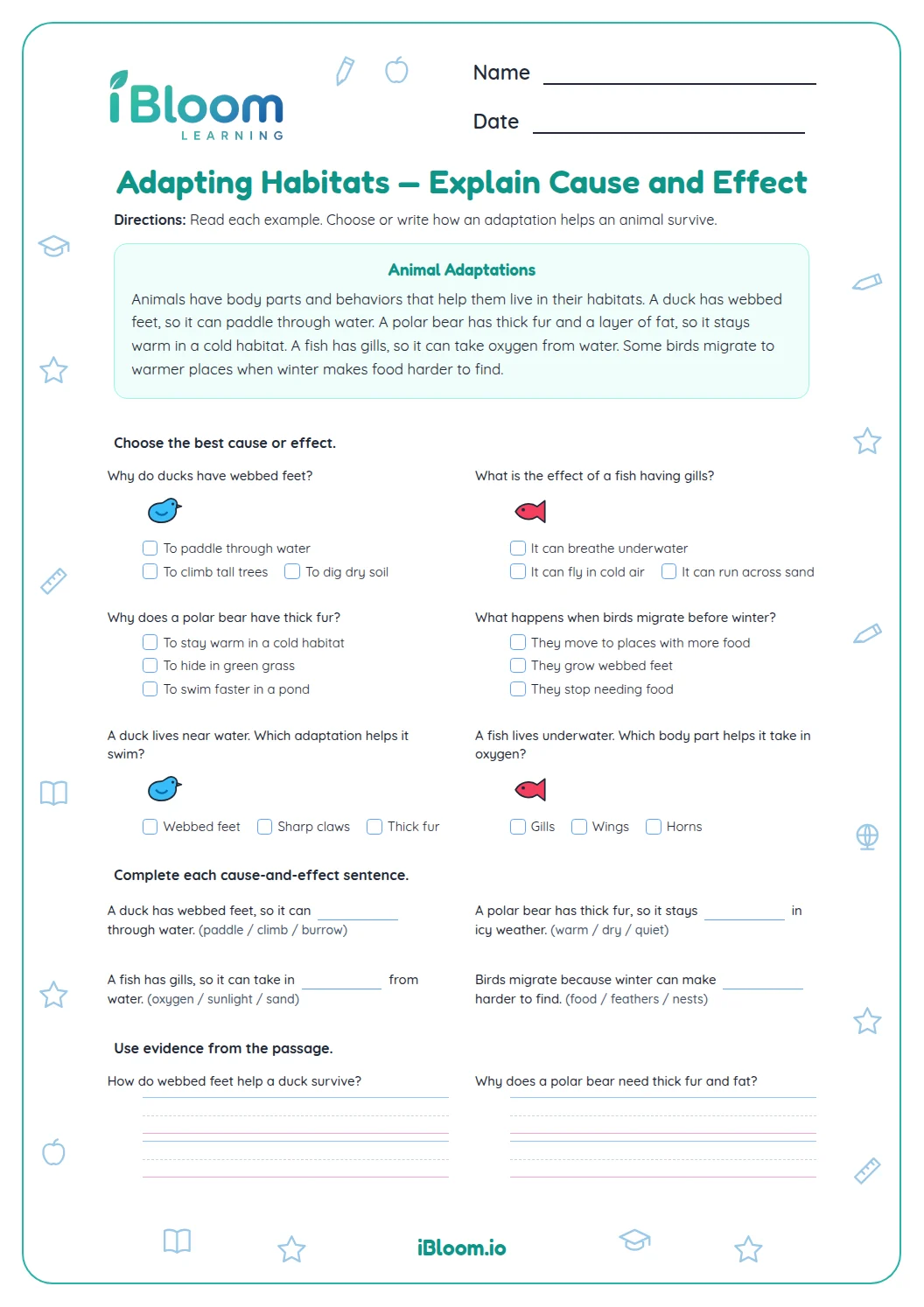
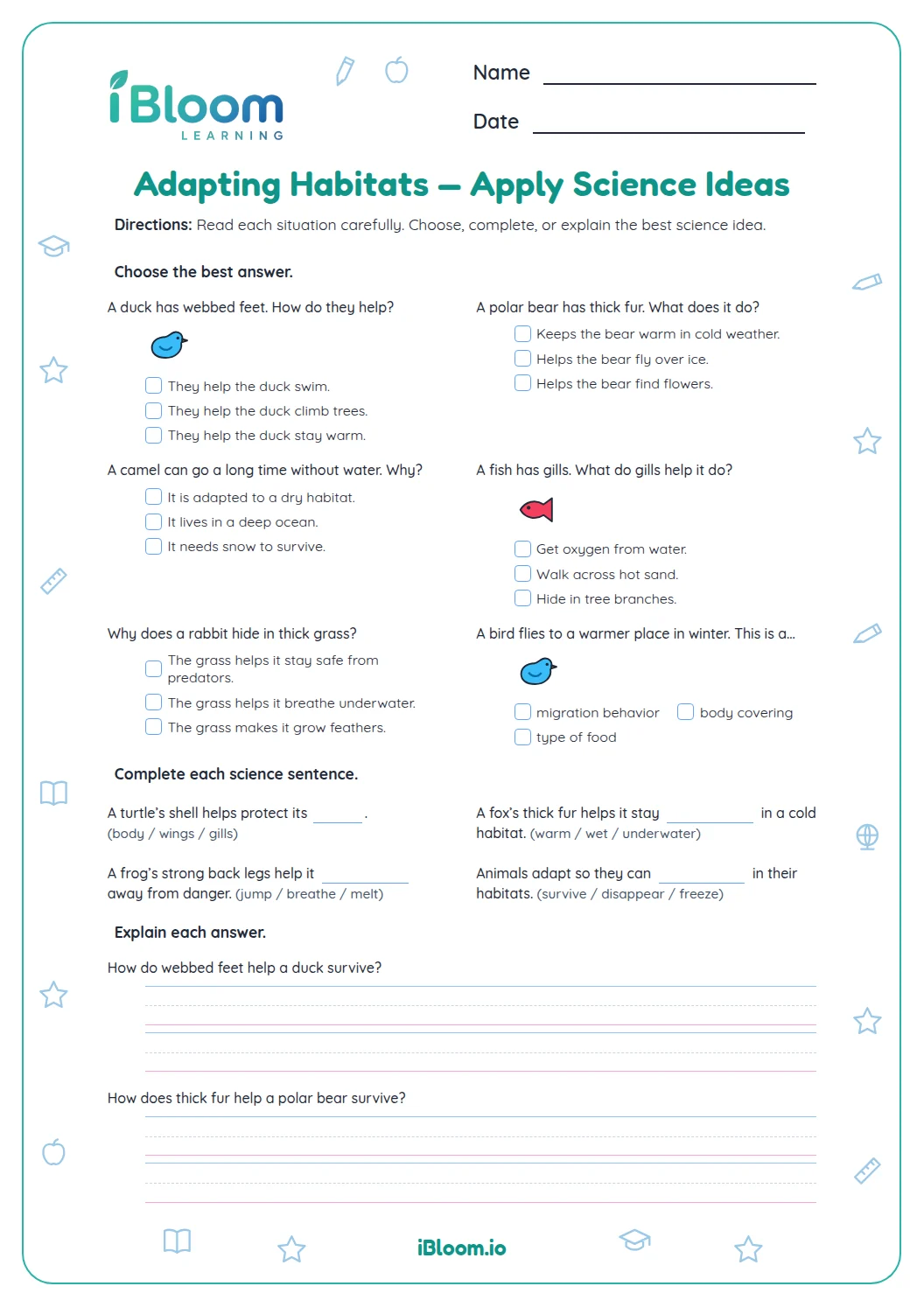
This Grade 2 science worksheet asks children to sort animal body parts by what they help an animal do. Twelve choice questions connect parts such as eyes, legs, ears, fins, and gills with sensing, moving, and breathing. Four short explanations ask children to state why a part fits its job. A separate answer key gives the choices and sample explanations.
How do animal parts help animals?
Animal body parts have jobs. Eyes and ears help animals sense their surroundings; legs, wings, and fins help them move. Gills help fish take oxygen from water, while a shell protects a turtle.
Question 1 pairs an owl’s eyes with seeing, a sensing job.
- 1Animal: owl
- 2Job: see
- 3Part: eyes
How can you sort body parts by their jobs?
Read the job first, then look for a part that can do it for that animal. Fins help fish move in water; eyes help birds see; claws help a cat grasp. A familiar part can have more than one job, so use the animal and clue together.
How can children explain a classification?
The last four questions ask children to explain a body-part match. For question 13, an owl’s eyes detect light and shapes, so they belong with sensing.
- Part A: 12 multiple-choice body-part matches
- Part B: four short explanations
- Animal pictures accompany the choice questions
- A separate answer key includes sample explanations
What kinds of animal parts are included?
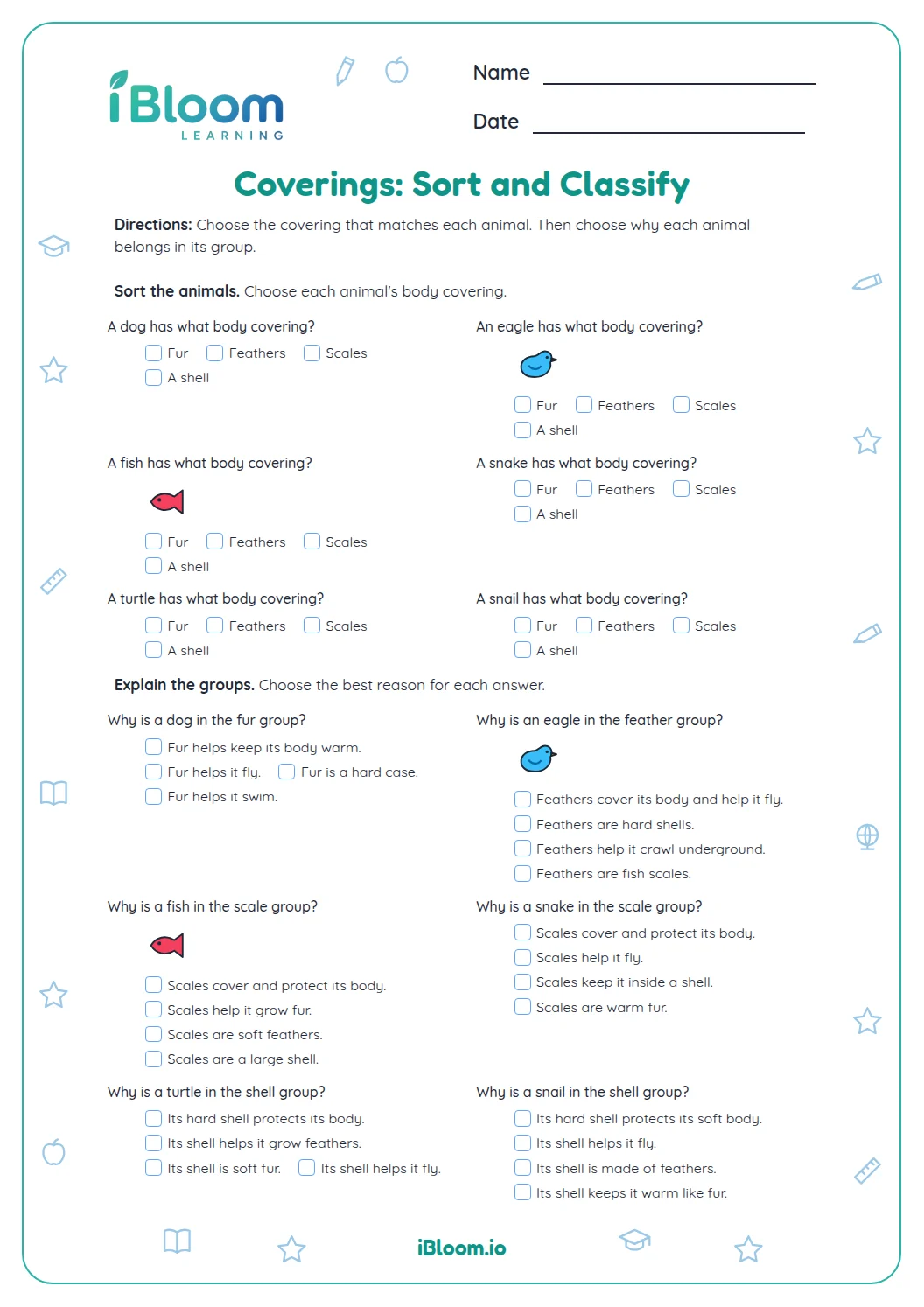
The worksheet includes parts for movement, sensing, eating, breathing, and protection, plus questions about feathers, scales, and fur.
- Part A: match six body parts to jobs
- Part B: classify six more animal-part clues
- Part C: explain four short examples
How to use this worksheet
- 1Read the animal and the job in the clue.
- 2Name a body part that can do that job.
- 3Check that the part belongs to the animal in the question.
- 4For short responses, write the part and its function.
- 5Use the key to discuss any other accurate examples.
Common slips and quick fixes
The mistake
Mixing up breathing and moving parts in a fish.
The fix
Gills help with breathing; fins help with movement.
The mistake
Naming a body part without explaining its job.
The fix
Add an action such as see, fly, grasp, protect, or move.
The mistake
Assuming a body part has only one use.
The fix
Use the exact clue and animal; some parts can do more than one job.
What to practice next
Questions parents and teachers ask
What does sort and classify mean on this sheet?
Children group or match animal body parts according to the jobs they do. They connect a part such as a fin, wing, eye, or shell with a function such as moving, seeing, flying, or protection. The final questions invite a short explanation of one animal-part connection.
Which animal functions are practiced?
The questions focus on movement, sensing, eating, breathing, and protection, as well as coverings. Examples include a fish using gills to breathe in water, a bird using wings to fly, and a turtle shell protecting its body. These examples show how a body part and its job are related.
Can an animal part have more than one job?
Yes. A body part may help in more than one way. Feathers, for example, can help keep a bird warm and support flight. For the open response question about feathers, either job is acceptable when the child states it clearly.
How should children answer the last four questions?
Children can answer in a short phrase or sentence. Encourage them to name the animal part and connect it to its job. For the whale tail question, “steer” or “move through water” gives the intended connection between the tail and movement. A spoken answer is fine.
What is the difference between gills and fins?
Gills help a fish breathe in water, while fins help it move and steer. The worksheet asks about both jobs so children practice connecting each body part to a function rather than treating all fish parts as interchangeable. That difference helps children classify the two parts correctly.
Does the worksheet include an answer key?
Yes. The separate key gives the matching choice for each multiple-choice item and sample acceptable ideas for the four short responses. If a child uses different wording, check whether it accurately links the animal part with a function.