








About this worksheet
This Grade 2 science worksheet focuses on the coverings animals have on the outside of their bodies. In Part A, learners choose the right covering or animal. Part B asks them to name feathers, scales, shells, fur, and wool from short descriptions. In Part C, they draw animals and label the covering shown. There are 15 questions, with a separate answer key. The open drawing prompts accept different accurate animal examples.
What are animal coverings?
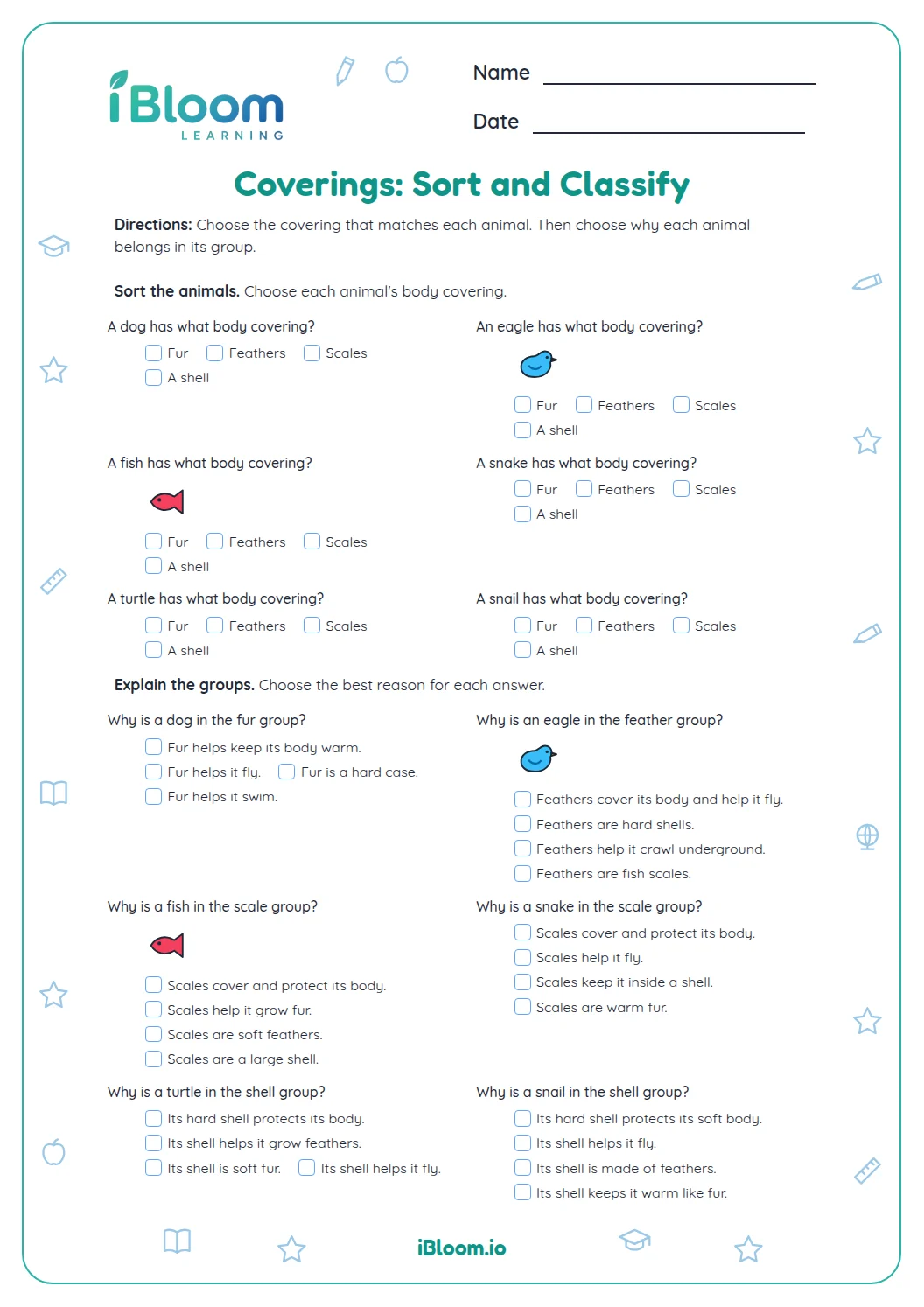
A covering is the outer layer on an animal’s body. Birds have feathers, many fish and reptiles have scales, turtles have shells, and mammals may have fur or wool. These features can help protect an animal or keep it warm. The worksheet asks children to notice the covering and connect it to an animal.
How can children identify a covering?
Look for the clue in the question: a bird’s many thin body parts are feathers; a fish’s overlapping plates are scales; a turtle’s hard outer covering is its shell. For a model, draw the animal clearly and add a label that points to the covering.
- 1A bird has a protective body covering made of many thin parts. Name the covering.
- 2The description says the covering is made of many thin parts.
- 3Birds have feathers, so write “feathers.”
What will learners practice?
Part A uses five choices to match animals and coverings. Part B gives five descriptions to label. Part C asks for five drawings, including a bird, fish, turtle, and cold-weather animal. A drawing can vary from the answer-key sample as long as the animal and covering are clearly shown and labeled.
How to use this worksheet
- 1Read the animal or covering clue all the way through.
- 2Choose or write the covering that matches the clue.
- 3For each model, draw the animal and add a clear label.
- 4Use the key to check names and compare drawings with the sample.
Common mistakes and quick fixes
The mistake
Mixing up fur and feathers.
The fix
Ask whether the animal is a bird with feathers or a mammal with fur.
The mistake
Calling scales a shell.
The fix
Scales cover much of a fish or snake; a turtle has a hard shell.
The mistake
Drawing an animal without labeling its covering.
The fix
Add a word label and point it to the feature you drew.
What to practice next
Further reading
Questions parents and teachers ask
What animal coverings appear on the worksheet?
The questions include feathers, scales, a shell, fur, and wool. Learners match these coverings with animals such as birds, fish, turtles, sheep, foxes, and snakes, then use some of the same examples in labeled drawings. Children can compare the body covering with the animal named in each question.
What should a child label on an animal drawing?
The label should name the body covering and point clearly to it. For example, a child might draw a bird and write “feathers” beside its body. The answer key gives sample drawings, but other accurate animals and labels are acceptable.
Can my child draw a different animal from the example?
Yes. The last five prompts allow more than one correct model. A different animal is fine when its covering fits and the label identifies it clearly; for example, a fox with fur or a hen with feathers. The model should show the animal and its covering in a way another reader can recognize.
Does this worksheet have an answer key?
Yes. The separate answer key gives the multiple-choice answers and the expected covering words. For the drawing prompts, it shows sample responses so an adult can check whether the animal and its labeled covering match. An adult can accept another accurate animal and covering when both are clearly labeled.
How can I explain why coverings matter?
Keep the explanation connected to the animal and its covering. Fur or wool can help keep an animal warm, while feathers, scales, and shells cover and protect the body. The worksheet accepts short, age-appropriate explanations about protection, warmth, or camouflage.