






About this worksheet
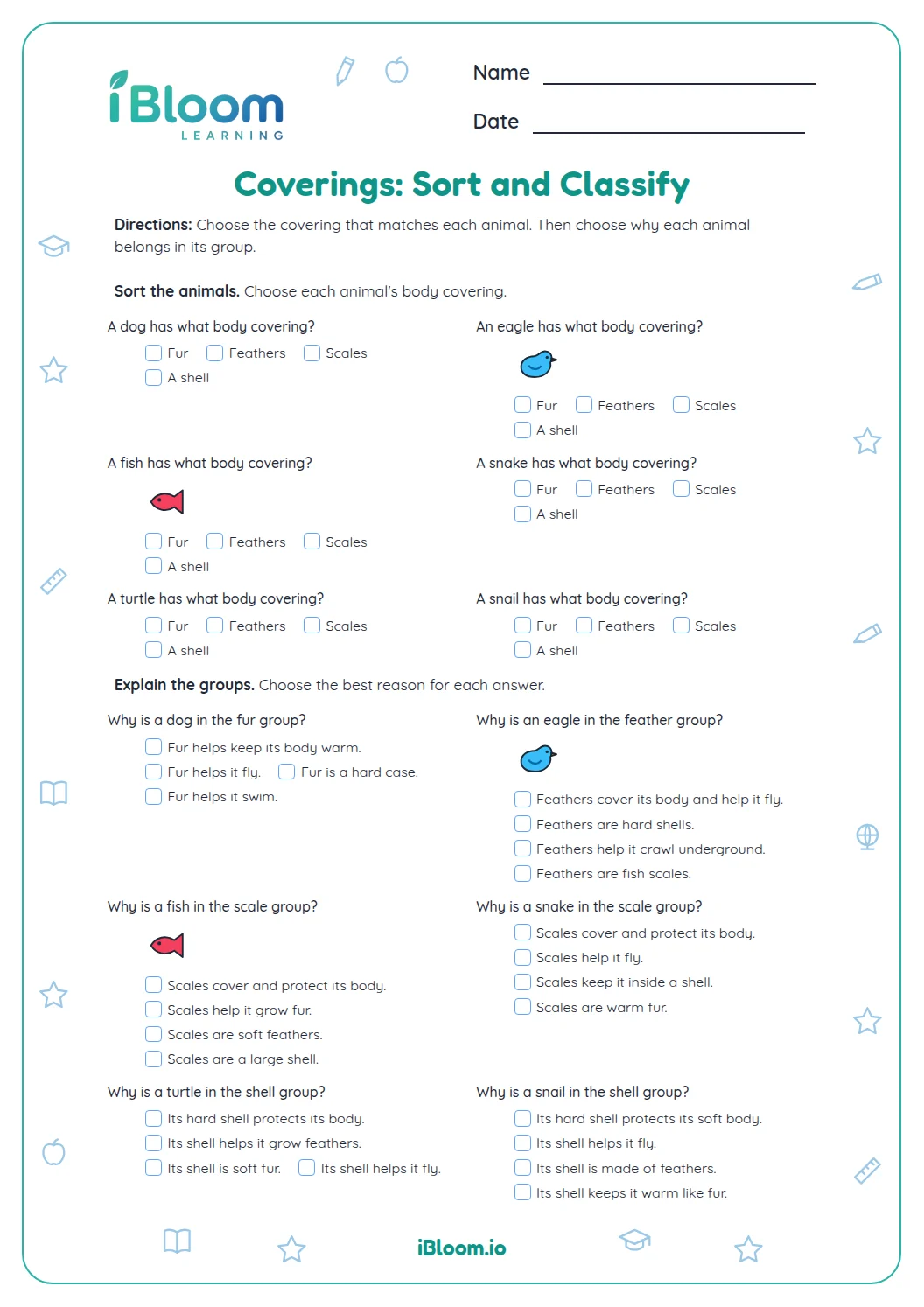
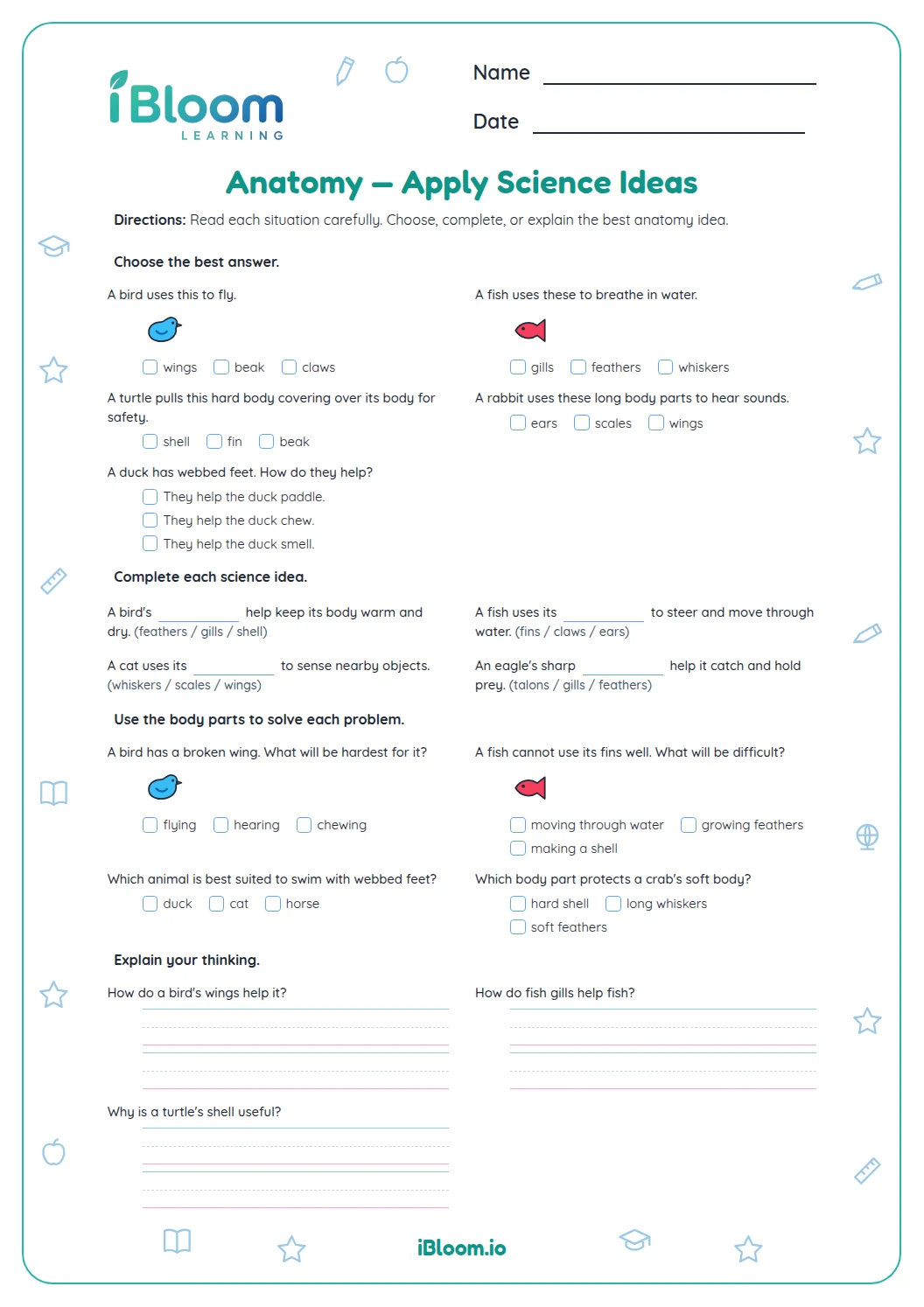
This free printable Grade 2 science worksheet asks children to connect an animal covering with what it does. Four multiple-choice questions explore fur, shells, and two ways feathers help birds. Two missing-word questions reinforce warmth and protection. Three written responses then ask children to explain how a snail’s shell, duck’s feathers, and fish’s scales help, using because. Each explanation starts with a fact about the covering. The separate answer key supplies model responses; children can use their own words to make the same scientific connection.
What is a cause-and-effect connection about coverings?
A cause-and-effect connection links a feature to a result. A hard shell provides a barrier around soft body parts. Fur and fluffed feathers trap air, helping an animal keep body heat. Children practice saying both the feature and the effect.
Part A supplies a fact before each question. Part B connects trapped air with warmth and a hard barrier with protection. In Part C, children use those ideas to explain three examples, including the tough layer formed by fish scales.
How can children explain the snail example?
The final part asks why pulling inside a shell helps a snail. A useful explanation names the hard shell and the soft body it protects. The word because joins the effect to its reason.
- 1Fact: A snail has a soft body and a hard shell.
- 2Connection: The shell is a protective barrier.
- 3Sample: It helps because the hard shell protects the snail’s soft body.
How should families check the written answers?
Look for an accurate link between the covering and its effect. For the duck, “It stays dry because water rolls off its outer feathers” communicates the connection. A sentence that only names the covering needs more detail about how that covering helps.
Keep the terms precise when discussing other examples. The duck question concerns outer feathers shedding water; the bird question concerns fluffed feathers holding air. Different features of feathers can serve different purposes.
How to use this worksheet
- 1Read the words fur, feathers, scales, and shell aloud.
- 2Ask the child to point to the fact in each Part A question before choosing its effect.
- 3Complete the two missing-word statements in Part B.
- 4Have the child say a because sentence aloud before writing Part C.
- 5Check written answers for both a covering and a sensible reason it helps.
Mistakes to check together
The mistake
Saying fur makes its own heat.
The fix
Explain that the animal’s body produces heat; fur helps keep that heat in.
The mistake
Saying every covering has the same job.
The fix
Compare the hard snail shell with fluffy rabbit fur: one protects soft parts, while the other helps retain warmth.
The mistake
Writing “because it helps” without explaining how.
The fix
Ask what the covering does, then add that idea: protects the body or keeps heat in.
What to practice next
Make more practice
Questions parents and teachers ask
Which animal coverings does this worksheet use?
The sheet uses fur, feathers, scales, and shells. Children consider a rabbit, birds including a duck, a fish, a turtle, and a snail. The questions connect specific properties with helpful effects, such as a hard shell protecting soft body parts or fur trapping air near the skin.
Does fur make an animal warm by producing heat?
Fur helps an animal keep body heat rather than producing heat itself. The rabbit questions state that fur traps air near the skin. Ask children to connect that trapped air with keeping heat in, then use the answer key to check their explanation of the cold-day example.
How much writing is required?
There are three written explanations after four multiple-choice questions and two missing-word items. Children use because to explain how a snail’s shell, duck’s feathers, and fish’s scales help. They can rehearse each sentence aloud before writing, and their wording may differ from the answer key.
Why do the bird questions describe different features?
The questions show that feathers help birds in more than one way. Fluffed feathers trap air and help a bird retain body heat. A duck’s outer feathers shed water and help keep its skin dry. Children first choose these effects, then explain the duck example in their own words.
What counts as a correct cause-and-effect explanation?
A correct explanation connects the stated feature to a sensible effect. For the snail, a child might write that pulling inside helps because the hard shell protects its soft body. Accept equivalent wording, but ask for more detail if the response only says the shell is helpful or good.