Free printable practice
Sounds Practice Activities
Grade 2 science worksheets that help children explore how animals make sounds and use them to communicate, warn, find mates, and care for young.
Free printable worksheet PDFs
Preview every available page, then download the free worksheet PDF for home, homeschool, tutoring, or classroom practice.
Preview the exact activity before downloading it.
 Sounds — Sort and ClassifyGrade 2 science worksheets that help children explore how animals make sounds and use them to communicate, warn, find mates, and care for young. This sort and classify worksheet provides a distinct, age-appropriate way to practise the same lesson.Grade 2Free PDF preview
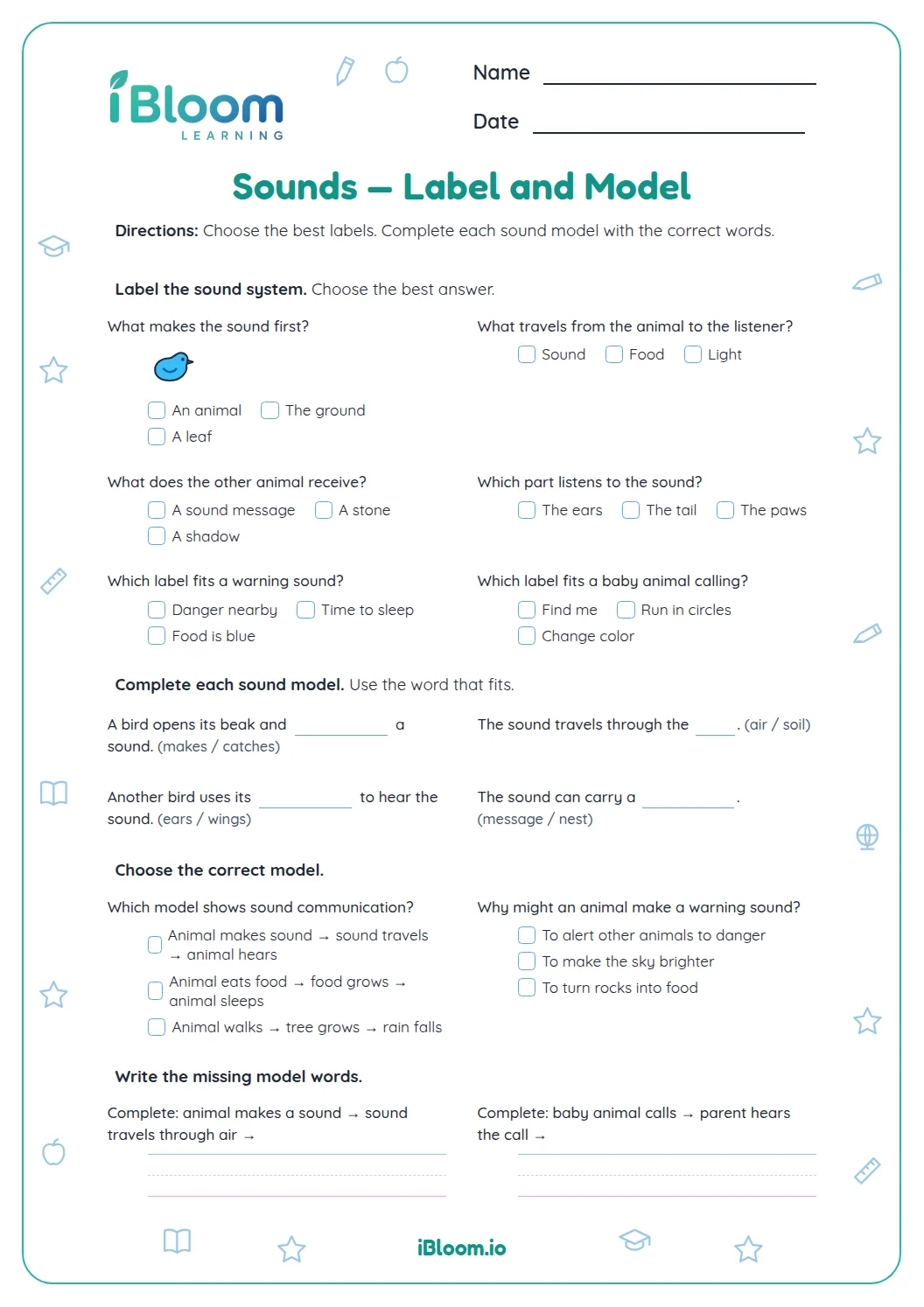 Sounds — Label and ModelGrade 2 science worksheets that help children explore how animals make sounds and use them to communicate, warn, find mates, and care for young. This label and model worksheet provides a distinct, age-appropriate way to practise the same lesson.Grade 2Free PDF preview
 Sounds — Explain Cause and EffectGrade 2 science worksheets that help children explore how animals make sounds and use them to communicate, warn, find mates, and care for young. This explain cause and effect worksheet provides a distinct, age-appropriate way to practise the same lesson.Grade 2Free PDF preview4 pages
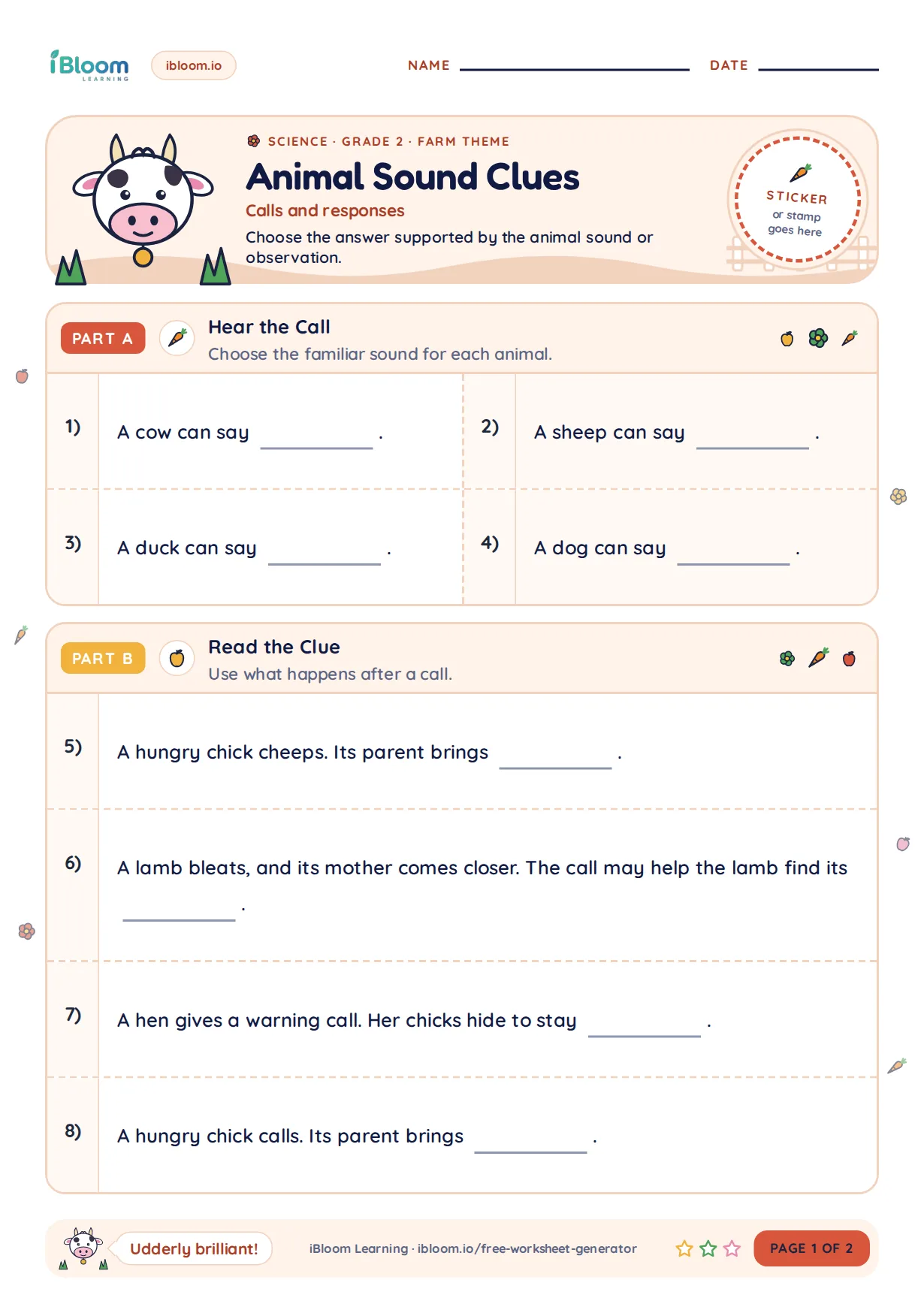 Sounds — Apply Science IdeasGrade 2 science worksheets that help children explore how animals make sounds and use them to communicate, warn, find mates, and care for young. This apply science ideas worksheet provides a distinct, age-appropriate way to practise the same lesson.Grade 2Free PDF preview
 Sounds — Science Reasoning ReviewGrade 2 science worksheets that help children explore how animals make sounds and use them to communicate, warn, find mates, and care for young. This science reasoning review worksheet provides a distinct, age-appropriate way to practise the same lesson.Grade 2Free PDF preview
Practice that builds confidence
What children learn about animal sounds
These Grade 2 science worksheets help children investigate animal sounds as part of the Animals topic. Students practise connecting familiar calls, cries, chirps, barks, and roars with the animals that make them and the reasons those sounds may be used.
The printable activities include observation-based questions, matching tasks, sorting prompts, picture clues, and simple explanations about communication in animals. Children build vocabulary while learning that sounds can signal danger, attract attention, locate group members, or help young animals and parents stay connected.
Children explore the idea that animals make sounds for a purpose. A dog may bark to alert, a bird may sing to communicate, and a young animal may call for its parent. At this grade level, the focus is not on memorising every animal noise, but on noticing patterns: who is making the sound, what might be happening, and why the sound is useful.

Building science vocabulary
The worksheets introduce and reinforce words such as sound, call, communicate, warning, signal, loud, soft, high, and low. Children may compare a roar with a chirp or a croak with a moo, then describe what is similar or different. This helps them move from simply naming sounds to explaining them in a science sentence.
A simple parent routine
At home, choose one animal from a worksheet and ask three questions: “What sound does it make?”, “When might it make that sound?”, and “Who needs to hear it?” Then look for a real-life example in a book, video, park, or backyard. Encourage your child to answer in a full sentence, such as, “A bird chirps to communicate with other birds.”

Classroom uses for teachers
Teachers can use these printables during an animals unit, as science centers, morning work, quick checks after discussion, or partner activities. The pages also support oral language because students can explain their choices before writing. Sorting tasks work well for small groups: warning sounds, parent-and-baby sounds, group communication, and sounds used to get attention.

Common errors to watch for
Some children think animals make sounds only because they are happy or angry. Others may match a sound to the correct animal but miss the purpose behind it. Guide students to use evidence from the picture or sentence. If an animal is near danger, the sound may be a warning; if a baby animal is shown alone, the sound may help it find a parent.
Free printable PDF download
Use this grade 2 animal sounds worksheet page to preview the activity, print it, or download it as a PDF for quick practice. It works well for homework, homeschool lessons, tutoring, morning work, revision, and classroom centers.
Answers and answer key support
After the child completes the worksheet independently, parents and teachers can use the answer support or answer key information to check the work, review mistakes, and choose the next practice step.
Why iBloom worksheets help
The activities move from familiar animal-sound matching to simple reasoning about communication. Clear pictures, short prompts, and repeated vocabulary help Grade 2 learners practise observation, comparison, and explanation without being overwhelmed.
A child-friendly strategy is: “Name the animal, name the sound, name the reason.” For example: “The frog croaks to communicate with other frogs.”
Helpful answers
Frequently asked questions
What do Grade 2 students learn from animal sounds worksheets?
They learn that animal sounds are not just noises. Animals may use sounds to communicate, warn others, find group members, attract attention, or help parents and young stay connected.
Do these worksheets require children to know many animal sounds already?
No. The activities use familiar examples and picture clues so children can reason about the animal and the purpose of the sound, even when a sound is new to them.
How can I help my child explain why an animal makes a sound?
Ask your child to use the sentence frame: “The ___ makes a ___ sound to ___.” For example, “The dog barks to warn its owner.”
Are animal sounds part of science or language practice?
They support both. The science focus is animal communication and behavior, while the activities also build vocabulary, describing words, and full-sentence explanations.
Can these worksheets be used in a classroom center?
Yes. They work well in science centers where students match animals to sounds, sort sounds by purpose, discuss picture clues, and write short explanations with a partner.
Is this grade 2 animal sounds worksheet free?
Yes. You can preview it for free and use the printable worksheet for home or classroom practice.
Can I download this grade 2 animal sounds worksheet as a PDF?
Yes. Use the worksheet download option to save a printable PDF, or print the worksheet directly from the page.
Does this grade 2 animal sounds worksheet include answers or an answer key?
When the activity has fixed answers, iBloom includes answer support so parents and teachers can check the completed worksheet.