







About this worksheet
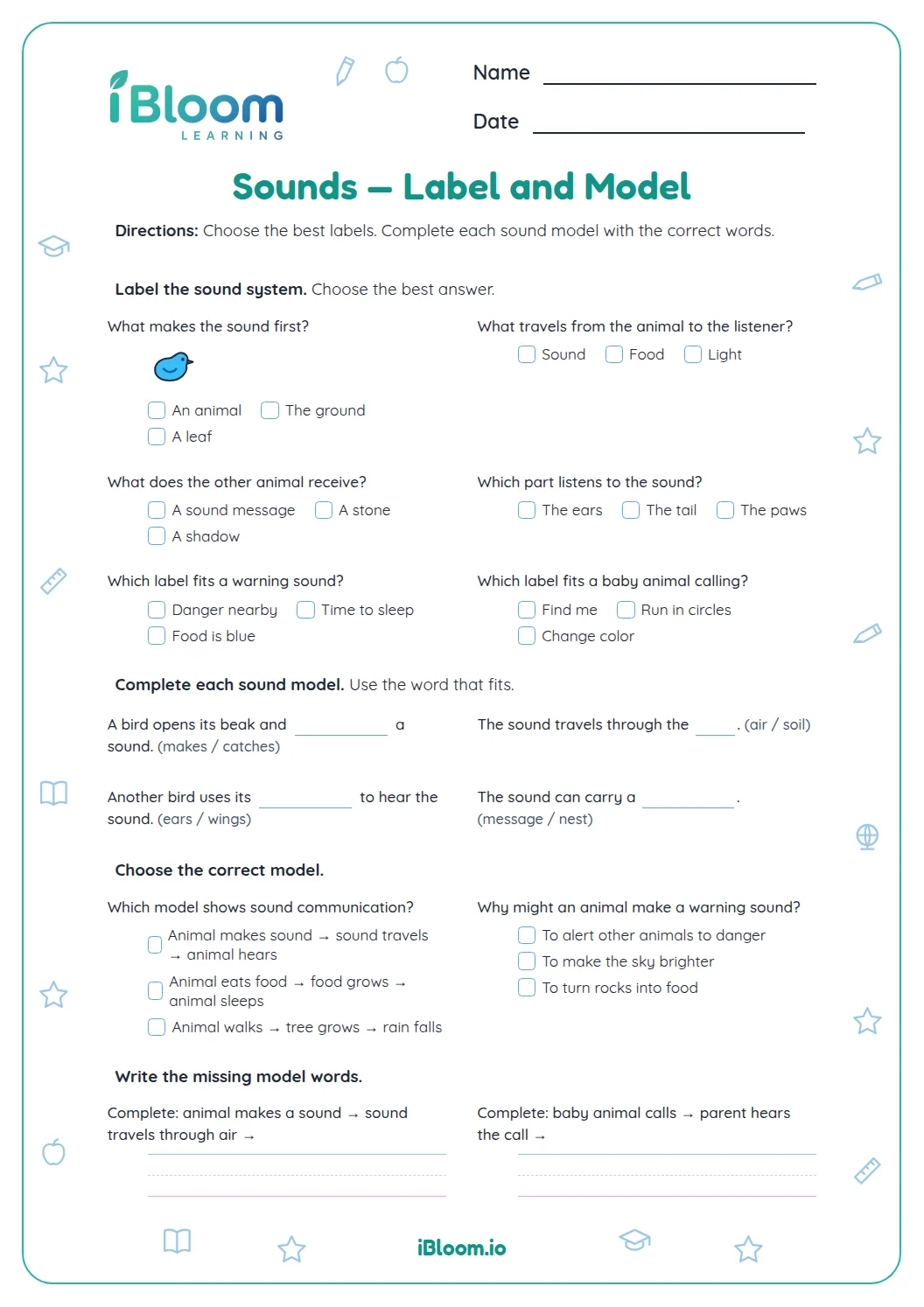
This Grade 2 animal sounds worksheet moves from familiar calls to what a sound can help an animal do. Fourteen fill-in questions cover cow, sheep, duck, and dog sounds, then use short observations about calls and parent responses. Children complete patterns about feeding, finding a parent, and hiding. The practice supports NGSS 1-LS1-2.
Aligned to 1-LS1-2
Which familiar animal sounds start the worksheet?
Part A has four short fill-ins about a cow, sheep, duck, and dog. Children write moo, baa, quack, and bark. Read the animal name first, then say the sound aloud before writing it.
- 1A cow can say ___.
- 2Answer: moo
How do observation clues reveal what a call does?
A call alone does not prove one meaning. What happens around it supplies evidence. In question 5, a hungry chick cheeps and its parent brings food, so food completes the blank. Other items describe a lamb finding its mother, chicks hiding after a warning, and ducklings turning toward a calling mother.
How do children use a sound pattern?
Part C compares repeated examples of calls followed by feeding or hiding. Children complete each sentence with a word that matches the observation. The final blank asks what chicks will likely do after the hen calls again.
How to use this worksheet
- 1Say each familiar animal sound before writing it.
- 2Read all of each observation, including what happens after the call.
- 3Use the event to complete the blank with a short word or phrase.
- 4For the final two items, compare the repeated events and name the pattern.
Mistakes to discuss
The mistake
Treating every cheep as a request for food.
The fix
Use the question’s hunger and feeding clues. Explain that a sound’s context helps reveal its purpose.
The mistake
Choosing “the chicks get bigger” after a warning call.
The fix
Reread what happens immediately after the warning: the chicks hide.
The mistake
Predicting an action without explaining how it helps.
The fix
Add the survival link: hiding can help chicks avoid danger.
NGSS alignment
Use observations of animal calls to identify parent-and-young survival patterns.
On this sheet: Children read short observations of calls, compare parent responses, and explain how feeding and protection help young survive.
Show the official wordingHide the official wording
Read texts and use media to determine patterns in behavior of parents and offspring that help offspring survive.
What to practice next
Make more practice
Further reading
Questions parents and teachers ask
Which animal calls are on the worksheet?
The first four questions ask for a cow’s moo, a sheep’s baa, a duck’s quack, and a dog’s bark. Later items describe calls from chicks, lambs, hens, ducklings, birds, and a young seal. Children write a short word or phrase for each blank.
Does the same animal sound always have one meaning?
No. Children use the situation to interpret a call. In one example, a hungry chick calls and its parent brings food, which supports a feeding explanation. Another describes a warning call followed by hiding. The observations provide the clues for each response.
How does this worksheet connect sounds with survival?
The observations connect calls with feeding, finding a parent, or responding to danger. Children complete each sentence with a word drawn from what happened. The final two items ask them to notice repeated feeding and warning patterns that can help young animals survive.
Are recordings needed to complete the questions?
No recordings are needed. The worksheet names each animal and describes what happens after its call. An adult can read the short sentences aloud while the child writes the missing word. The answer key gives a short answer for each of the 14 items.
What counts as a correct answer in Part C?
For question 13, the answer should connect calls with young animals getting food. For question 14, it should say that the chicks will likely hide again. The key gives “food” and “hide” as the short answers, and children can write those words clearly.