






About this worksheet
This free Grade 2 science printable gives children practice reading simple food-chain models. Students identify producers and consumers, follow arrows from food to eater, and use several short chains to work out what an organism eats. The 14 multiple-choice questions move from basic vocabulary to applying those ideas in new models. A separate answer key gives the correct choice for each question.
How do you read a food chain?
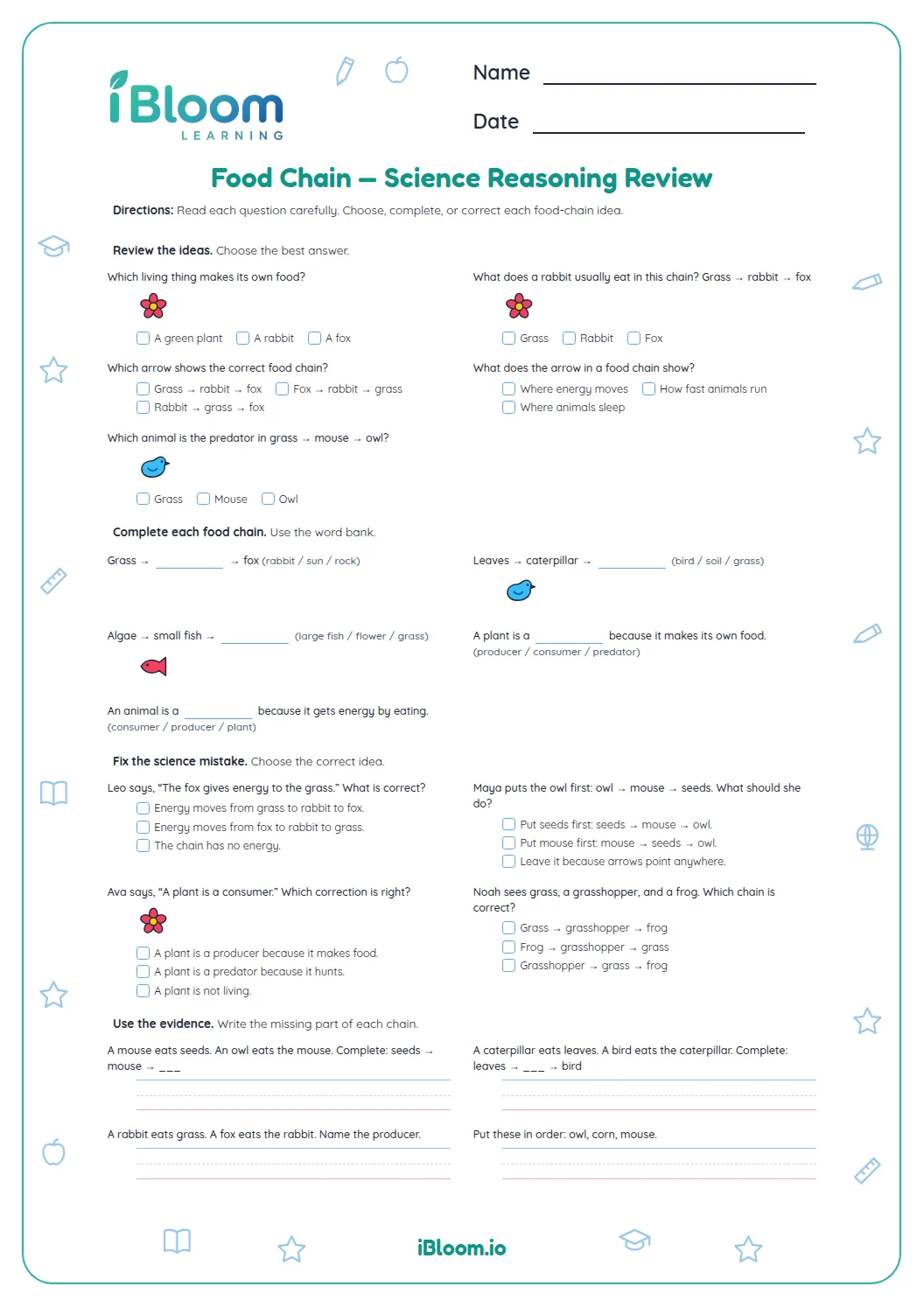
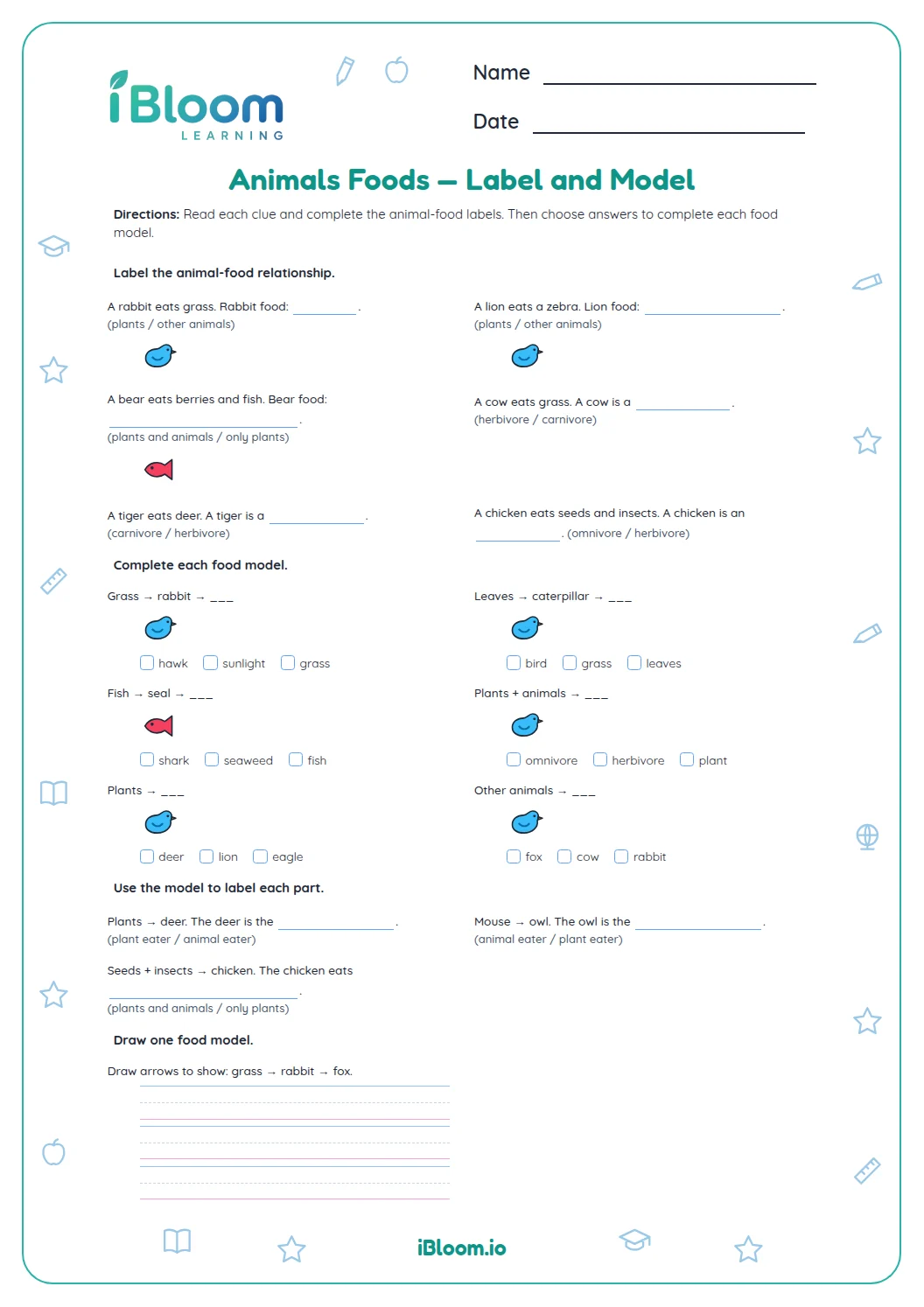
Read the chain from left to right. Each arrow points from a food source to the living thing that gets energy from it. A plant can be followed by a plant-eating animal, then by an animal that eats that animal.
For example, in seedling → caterpillar → bird, the caterpillar gets energy from the seedling and the bird gets energy from the caterpillar. Several worksheet items use this same left-to-right model with different organisms.
- 1Seedling → caterpillar → bird
- 2Question: Which animal gets energy directly from the plant?
- 3Answer: caterpillar
What are producers and consumers?
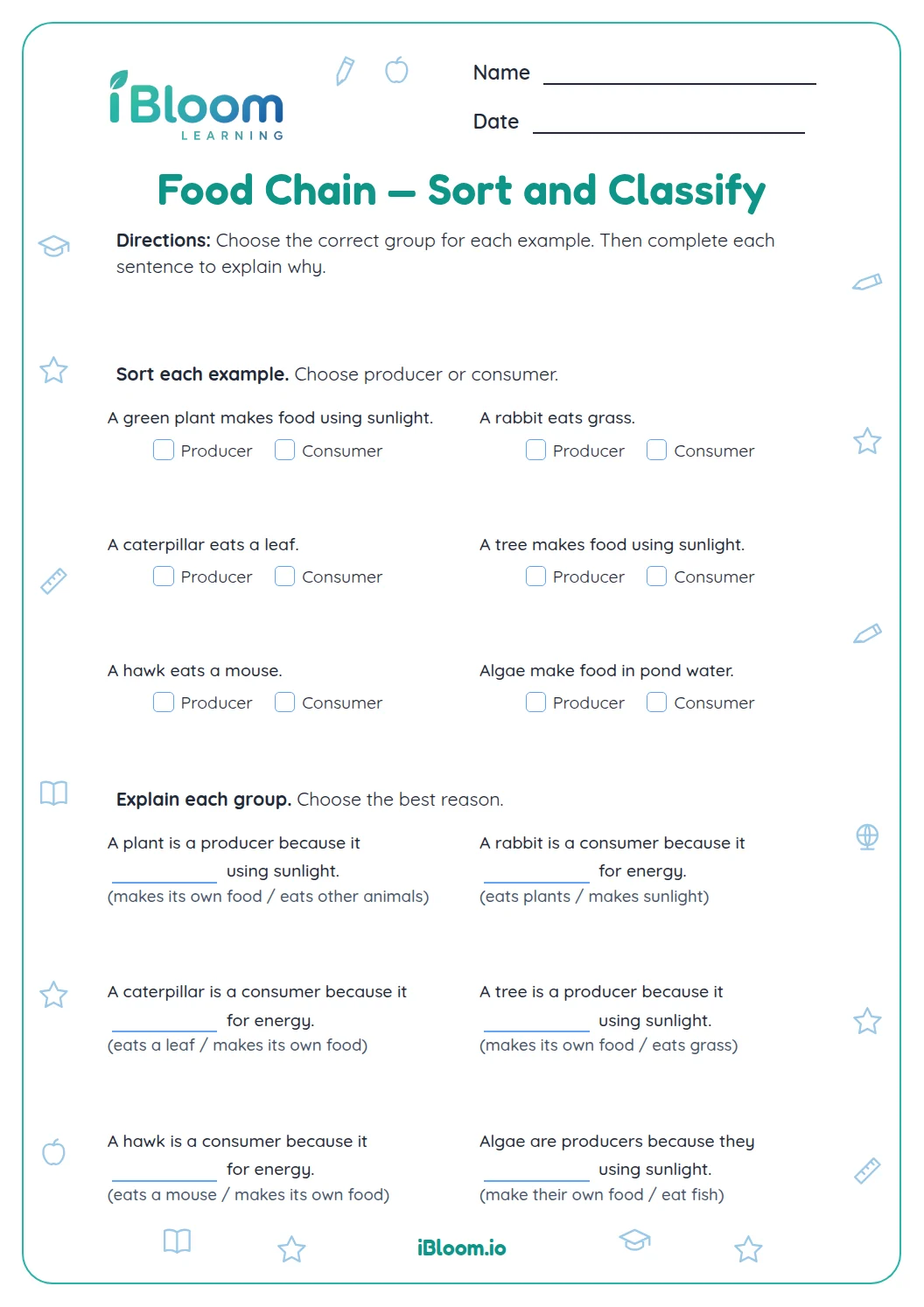
A producer makes its own food. Green plants use energy from sunlight to grow, so a plant is a producer in these models.
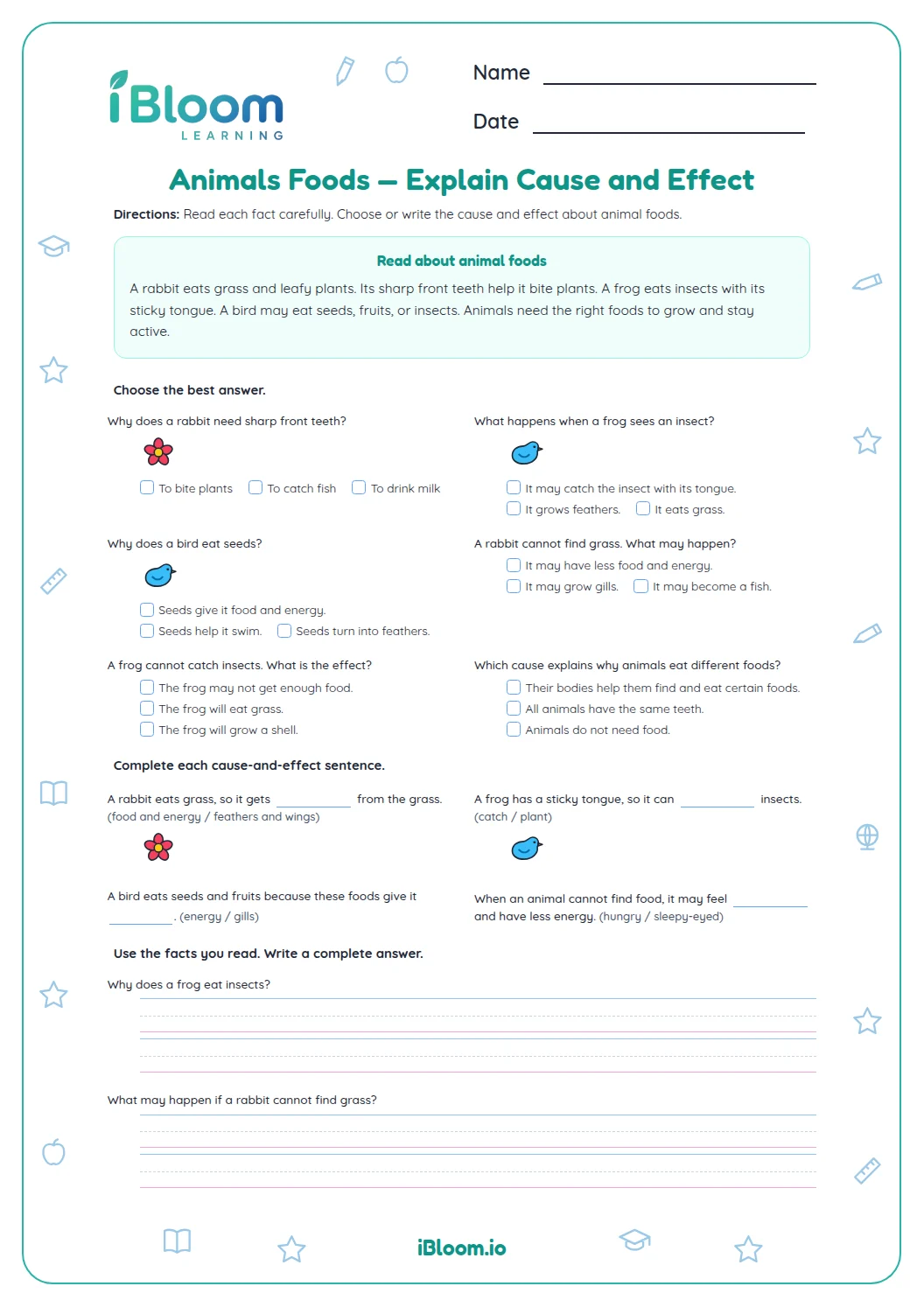
A consumer gets energy by eating plants or other animals. Rabbits, caterpillars, birds and foxes are consumers in the chains on this page.
How can a child check a food-chain model?
Start with a plant, then follow the arrow from food to eater. A plant is a producer because it makes its own food; an animal that eats is a consumer.
The final questions apply producer, consumer and food-source ideas to new chains. Read each arrow as moving from the food to the organism that gets energy from it.
How to use this worksheet at home or in class
- 1Read each picture sequence from left to right.
- 2Name the food source and the living thing that eats it.
- 3Use producer for a plant that makes food and consumer for an eater.
- 4For the final models, follow each arrow from food to eater.
Common mistakes and quick fixes
The mistake
Reading an arrow as pointing toward the food.
The fix
Say “the food gives energy to the next living thing” at every arrow.
The mistake
Calling an animal a producer because it is at the start of a question.
The fix
A producer makes its own food; in these examples that is the plant.
The mistake
Writing any animal after a plant without checking what it eats.
The fix
Check each pair: the organism on the right must be able to eat the one before it.
What to practice next
Make more practice
Questions parents and teachers ask
What is a food chain?
A food chain is a simple model showing how energy moves from one living thing to another. This page uses short sequences such as plant → caterpillar → bird. Read each arrow from the food source to the organism that eats it, then use the sequence to identify what each organism gets energy from.
What does the arrow in a food chain mean?
The arrow points from the food to the living thing that gets energy from that food. In plant → caterpillar → bird, the caterpillar gets energy from the plant, and the bird gets energy from the caterpillar. Follow the arrows in that direction when answering the model questions.
What is a producer on this worksheet?
A producer is a living thing, such as a green plant, that makes its own food using energy from sunlight. On this worksheet, identify the plant in a chain as the producer, then follow the arrows to see which animals get energy by eating plants or other animals.
How many questions are on the printable?
There are 14 multiple-choice questions in two parts. Part A practices food sources and producer and consumer roles; Part B uses new food-chain models to check arrow direction and what an organism eats. The separate answer key lists one correct choice for each question.
Which way does energy move in a food-chain model?
In these simple models, follow the arrows from the food source to the organism that eats it. In plant → caterpillar → bird, energy moves from the plant to the caterpillar, then from the caterpillar to the bird. The chain helps show who gets energy from whom.