







About this worksheet
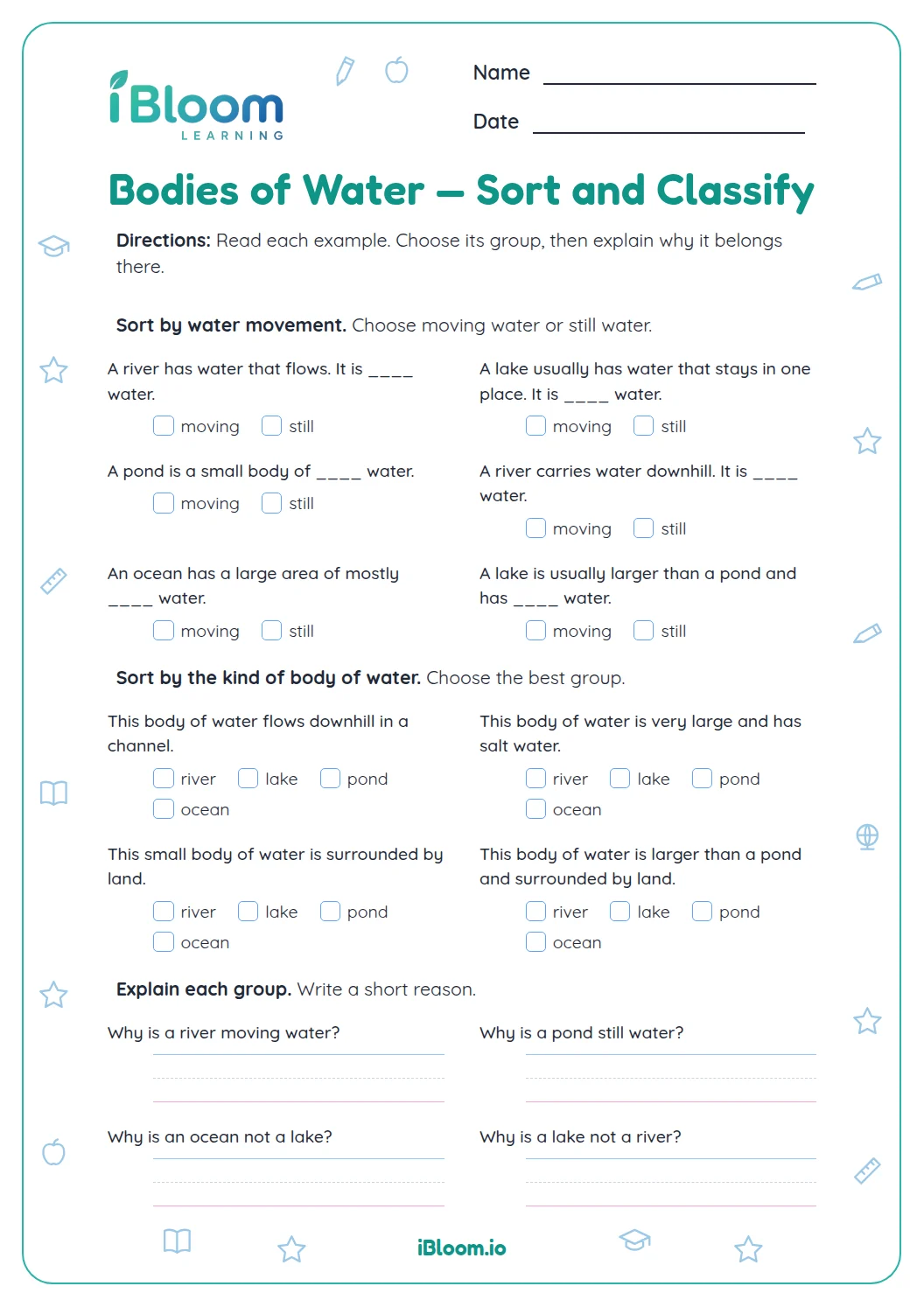
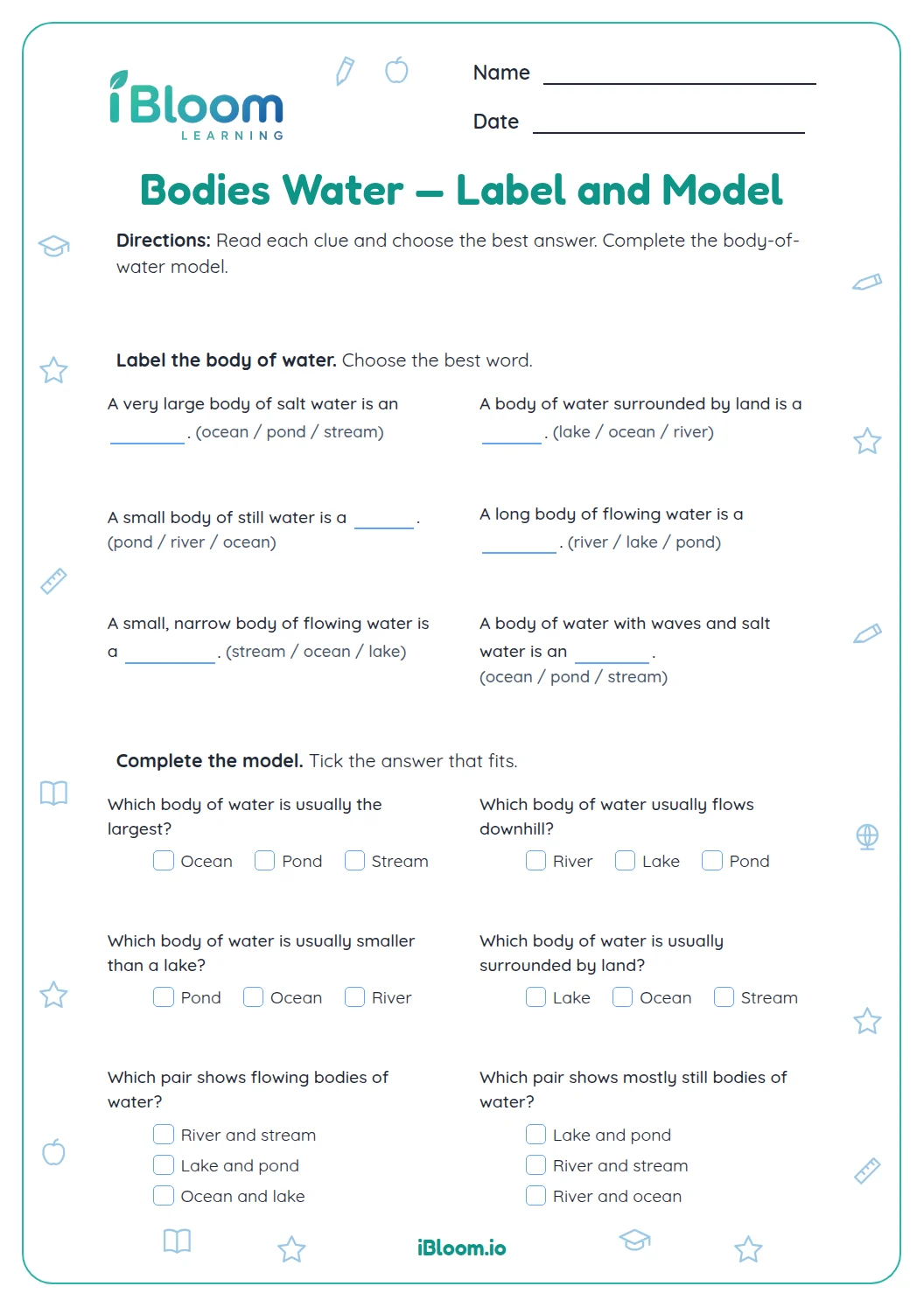
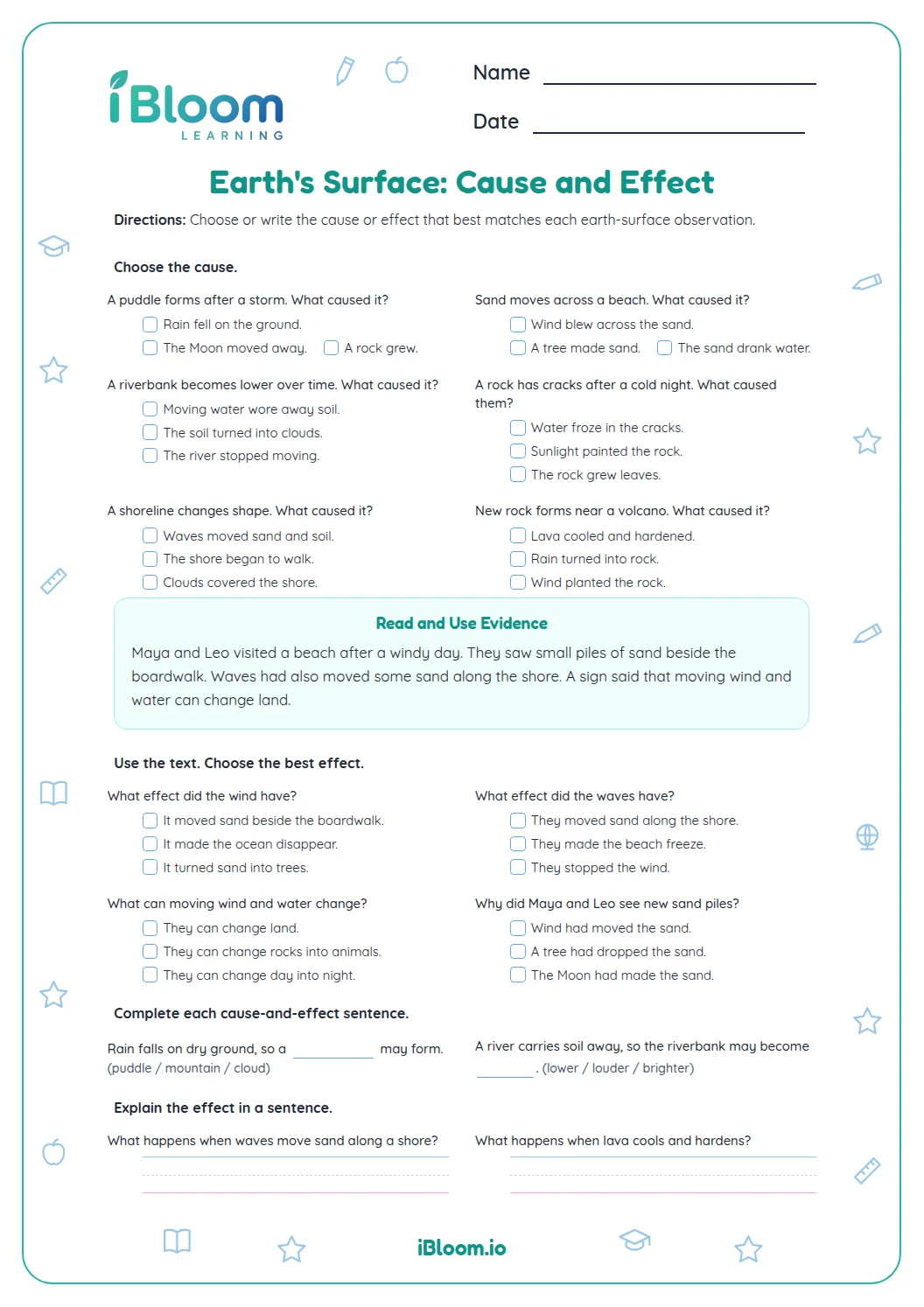
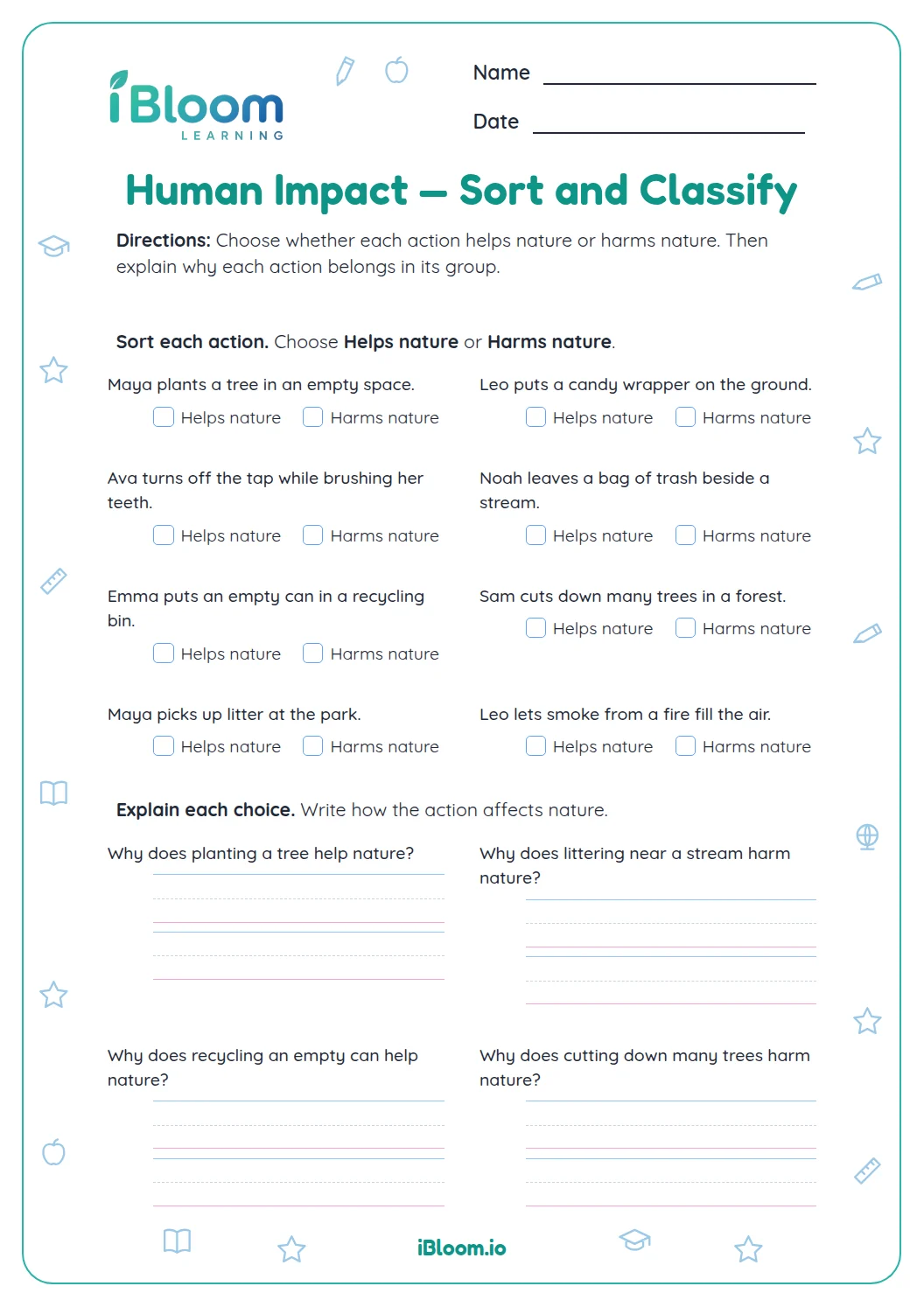
This Grade 2 science worksheet gives 14 questions about bodies of water and cause and effect. Students connect rain, runoff, waves, and freezing with changes to streams, shores, ponds, and soil, then identify water bodies and water as a solid. A separate answer key supports review. The page aligns with NGSS 2-ESS2-3.
Aligned to 2-ESS2-3
How can I tell one water body from another?
A stream or river flows; a lake or pond is still water surrounded by land; an ocean is a very large body of salt water. A map or model can show where each feature is located.
- 1What can heavy rain do to a stream? → Raise its water
- 2Rain adds runoff to the stream, so its water level can rise.
What causes a change near water?
Rain can send runoff down a slope and raise a stream. Moving water can carry soil or sand and change a bank or shore. Use the stated event to identify what happened next.
What can a simple map model show?
The questions connect events such as heavy rain, waves, and freezing with likely effects. They also ask students to identify flowing water, a lake surrounded by land, and frozen water as a solid.
How to use this worksheet
- 1Read the event first: rain, flowing water, waves, or freezing.
- 2Name the water body or land feature in the clue.
- 3Connect the event to its likely result.
- 4Use a short phrase for the open response questions.
- 5Check the key and explain the cause in your own words.
Common mistakes and quick fixes
The mistake
Mixing up a lake and a river; a river flows, while a lake is surrounded by land.
The fix
Pause and use the clue in the sentence or model to check: mixing up a lake and a river.
The mistake
Saying waves create rain; waves move water and sand along a shore.
The fix
Pause and use the clue in the sentence or model to check: saying waves create rain.
The mistake
Naming a result without its cause; connect rain runoff to rising stream water.
The fix
Pause and use the clue in the sentence or model to check: naming a result without its cause.
Curriculum alignment
This worksheet connects observations about water to the places it is found and its solid or liquid state.
Identify where water is found on Earth and recognize water as a solid or liquid.
On this sheet: Students identify streams, rivers, lakes, and oceans and recognize frozen pond water as solid.
Show the official wordingHide the official wording
Obtain information to identify where water is found on Earth and that it can be solid or liquid.
What to practice next
Make more practice
Further reading
Questions parents and teachers ask
How can water change land?
Moving water can carry soil and sand, and rain runoff can raise streams or fill low places. On this worksheet, students connect rain, waves, and freezing with changes to streams, shores, lakes, and ponds. The answer key explains each selected result.
How many questions are on the printable?
There are 14 questions in two parts. Students identify bodies of water and connect causes such as rain or waves with effects on water and land. The separate answer key lists one answer for each question. Read each question and select its best answer.
What should I have ready?
Use a pencil and the printed worksheet. Read the directions once, then encourage the student to work through one item at a time and explain a choice or calculation when it is useful. The answer key makes it easy to review the completed page together.
How can I check the answers?
Check the separate answer key after the student completes the questions. For a missed item, reread the named event and result: for example, heavy rain can raise stream water, while frozen pond water is solid. Ask the student to explain the clue.
Can this be used for class or home practice?
The two parts can be used for a short classroom station, small group, or home review. An adult can model one item first, then let the student finish independently or discuss the reasoning aloud before checking answers. An adult can briefly review the directions first and save the key for checking after the student has finished.