







About this worksheet
This free Grade 2 science worksheet reviews where water is found on Earth and how it can appear as solid ice or liquid water. Children identify oceans, rivers, lakes, and ponds, sort examples by water state, and think about useful sources of science information. It aligns with NGSS 2-ESS2-3, which asks students to obtain information about water’s locations and forms. The answer key includes correct choices and sample explanations.
Aligned to 2-ESS2-3
Where is water found on Earth?
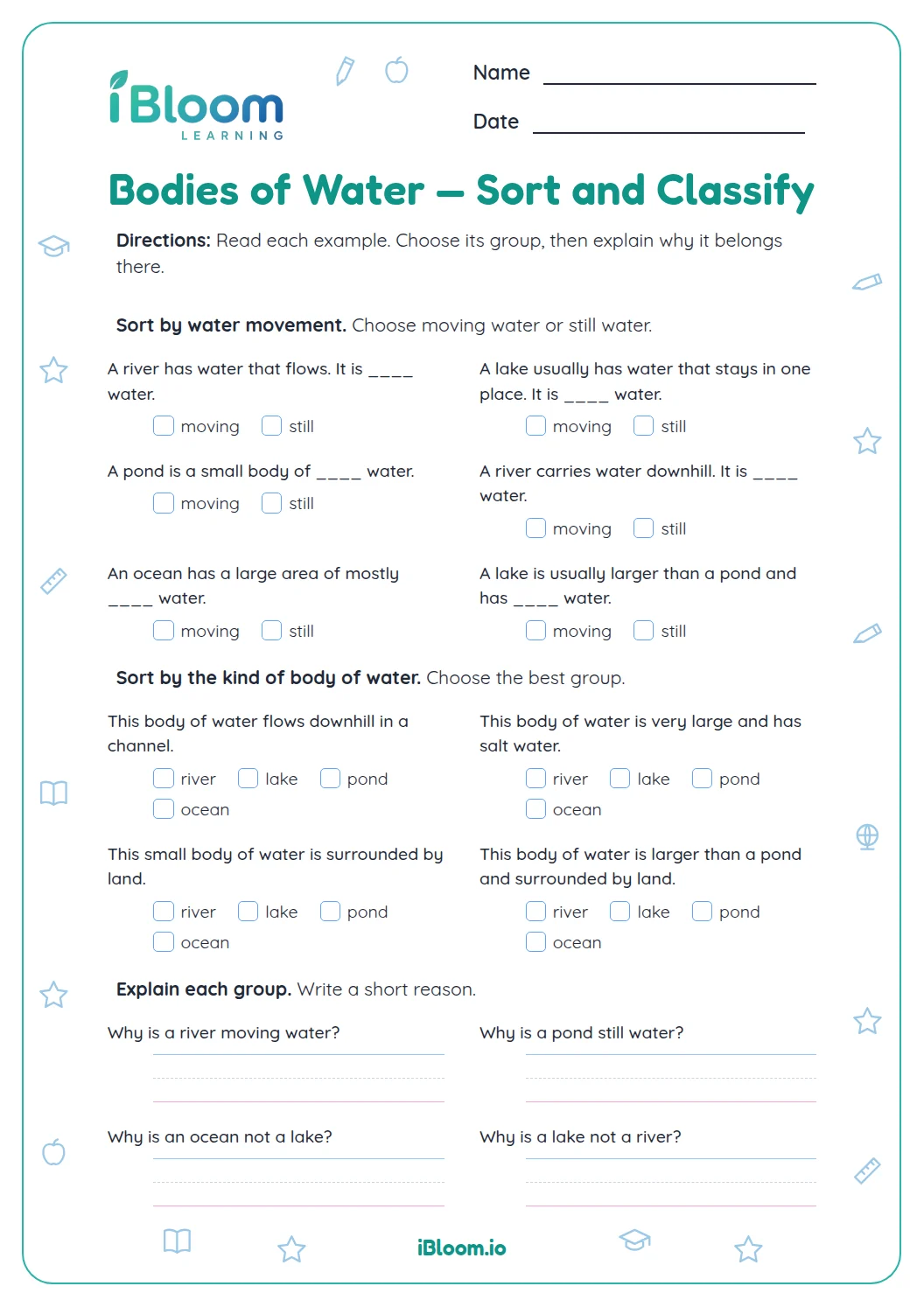
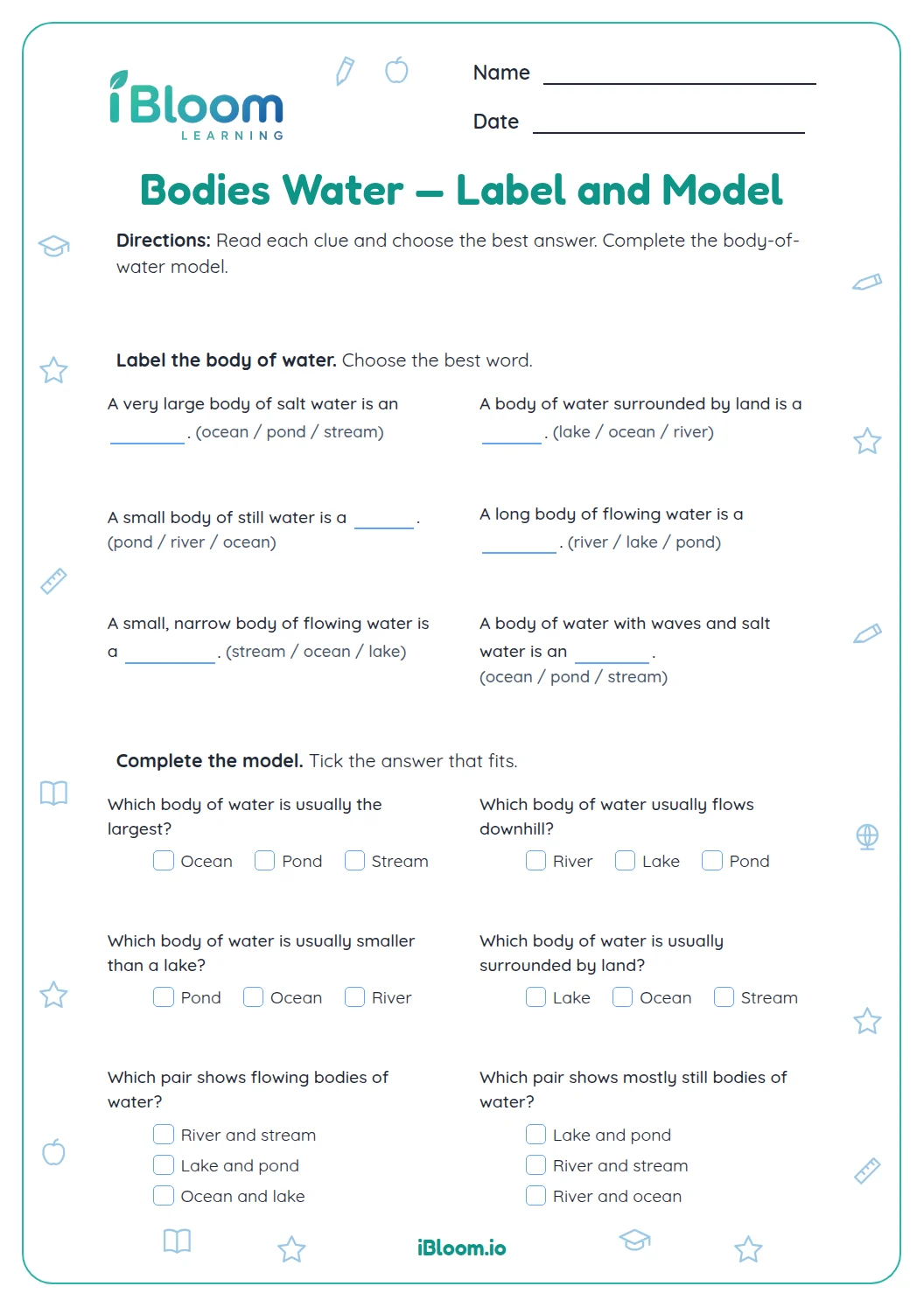
Water can be found in oceans, rivers, lakes, and ponds. These bodies of water differ in size and movement. Students use those features to identify examples and think about where water is located.
How can water be solid or liquid?
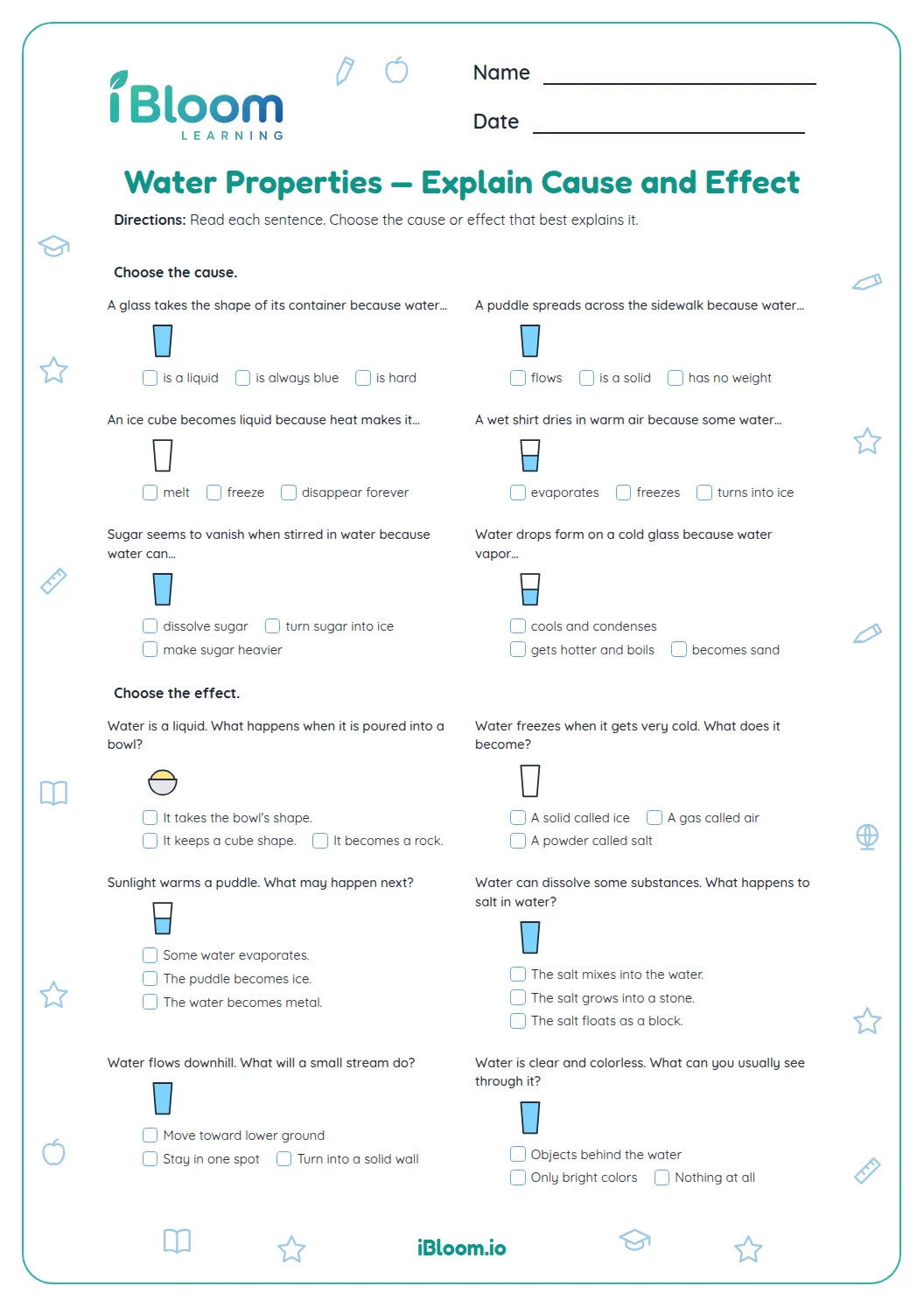
Water in a flowing river is liquid. When a pond or lake freezes, some of its water becomes solid ice. The location and the state are related ideas, but a body of water can change form when conditions change.
- 1Question: Water in a frozen pond is in which state?
- 2Clue: Frozen water is ice.
- 3Answer: Solid
How do you choose useful science information?
A labeled map can show where rivers and lakes are. A science book can describe how water freezes. A personal preference may be interesting, but it does not answer a factual question about Earth’s water.
How to use the science review
- 1Read each question and identify whether it asks about a place, a form, or an information source.
- 2For multiple choice, compare each option to the science idea in the question.
- 3Remember that ice is solid water and flowing water is liquid.
- 4Use a map or factual text when looking for a location or science explanation.
- 5Answer the final questions in a complete phrase or sentence.
- 6Review the key and explain any answer that needs a second look.
Common science mix-ups and fixes
The mistake
Calling a frozen pond liquid because ponds usually hold water.
The fix
Focus on the word frozen: the water has become solid ice.
The mistake
Confusing a river with a lake because both contain water.
The fix
A river flows; a lake is a larger body of water that is generally still.
The mistake
Treating an opinion as proof about a science fact.
The fix
Choose a source that provides information, such as a labeled map or science text.
Curriculum alignment
Use information to identify where water is found and that it can be solid or liquid.
On this sheet: Questions identify oceans, rivers, lakes, ponds, solid ice, liquid water, and useful information sources.
Show the official wordingHide the official wording
Obtain information to identify where water is found on Earth and that it can be solid or liquid.
What to practice next
Make more practice
Further reading
Questions parents and teachers ask
Which bodies of water are included?
The worksheet reviews where water is found, the solid and liquid forms it can take, and how information sources can answer questions. Items ask students to identify bodies of water, distinguish ice from flowing water, and choose useful evidence such as a labeled map.
Does the sheet explain water as ice?
Yes. Several items ask students to recognize that frozen water is solid and flowing water is liquid. A question compares a frozen pond with a flowing river so children use both forms in one response. The examples also name familiar locations, including lakes, oceans, and ponds.
What does NGSS 2-ESS2-3 ask students to learn?
The performance expectation asks students to obtain information to identify where water is found on Earth and that it can be solid or liquid. This review uses familiar examples including oceans, rivers, lakes, ponds, ice, and flowing water.
How does the worksheet cover science sources?
Students consider whether a labeled map or a factual source can help answer a question about water. They also distinguish useful science information from a personal preference, building the habit of selecting information that fits the question. Another item asks what a student might investigate about a local pond.
Can children answer from their own experience?
Experience can help children picture a pond, river, or frozen lake, but they should choose answers that match the science facts. If a child has never seen one of these places, a map, book, or adult explanation can supply the needed information.
How many questions and pages are included?
The review has 16 questions: all are multiple-choice items, including four that ask children to choose a science explanation. It prints across two worksheet pages, with a separate answer key page. Plan for about 20 minutes, including time to discuss the science source questions.