






About this worksheet
This free Grade 2 science worksheet helps children connect water’s properties with the labels solid and liquid. Four observations describe water in a river, a puddle, pond ice and snow. Children label each state, answer nine questions about shape, flow and freezing, then draw two models in one box: liquid water in different cups and a pond with water and ice. The natural examples and labeled pond model practice NGSS 2-ESS2-3, identifying where water is found and that it can be solid or liquid. A separate key lists answers and describes the model.
Aligned to 2-ESS2-3
How can a child tell solid water from liquid water?
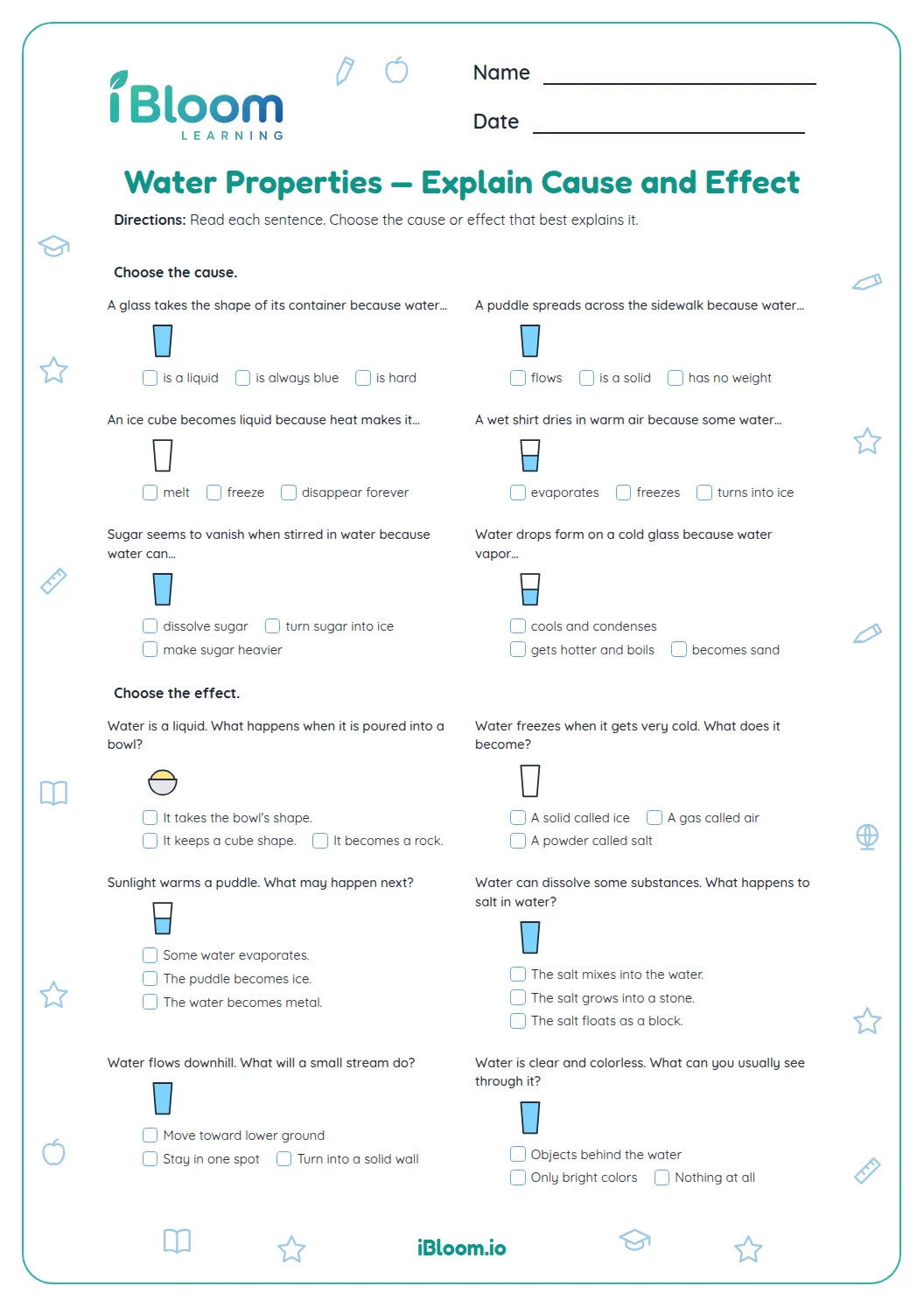
Liquid water flows and takes the shape of the part of a container it fills. Solid ice keeps its own shape while it remains frozen. Snow is made of ice crystals, so the snow in question 4 is solid water too. Questions 10–14 apply these clues to water in a bowl, an ice cube, a spreading puddle, freezing and clear water.
Part A supplies brief observations rather than asking children to guess from a place name alone. A pond can contain liquid water and solid ice at the same time, which children show in their final drawing.
What should the labeled model show?
The drawing task asks children to show liquid water in both a tall cup and a wide cup, then a pond with some floating ice. Children label the water liquid and the ice solid.
A simple outline is enough, provided the water fits inside each differently shaped cup and the pond clearly shows both states.
- 1Liquid water takes the shape of its container.
- 2Complete the sentence: It is liquid.
- 3The water stays liquid while its shape fits the container.
What labels belong on the pond model?
The model prompt asks for a pond with some ice floating on liquid water. Children label the ice solid and the water liquid. Their drawing should make the two parts easy to identify, using arrows if helpful.
The key describes the required features and labels. Accept simple outlines with clear labels; the scientific idea matters more than detailed artwork.
How to use this worksheet
- 1Read the four outdoor observations and underline clues such as flows or frozen.
- 2Write solid or liquid for each observation in Part A.
- 3Complete the Part B property sentences and the later state questions with the fitting words.
- 4Draw water in tall and wide cups, then add a pond with floating ice in the same model box.
- 5Label the water liquid and the ice solid, then compare the model with the key.
Mistakes to notice and how to help
The mistake
Calling snow liquid because it is a kind of water.
The fix
Explain that snow consists of ice crystals; water can be solid as well as liquid.
The mistake
Drawing liquid water as a separate ball inside a cup.
The fix
Have the drawn water meet the cup’s sides with a level surface at the top.
The mistake
Labeling the whole pond solid when only some ice floats on it.
The fix
Point to each part separately: the ice is solid and the surrounding water is liquid.
Curriculum alignment
Identify solid and liquid water in natural places and label a pond model.
On this sheet: Children use short observations of water outdoors to label its state and model a pond with water and ice.
Show the official wordingHide the official wording
Obtain information to identify where water is found on Earth and that it can be solid or liquid.
What to practice next
Make more practice
Further reading
Questions parents and teachers ask
Does this worksheet include drawing tasks?
Yes, one drawing task has room for two connected models. Children draw liquid water in a tall and a wide cup, then a pond with floating ice. They label the water liquid and the ice solid; thirteen other tasks ask about states and properties.
Why is snow labeled solid water?
Snow is made of tiny ice crystals, so it is solid water. The sheet’s snow question describes snow resting on a hill. Children can connect that example with frozen pond ice, then compare both with the flowing river water and the puddle that spreads across the ground.
Can a pond contain both solid and liquid water?
Yes, a pond can have solid ice with liquid water around or beneath it. The drawing task asks children to show some ice floating on liquid water and label both. This connects each state label to a part of the same natural place.
Do we need cups and water to complete the sheet?
No, the printed observations and questions provide the information needed for the tasks. If you have two differently shaped cups available, looking at liquid water in each can help with question 9. Children can then draw what they notice and label the water liquid in both cups.
How should I mark the two models?
Check the ideas and labels rather than artistic detail. The cup models should show liquid water fitting inside differently shaped cups. The pond should distinguish solid ice from liquid water and label both correctly. The key gives a concise model description.