







About this worksheet
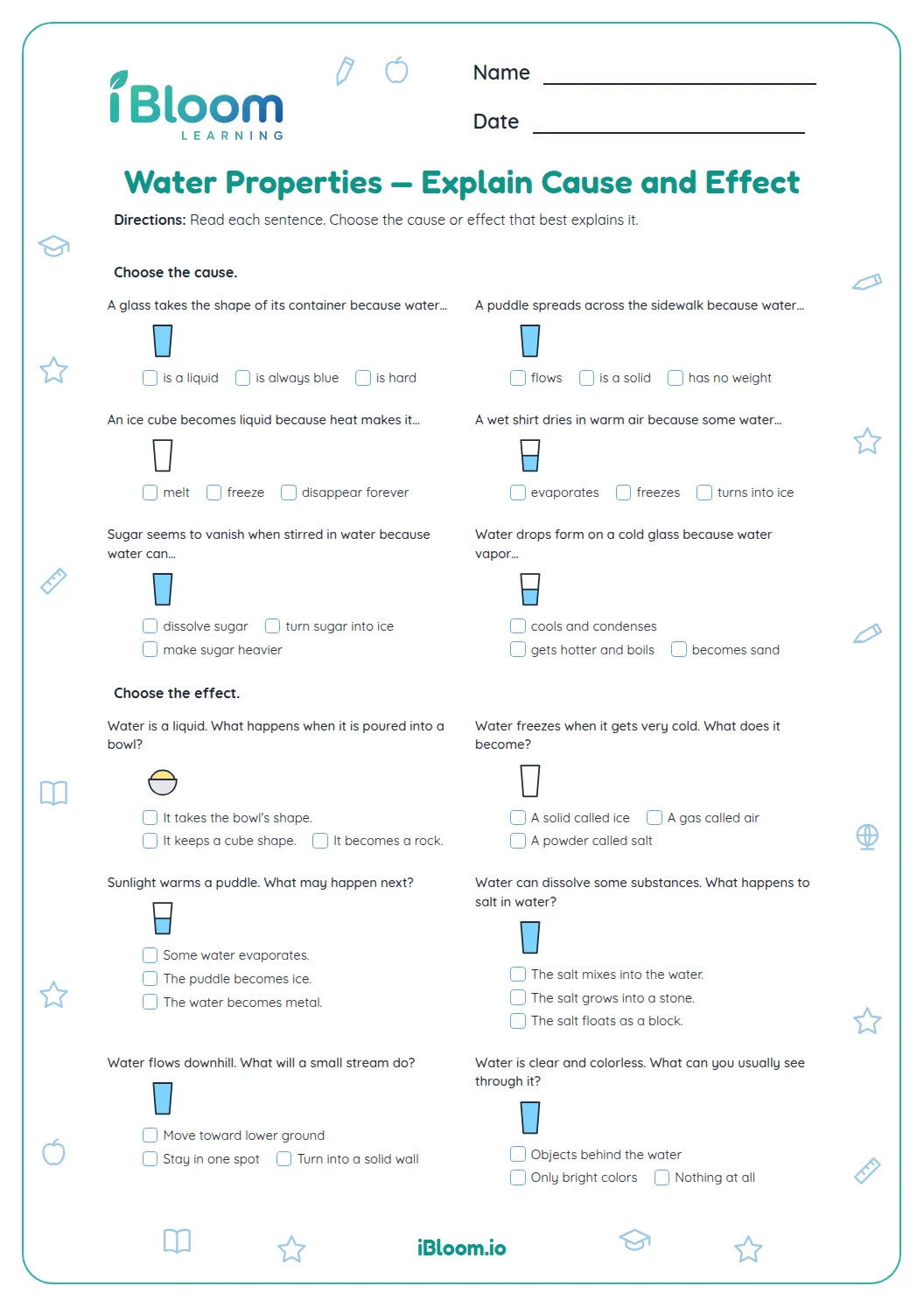
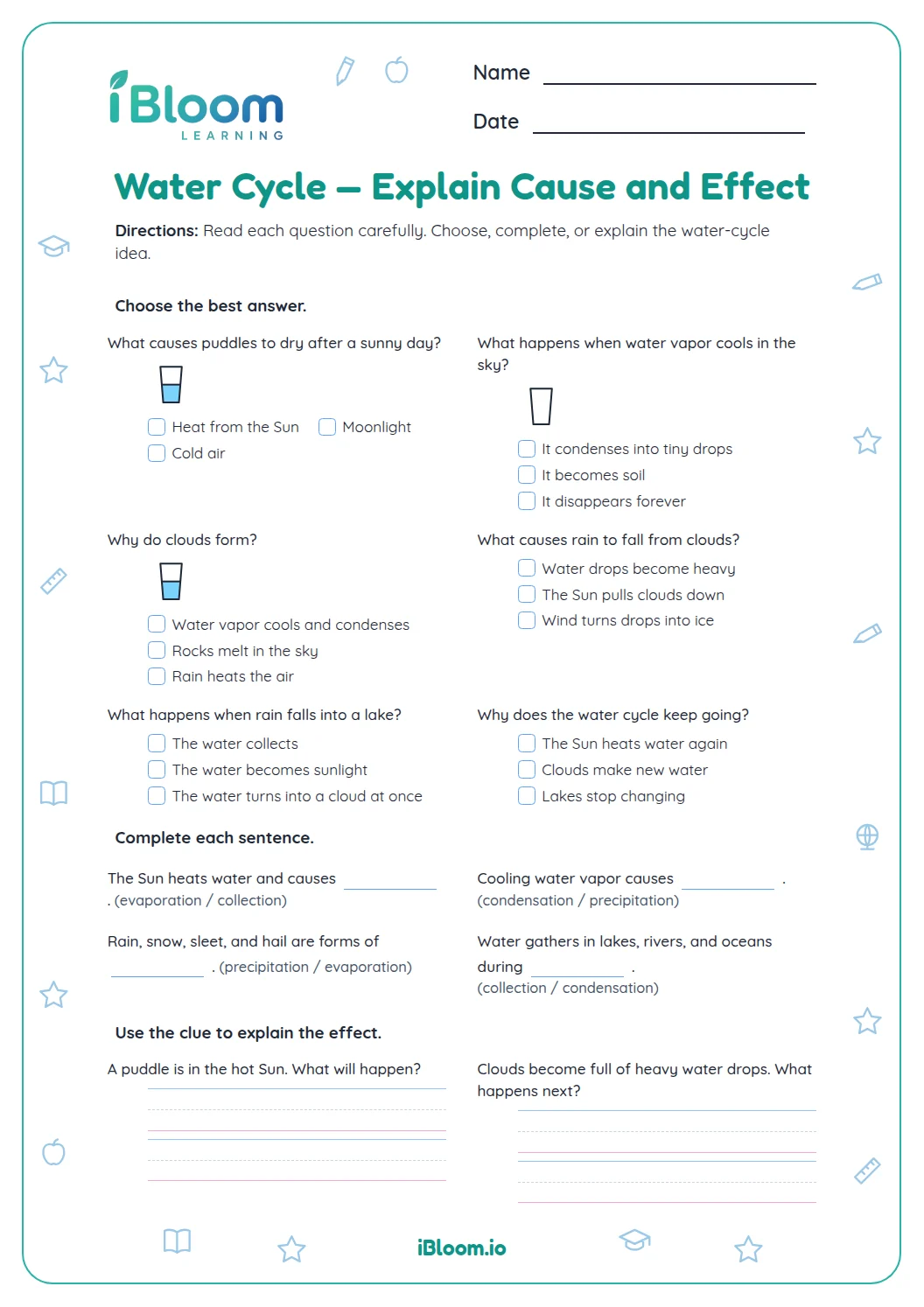
This Grade 2 science worksheet asks students to describe water using observable properties and to connect observations with changes of state. Across 14 multiple-choice questions, students identify how liquid water flows and takes a container’s shape, recognize clear or colorless water, compare ice with liquid water, and consider freezing, melting, and dissolving. The answer key follows the same question numbers. The questions practice NGSS 2-PS1-1 by classifying materials using observable properties.
Aligned to 2-PS1-1
How can you describe liquid water?
Look for properties that can be observed without tasting: clear water lets light pass through, liquid water flows, and it takes the shape of its container. Question 1 combines flow and shape to identify liquid water.
- 1Water flows and takes the container’s shape.
- 2Those observable properties identify it as a liquid.
What changes when water freezes or melts?
Freezing changes liquid water into solid ice. Warming ice can make it melt back into liquid water; the material remains water even though its state and shape change. Questions 9 and 10 check these relationships.
What can dissolving tell us?
The final questions use salt in water as evidence that some materials dissolve. They also distinguish an observation from an overgeneralization: one material dissolving does not mean every material will.
How to use this worksheet
- 1Read each question and name the property or change it describes.
- 2For liquid water, check whether the clue is flow, container shape, or clarity.
- 3For freezing and melting, state the starting form and the resulting form.
- 4Choose an answer only after checking that it fits all the clues.
- 5Use the key to revisit any answer that needs a clearer observation.
Common mistakes and quick fixes
The mistake
Saying liquid water has one fixed shape.
The fix
Compare water in two differently shaped containers; its amount stays while its shape changes.
The mistake
Calling ice a different material from liquid water.
The fix
Warm the ice: melting shows that the solid form can become liquid water.
The mistake
Assuming every material dissolves because salt dissolves.
The fix
Use the careful claim in question 13: some materials dissolve.
Curriculum alignment
This worksheet practices 2-PS1-1 through its question set.
Classify water and ice using observable properties such as flow, shape, and clarity.
On this sheet: The questions directly practice the named skill through identification, application, and explanation.
Show the official wordingHide the official wording
Plan and conduct an investigation to describe and classify different kinds of materials by their observable properties.
What to practice next
Make more practice
Further reading
Questions parents and teachers ask
What properties do the questions ask students to observe?
Students identify that liquid water flows and takes the shape of its container, and that clear water is transparent. Other questions ask students to recognize that water can be colorless and that ice keeps its own shape. Have students point to the clue in the question or passage and explain how it supports the choice they made.
Does the worksheet include changes of state?
Yes. Students identify what happens when liquid water freezes and when ice is warmed. They also consider water vapor as a gas, connecting familiar water forms with solid, liquid, and gas states. Have students point to the clue in the question or passage and explain how it supports the choice they made.
How many questions are included?
The worksheet has 14 multiple-choice questions arranged in four parts. They move from observing water to comparing its forms and using evidence about flow, melting, and dissolving. Have students point to the clue in the question or passage and explain how it supports the choice they made.
What does the answer key include?
The separate key gives the correct choice for each of the 14 questions. Students can compare answers and return to the observation in a prompt when they want to explain why a choice fits. Have students point to the clue in the question or passage and explain how it supports the choice they made.
Which science standard does this practice connect to?
The questions connect to NGSS 2-PS1-1, which asks students to describe and classify materials by observable properties. Students use visible and testable properties to identify water and ice. Have students point to the clue in the question or passage and explain how it supports the choice they made.