

About this worksheet
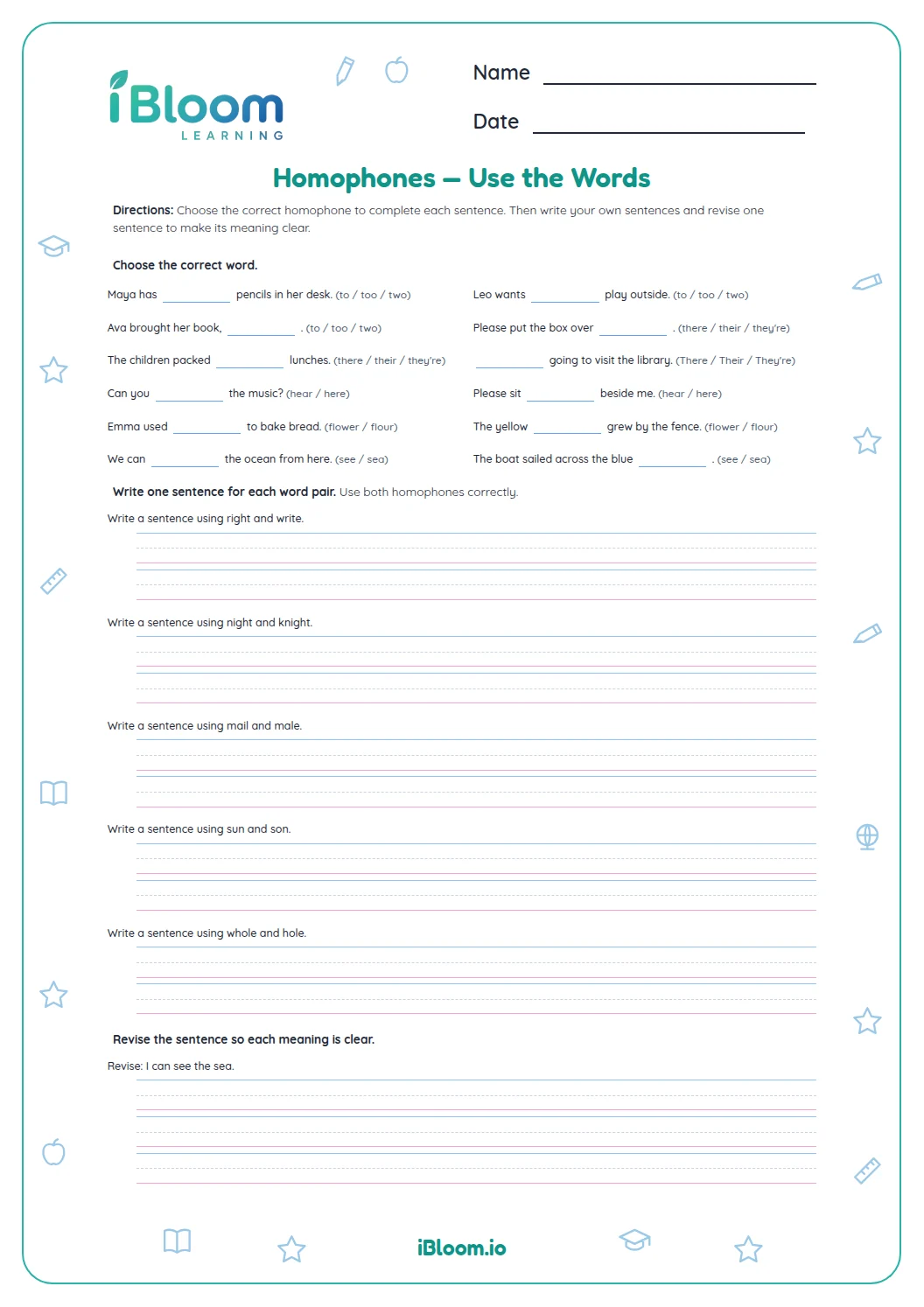
This free Grade 4 vocabulary worksheet reviews hear and here through sentence meaning. Students complete eight sentence blanks, answer two meaning questions, and explain two spelling choices. The final questions ask them to correct “Wait hear beside me” and explain why hear fits a sentence about a whispered message. The three parts practice Common Core L.4.1g, correctly using frequently confused words. A separate answer key gives the ten fixed answers and sample explanations for the two written responses. The aim is to connect each spelling with its job in the sentence.
Aligned to L.4.1g
How can meaning help students choose hear or here?
The two words sound alike, so speaking the sentence alone cannot decide the spelling. Ask students whether the blank is about receiving a sound or identifying a place. A whisper, drum, or announcement can be heard; a seat or meeting spot can be here.
The letters ear appear inside hear. That spelling reminder connects the word to listening. For here, try replacing the word with “in this place” or “at this spot” and see whether the sentence still makes sense.
Which clues lead to the right answer?
Question 1 includes both whisper and soft. Those words describe a sound and tell students which spelling belongs in the blank. A complete explanation names the meaning and connects it to one of those details.
- 1The whisper was so soft that I could barely ___ it.
- 2A whisper is a sound.
- 3Hearing is perceiving that sound.
- 4Answer: hear.
What makes the last part a reasoning review?
Part A supplies eight blanks with sound or location clues. Part B asks students to connect HERE with a location and HEAR with noticing a sound. The answer choices test meaning rather than asking for another spelling guess.
Part C asks for written reasons. In question 11, students replace hear with here and explain that beside me names a place. In question 12, they explain that a whispered message is a sound. The key provides sample wording; accept other explanations that make those same connections.
How to use this worksheet
- 1Review the meanings of hear and here without completing a worksheet sentence.
- 2Let students finish the eight blanks and underline the clue for each choice.
- 3In Part B, ask students to read all three meanings before choosing.
- 4Have students include both a word meaning and a sentence clue in Part C.
- 5Check fixed answers with the key and compare written reasons by meaning.
Mistakes to check and how to fix them
The mistake
Choosing a spelling because both words sound right aloud.
The fix
Ask whether the sentence refers to a sound or a location before spelling the word.
The mistake
Writing hear in “Wait here beside me.”
The fix
Replace the word with “at this spot”; beside me describes a place.
The mistake
Explaining a choice with only “It is correct.”
The fix
Name the clue, such as whispered message, and explain how it connects to sound.
Common Core alignment
Choose hear or here by connecting each spelling to sound or location.
On this sheet: All three parts ask students to distinguish hear from here in context.
Show the official wordingHide the official wording
Correctly use frequently confused words (e.g., to, too, two; there, their).*
What to practice next
Make more practice
Further reading
Questions parents and teachers ask
Which meaning belongs to hear, and which belongs to here?
Hear refers to perceiving sound, and here refers to a place near the speaker. The worksheet gives sound clues such as whisper and drum, along with place clues such as beside me. Students use those details to choose the spelling that matches each sentence’s meaning.
Why does this Grade 4 worksheet ask for explanations?
Explanations show whether students connect spelling to meaning. The final two questions ask them to correct a location sentence and explain a sound sentence. A student who names the clue and explains its meaning gives you more information than a student who only supplies the word.
What counts as a good answer to question 11?
A good answer changes hear to here and explains that beside me names a place. For example, a student could write, “Use here because the person should wait at this spot.” The wording may differ from the key as long as the correction and reason are clear.
Can students use the ear inside hear as a reminder?
Yes. The letters ear inside hear provide a useful spelling reminder for the sound meaning. Ask students to use that reminder after reading the whole sentence. They still need to decide whether the sentence refers to hearing a sound or being in a particular place.
Does the answer key give one required sentence for each explanation?
No. The key gives sample responses for the two explanation questions, so students can use their own wording. Check for the correct spelling and a reason tied to sound or location. The eight blanks and two multiple-choice questions each have one fixed answer on the key.