


About this worksheet
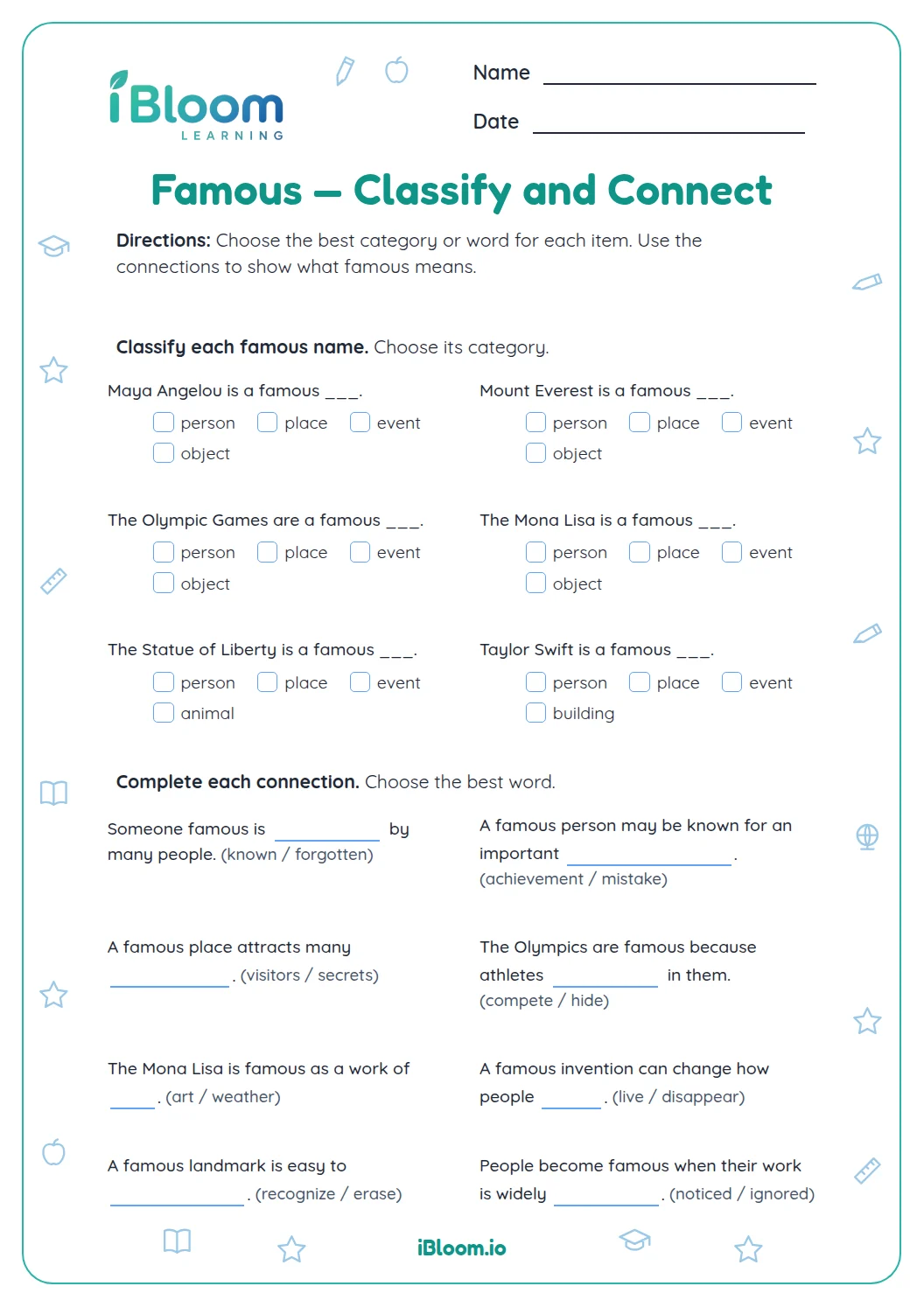
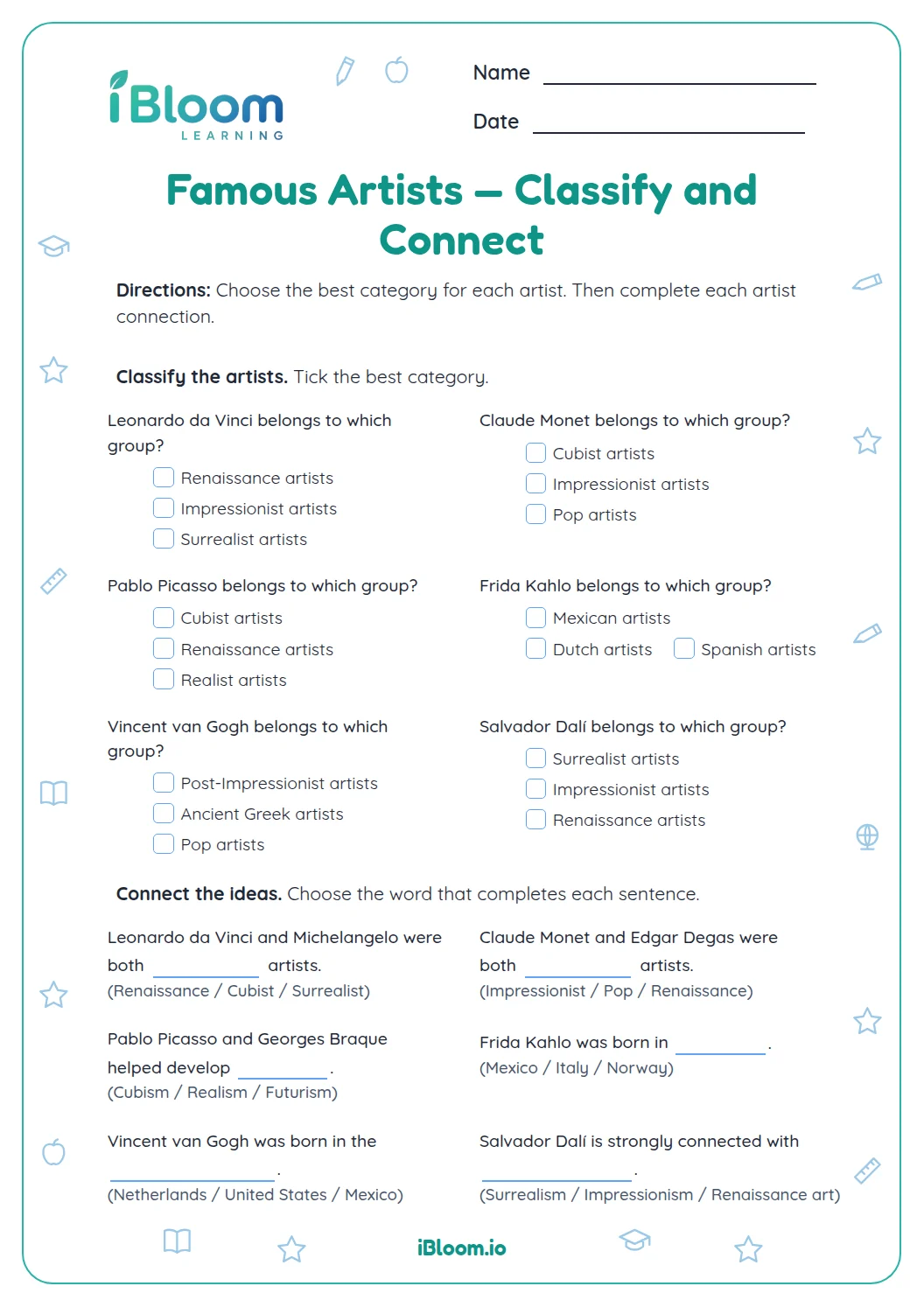
This Grade 5 vocabulary worksheet explores famous and related words such as renowned, achievement, legacy, and influence. Children search for eight terms, use sentence clues to choose meanings, and compare how related words connect. The work practices Common Core L.5.4a context clues and L.5.5c word relationships, with a separate answer key listing the expected vocabulary.
Aligned to L.5.4a and L.5.5c
What clues explain the word famous?
A sentence may explain that someone is known in a town, across a country, or for a particular accomplishment. Those details show the reach or reason for the person’s fame.
How do related words sharpen meaning?
Renowned is close in meaning to famous, while achievement names an accomplishment. Legacy and influence describe lasting results in different ways.
- 1A lasting effect on people or events is an ___.
- 2The clue “lasting effect” points to influence.
- 3Answer: influence.
Why begin with a word search?
Locating each target word helps students attend to spelling before they examine how the word works in a sentence. The search is a short entry task; meaning questions ask for deeper reasoning.
How can students check a word choice?
Read the completed sentence again with the chosen word. A meaning that fits both the clue and the whole sentence is more likely to be correct. The key lists an expected word for each blank.
How to use this worksheet
- 1Circle each target word in the grid.
- 2Read the entire context sentence before choosing a meaning.
- 3Use nearby examples, contrasts, and cause-and-effect clues.
- 4Compare close synonyms and decide whether they fit the same way.
- 5Write complete explanations that include a relevant clue.
Common mistakes and quick fixes
The mistake
Treating famous and renowned as different in every context.
The fix
Check whether both words describe something known by many people, then look for differences in tone or emphasis.
The mistake
Confusing an achievement with the person who completed it.
The fix
Ask whether the word names a person or something important that was accomplished.
The mistake
Choosing a meaning from the topic alone.
The fix
Point to a phrase in the sentence that supports the meaning.
Common Core alignment
Use sentence and paragraph clues to determine a word’s meaning.
On this sheet: Children use sentence clues and comparisons to distinguish related vocabulary meanings.
Show the official wordingHide the official wording
Use context (e.g., cause/effect relationships and comparisons in text) as a clue to the meaning of a word or phrase.
Use relationships among words to understand shades of meaning.
On this sheet: Questions compare famous with renowned and explain how vocabulary words relate.
Show the official wordingHide the official wording
Use the relationship between particular words (e.g., synonyms, antonyms, homographs) to better understand each of the words.
What to practice next
Make more practice
Further reading
Questions parents and teachers ask
What does renowned mean?
Renowned means known or admired by many people, so it is close in meaning to famous. The sentence clues on this page connect the word to recognition, achievement, and the way a person’s work affects others. Ask learners to point out the sentence clue and reread their answer in context.
What is a legacy?
A legacy is what someone leaves behind or is remembered for, such as work, ideas, or lasting changes. The worksheet distinguishes a legacy from an achievement, which is a task or goal someone completes. Ask learners to point out the sentence clue and reread their answer in context.
How does the word search connect to the other questions?
Students first locate eight target words, including famous, renowned, achievement, and legacy. Later items use definitions and sentence clues to check how those words relate in meaning and in use. Ask learners to point out the sentence clue and reread their answer in context.
What is the difference between famous and popular?
Famous means widely known. Popular means liked by many people. Someone or something can be famous without being liked by everyone, so the words are related but do not mean exactly the same thing. Ask learners to point out the sentence clue and reread their answer in context.
What does the answer key include?
The key lists the expected vocabulary word or phrase for each question and confirms the eight search words. For a fill-in response, accept another form only when it fits the sentence and preserves the intended meaning. Ask learners to point out the sentence clue and reread their answer in context.