



About this worksheet
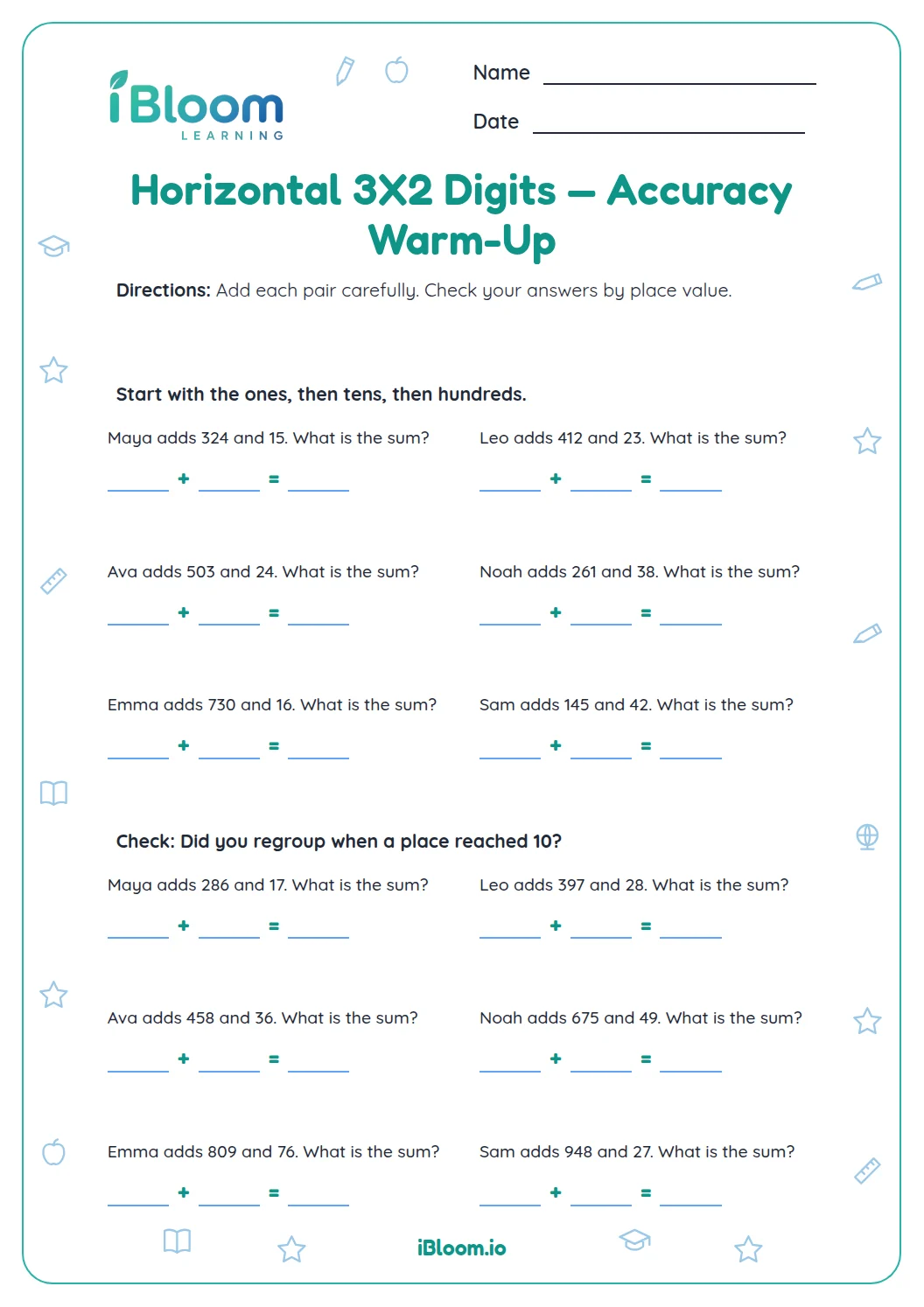
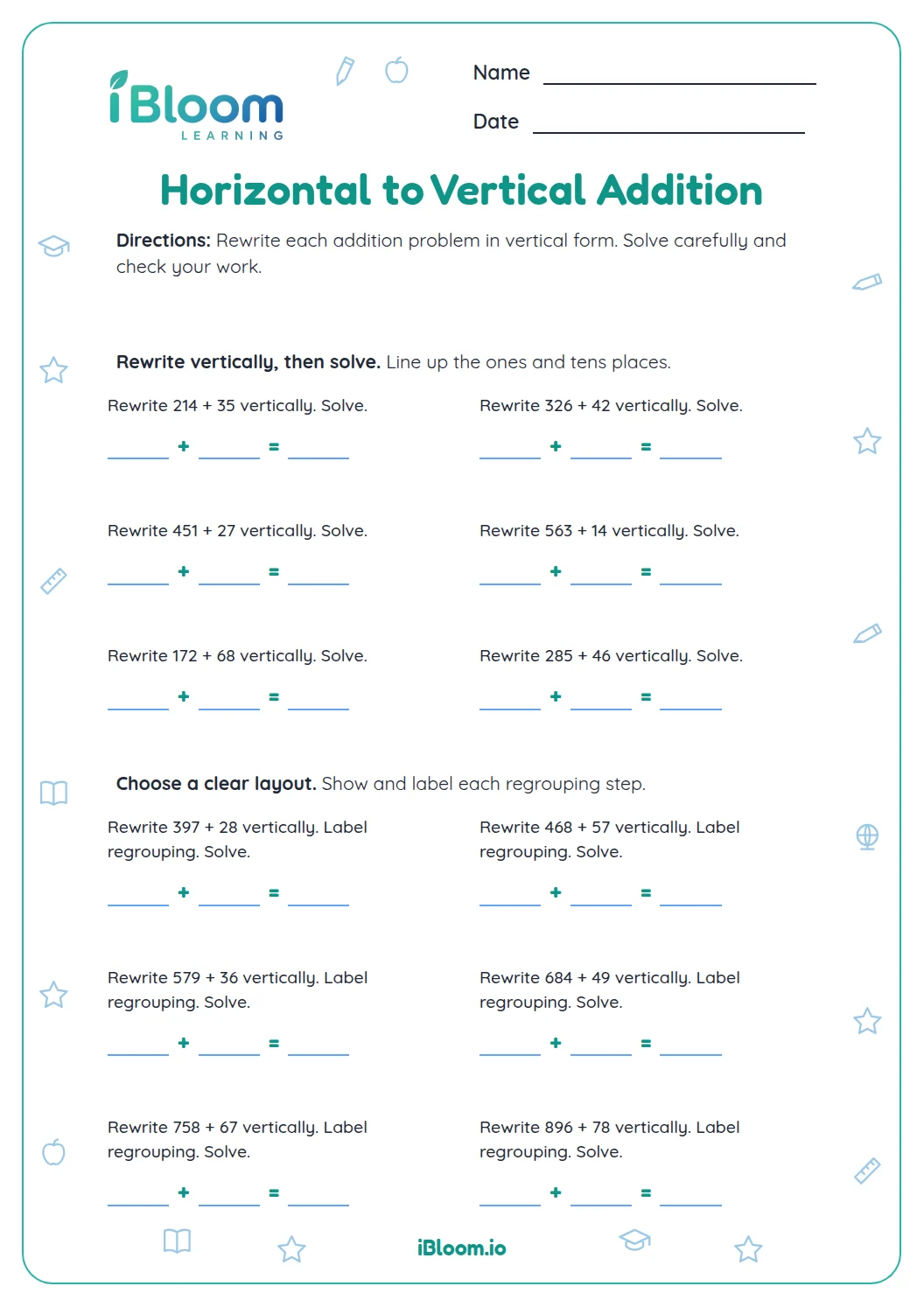
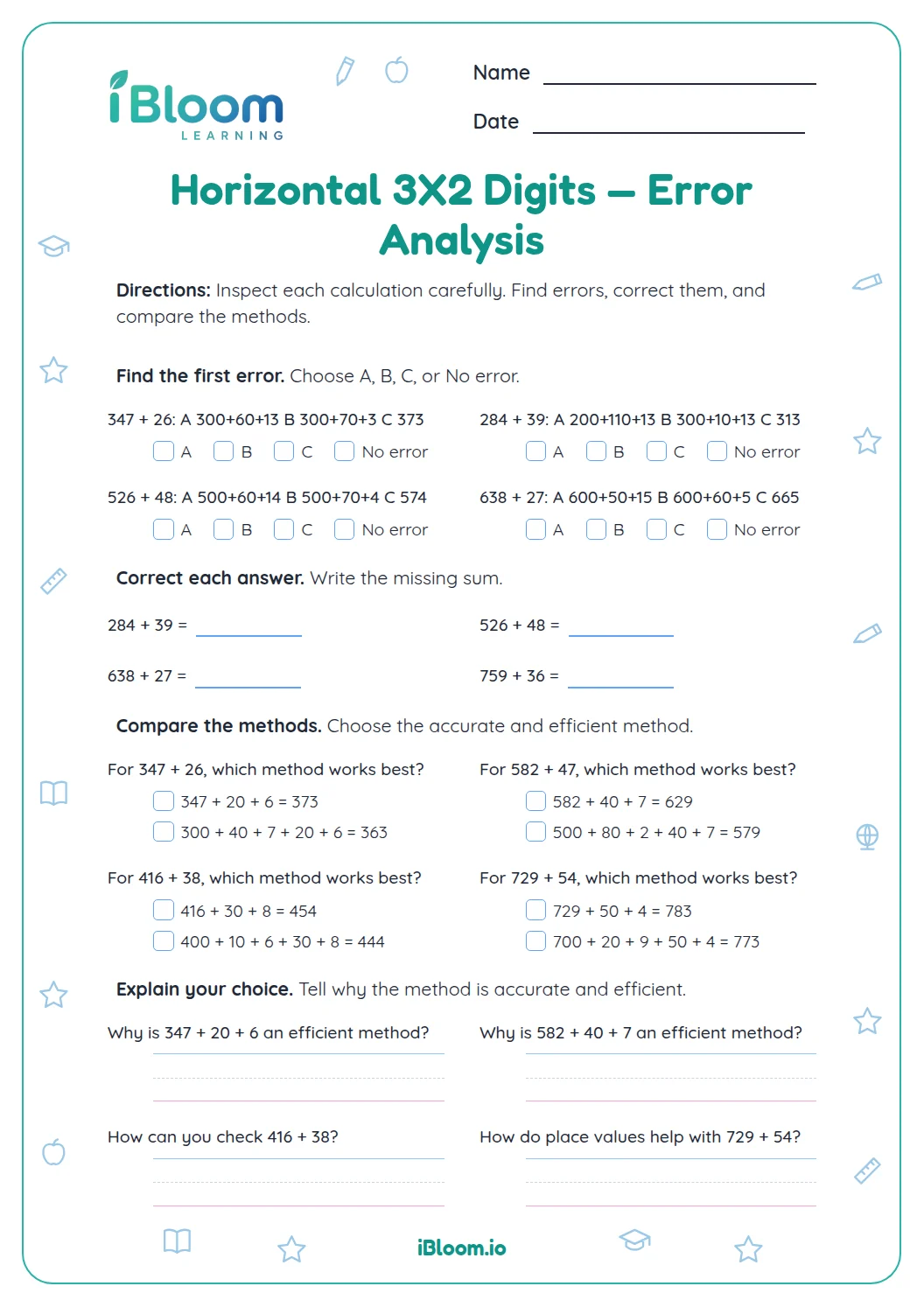
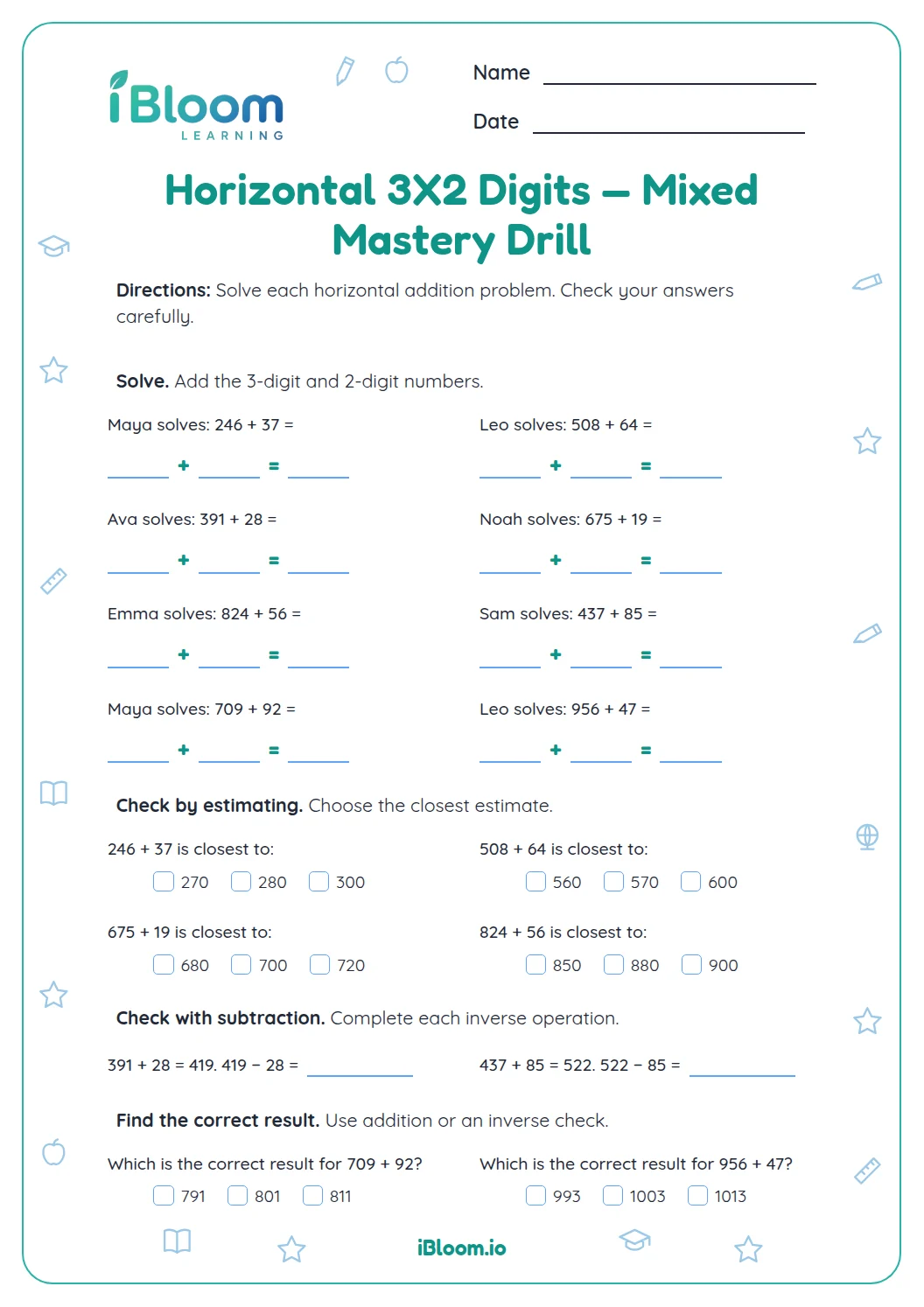
This free two-page addition worksheet gives Grade 2 and Grade 3 children practice adding a three-digit number and a two-digit number written side by side, like 157 + 68. Part A has four problems with no regrouping, Part B has four where both the ones and the tens regroup, Part C asks children to rewrite four problems in columns and solve them, and Part D asks them to find the right sum after a friend forgets a carry. It practices Common Core 2.NBT.B.7 and 3.NBT.A.2, and a separate answer key gives every sum.
Aligned to 2.NBT.B.7 and 3.NBT.A.2
Why do side-by-side numbers need to be lined up?
When a problem is written sideways, the digits look as if they sit next to each other, but the places do not match. In 157 + 68, the 7 and the 8 are both ones, and the 5 and the 6 are both tens. The 1 in 157 has no partner, so it waits in the hundreds place.
Rewriting the problem in columns lines up the places, so every digit is added to a digit of the same value. Many mistakes with 3-digit and 2-digit numbers come from lining up the 6 of 68 under the hundreds instead of the tens.
What does regrouping mean in 157 + 68?
Add the ones first: 7 + 8 = 15 ones. That is 1 ten and 5 ones, so write 5 in the ones place and add the 1 ten to the tens. Then 5 tens + 6 tens + 1 ten = 12 tens, which is 1 hundred and 2 tens. Write 2 in the tens place and add the 1 hundred to the hundreds. Finally, 1 hundred + 1 hundred = 2 hundreds, so the sum is 225.
All four Part B problems regroup twice like this one: the ones make a new ten, and then the tens make a new hundred. Part C mixes the cases, so children have to check each column: 638 + 47 regroups only the ones, 892 + 76 only the tens, and 748 + 57 and 567 + 89 both.
- 1157 + 68
- 2Ones: 7 + 8 = 15, write 5 and carry 1 ten
- 3Tens: 5 + 6 + 1 = 12, write 2 and carry 1 hundred
- 4Hundreds: 1 + 1 = 2
- 5Answer: 225
What is on this worksheet?
The problems get harder in order. Part A is horizontal with no regrouping, so children can focus on matching ones with ones and tens with tens. Part B regroups the ones and then the tens in every problem. Part C gives a box of working space for four problems to write in columns, each needing a different kind of regrouping. Part D shows two answers that are each 10 too low, because the carried ten was dropped.
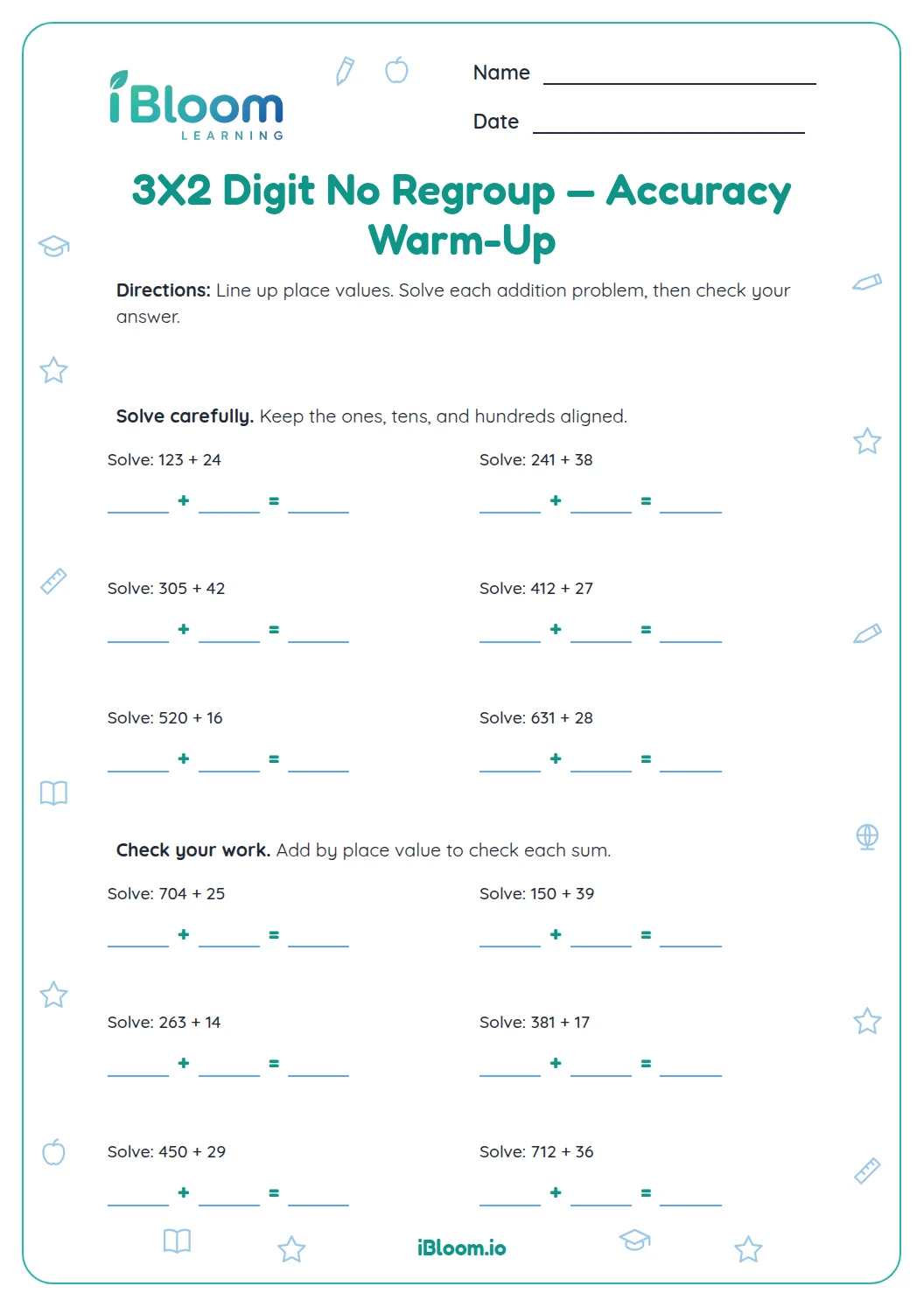
- Part A: 124 + 23, 231 + 14, 305 + 42, 526 + 31
- Part B: 157 + 68, 284 + 39, 369 + 54, 475 + 86
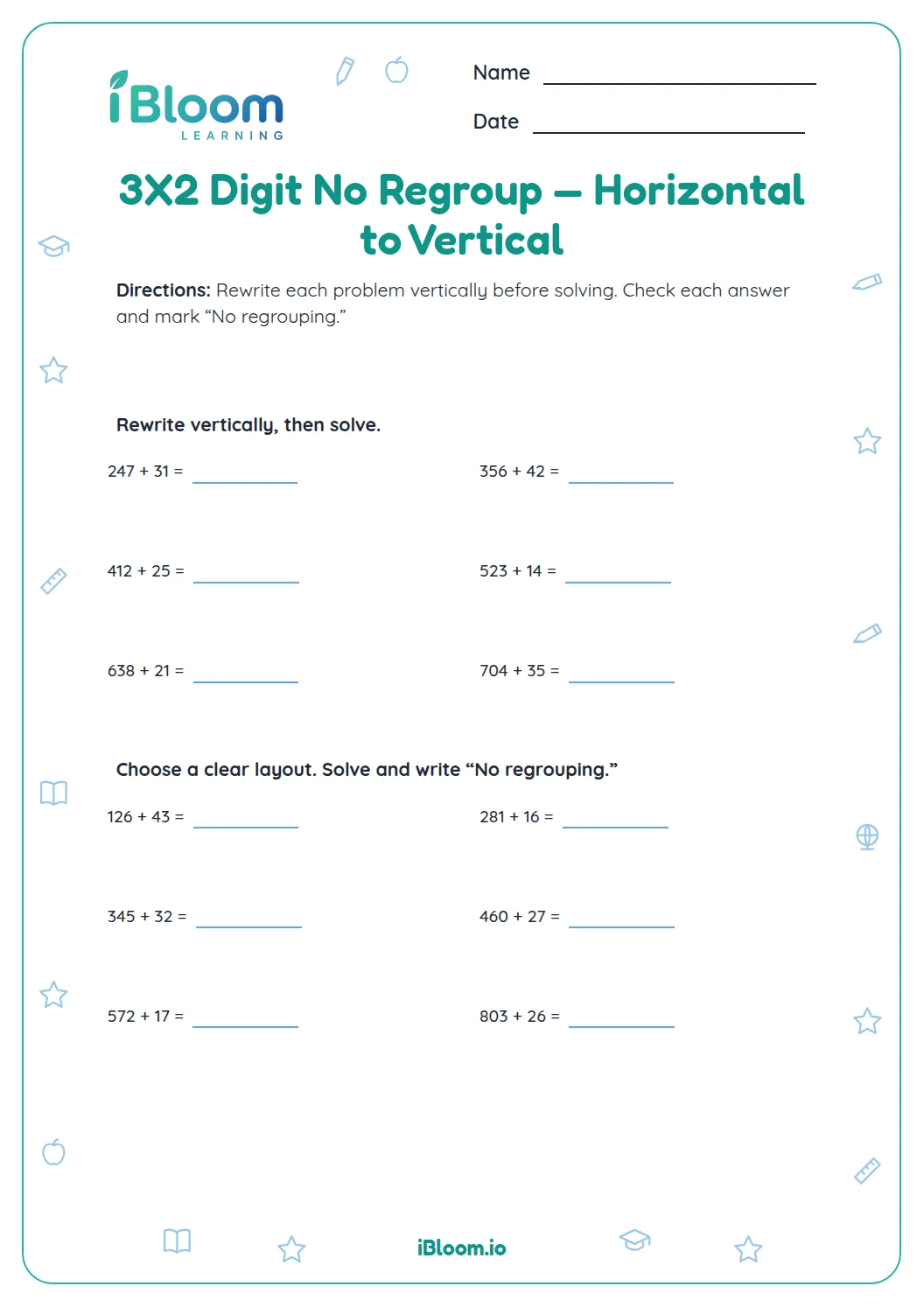
- Part C: 638 + 47, 748 + 57, 892 + 76, 567 + 89, with room to work
- Part D: 2 sums to check, 186 + 47 and 364 + 58
How can children check a sum?
Round both numbers and add the rounded numbers, then see whether the answer is close. For 157 + 68, 160 + 70 is 230, so 225 is a sensible sum while 215 or 325 is not. Estimating takes a few seconds and catches most carrying mistakes.
How to use this worksheet at home or in class
- 1Start with 124 + 23 in Part A. Ask your child which digits are ones, which are tens and which are hundreds, and why the 1 in 124 has no partner.
- 2Let your child finish Part A on their own, adding the ones first.
- 3Do question 5 together using the worked example, saying "15 ones is 1 ten and 5 ones" out loud.
- 4In Part C, have your child draw the columns first, with ones under ones and tens under tens.
- 5For Part D, ask your child to find the friend's mistake before choosing the right sum.
- 6Check with the answer key, and round the numbers to see whether each sum is close.
Common mistakes and quick fixes
The mistake
Lining up the digits from the left, so the 47 sits under the hundreds and tens of 186 in 186 + 47.
The fix
Line up from the right. Ones go under ones. Draw a small place-value header (H, T, O) above the columns until it becomes a habit.
The mistake
Forgetting the carried ten, as in 186 + 47 = 223 instead of 233.
The fix
Write the small 1 above the tens column as soon as the ones add to ten or more. Cross it off after adding it.
The mistake
Dropping the new hundred when the tens add to 10 or more, as in 748 + 57 = 705.
The fix
Add the tens, then ask whether the total is 10 or more. If it is, write the extra 1 above the hundreds column.
Common Core alignment
Most US states use the Common Core Math standards or a close state version, so this sheet fits Grade 2 and Grade 3 addition in most classrooms.
Add within 1000 using place value, with 10s and 100s composed when needed.
On this sheet: Every problem adds ones to ones, tens to tens and hundreds to hundreds, with composing in Parts B and C.
Show the official wordingHide the official wording
Add and subtract within 1000, using concrete models or drawings and strategies based on place value, properties of operations, and/or the relationship between addition and subtraction; relate the strategy to a written method. Understand that in adding or subtracting three-digit numbers, one adds or subtracts hundreds and hundreds, tens and tens, ones and ones; and sometimes it is necessary to compose or decompose tens or hundreds.
Add within 1000 fluently and accurately with a written method.
On this sheet: Parts A to C build speed and accuracy with the column method for sums within 1000.
Show the official wordingHide the official wording
Fluently add and subtract within 1000 using strategies and algorithms based on place value, properties of operations, and/or the relationship between addition and subtraction.
What to practice next
Make more practice
Further reading
Questions parents and teachers ask
How do you add a 3-digit number and a 2-digit number?
Line the numbers up so ones are under ones and tens are under tens, then add from the right, regrouping when a column reaches 10. For 284 + 39, the ones make 13, so write 3 and carry a ten. The tens make 12, so write 2 and carry a hundred. The sum is 323.
What are the answers to Part B?
The four sums are 225, 323, 423 and 561. Each one regroups the ones first: 7 + 8 = 15, 4 + 9 = 13, 9 + 4 = 13 and 5 + 6 = 11. Then each regroups the tens, because the tens plus the carried ten reach 10 or more. The answer key shows all 14 answers.
Why are the Part C problems written without an answer line?
Part C gives each problem a working box so children copy it into columns before adding. Writing the problem vertically is what lines up the places, which is the step this sheet practices. The small answer box beside each one holds the final sum, and carry marks go above the columns.
What is the mistake in Part D?
Both friends forgot a carry. Leo wrote 223 for 186 + 47, but 6 + 7 = 13 ones makes a ten to carry, so the sum is 233. Ava wrote 412 for 364 + 58, but 4 + 8 = 12 ones makes a ten to carry, so the sum is 422. Each answer is 10 too low.
Is this a timed drill?
No. This sheet is about accuracy, with room to work and check. If you want a speed goal, wait until your child gets most of Parts A and B right, then time a copy of the same kind of problems. Timing too early can lead to rushed carrying mistakes.
Is there an answer key, and how long does the sheet take?
Yes. The answer key is two separate pages with the correct sum for all 14 questions. Most children in Grades 2 and 3 finish in about 15 minutes. Part C takes the longest, because children rewrite each problem in columns and add carry marks above them.