










About this worksheet
This Grade 2 science printable uses familiar animal examples to practice inherited traits and cause and effect. Fourteen concise multiple-choice questions ask children to distinguish traits passed from parents from learned behaviors, then connect a trait with an effect. The answer key follows the same order and gives the best explanation for each example.
Aligned to 1-LS3-1
Which animal traits can pass from parents?
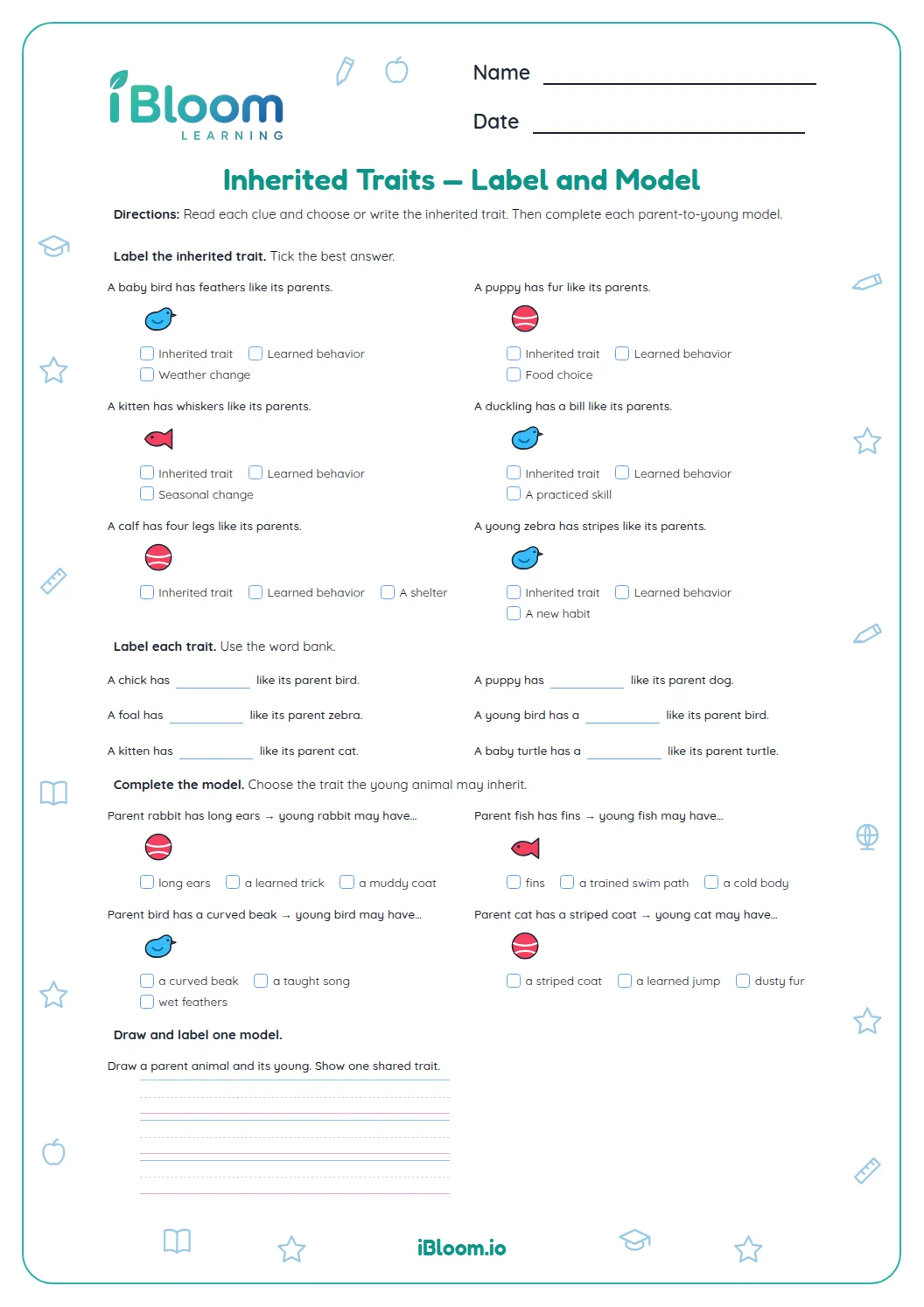
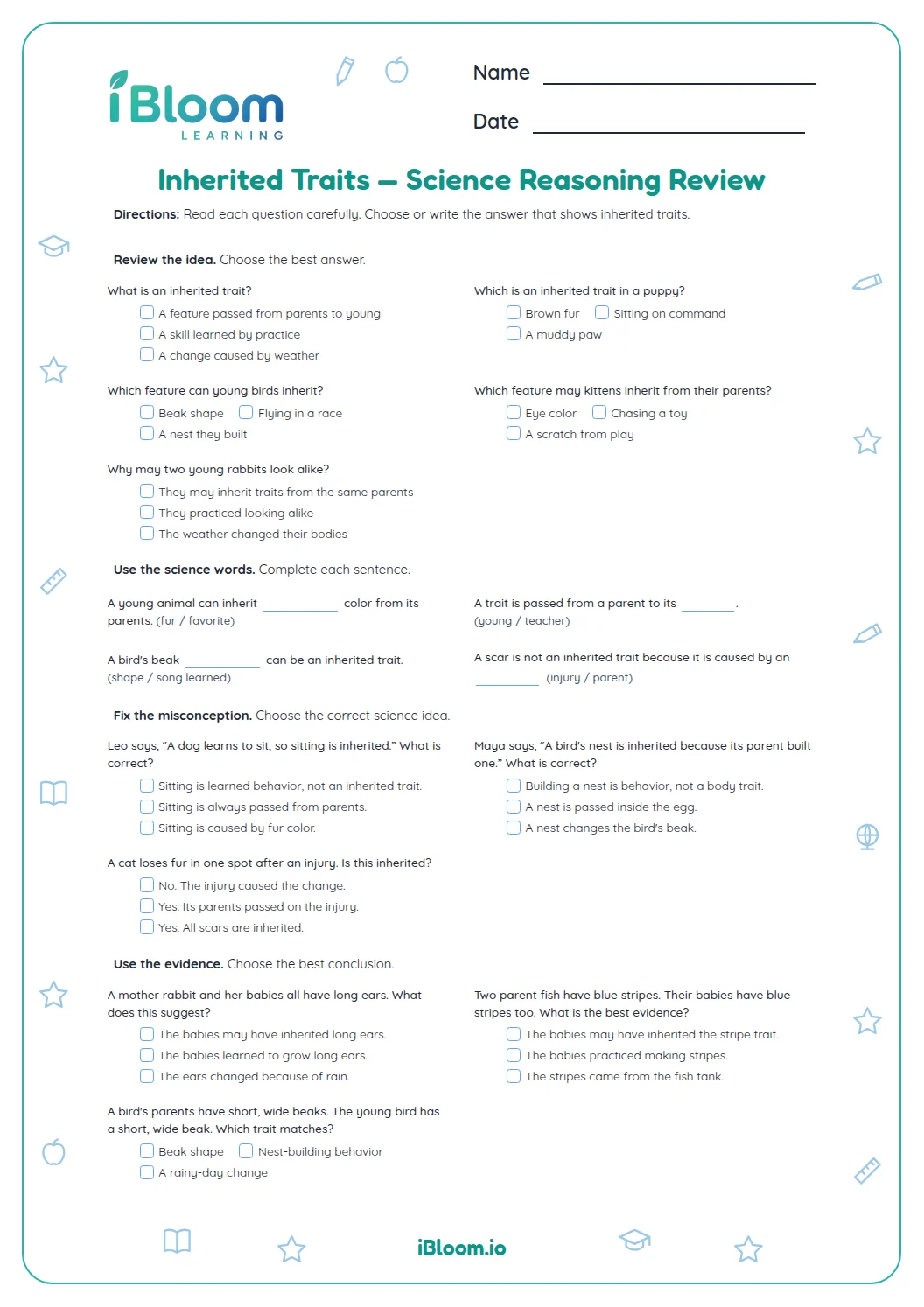
The worksheet uses ears, tails, feathers, coats, and other visible features to distinguish inherited body traits from learned behaviors. Each question gives an animal example and asks for the best explanation.
How does an inherited trait lead to an effect?
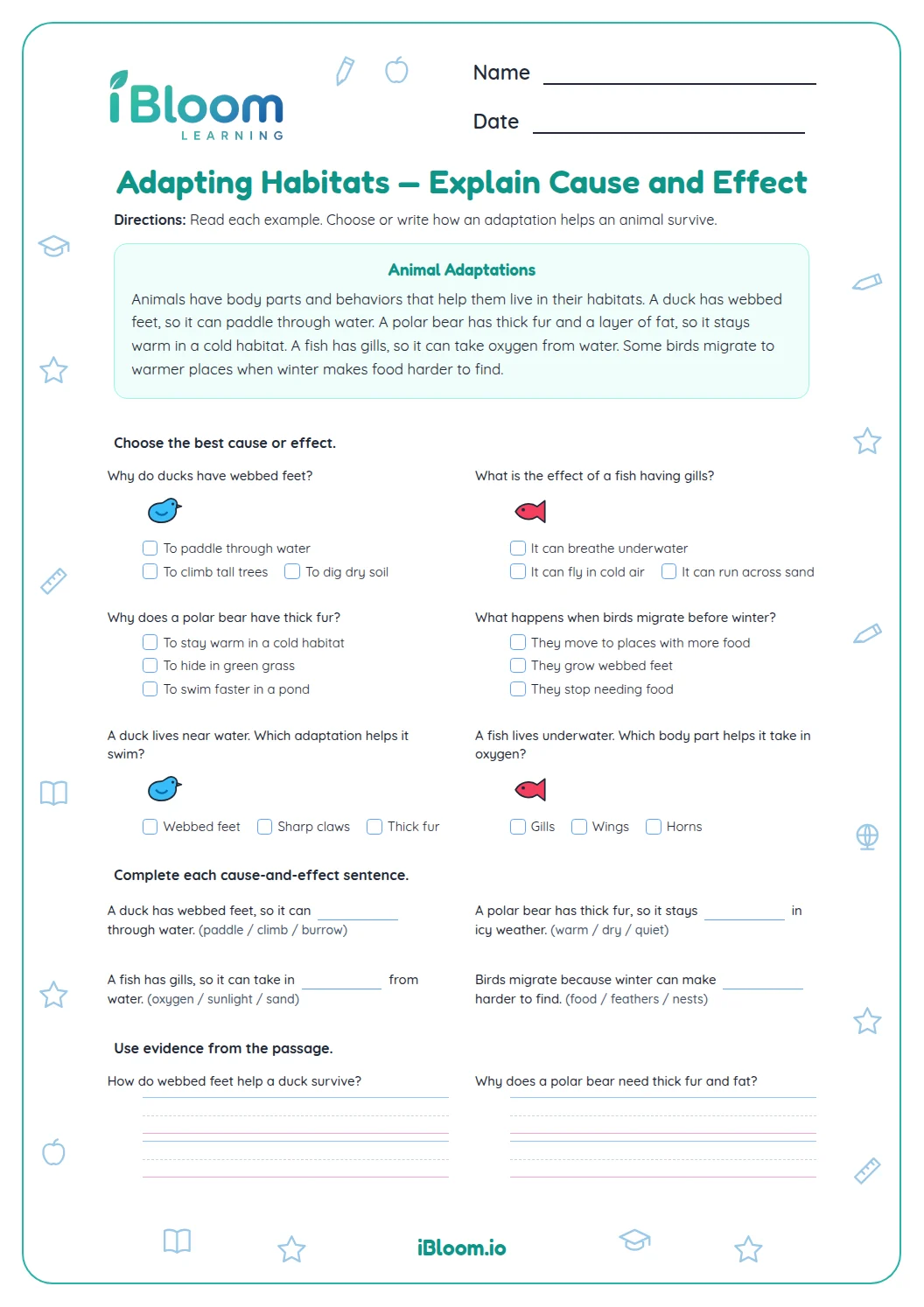
A young animal may share a body feature with a parent. In question 5, the duckling’s webbed feet are the inherited feature; swimming is an action, not the body trait named in the answer.
Can animals of one kind have different traits?
Yes. The puppy and bird examples show that animals of one kind can vary. Offspring may share some traits with parents without looking exactly alike.
How to use this worksheet
- 1Notice the animal feature named in each question.
- 2Ask whether it is a body trait or a learned behavior.
- 3Connect a parent trait to an effect in its young.
- 4Remember that offspring can resemble parents without being exactly alike.
- 5Check the answer key and explain the evidence.
Common mistakes and quick fixes
The mistake
Calling every behavior inherited.
The fix
Separate body features from actions an animal learns.
The mistake
Assuming offspring are exact copies.
The fix
Look for the possibility of differences among young animals.
The mistake
Naming a trait without explaining the cause.
The fix
Connect the similarity to a trait passed from parent to offspring.
Curriculum alignment
Use animal examples as evidence that young can resemble, but differ from, their parents.
On this sheet:
Show the official wordingHide the official wording
Make observations to construct an evidence-based account that young plants and animals are like, but not exactly like, their parents.
What to practice next
Further reading
Questions parents and teachers ask
What is an inherited trait?
An inherited trait is a body feature passed from parents to offspring. The worksheet uses examples such as fur color, ears, tails, feathers, and beaks to help children identify these features. Learners choose the explanation that best links a parent trait to a young animal.
How is a learned behavior different from an inherited trait?
A learned behavior is picked up through experience or practice, while an inherited trait is a body feature passed from parents. One question contrasts a puppy learning to sit with body features such as fur color. This helps children separate an action from a physical trait.
How many questions are on the worksheet?
The printable has 14 multiple-choice questions about inherited animal traits, learned behaviors, and cause and effect. The answer key follows the same question order. Children can read each animal example, choose an explanation, and then check the response.
Do offspring always look exactly like their parents?
No. Offspring can share some inherited traits with their parents and still differ in other ways. The questions about puppies with different coat colors and birds with different beak shapes show that members of one kind may vary.
What does cause and effect mean here?
Cause and effect links a reason to what happens as a result. In this worksheet, a trait passed from a parent can explain why a young animal has a similar body feature. Children choose which outcome fits each example.