






About this worksheet
This free printable worksheet is for Grade 1 learners practicing bean plant life cycle. It includes 14 questions in 2 parts, with focused directions and a separate answer key for checking.
What happens as a bean plant grows?
A bean plant life cycle starts with a seed. With water and warmth, the seed may sprout: a root grows down and a shoot grows up toward light. The young plant grows, flowers, and can make new seeds. Those seeds may begin the cycle again.
- 1Seed → sprout → young plant
- 2The young plant grows and may flower.
- 3A flowering plant can make seeds.
What can help a seed sprout?
Water and warmth can help a bean seed begin to grow. A seed needs the right conditions; adding water does not make a flower appear at once. Question 9 asks what may happen next when a seed has water and warmth.
How do the questions use life-cycle clues?
Some questions ask for the next stage, while others describe a root, stem, or missing water. Use the clue in the question to decide whether the seed has started to sprout or the plant is still young.
How to use this worksheet
- 1Start with the seed, then look for the sprout and young plant stages.
- 2Notice what a seed needs to begin growing, such as water and warmth.
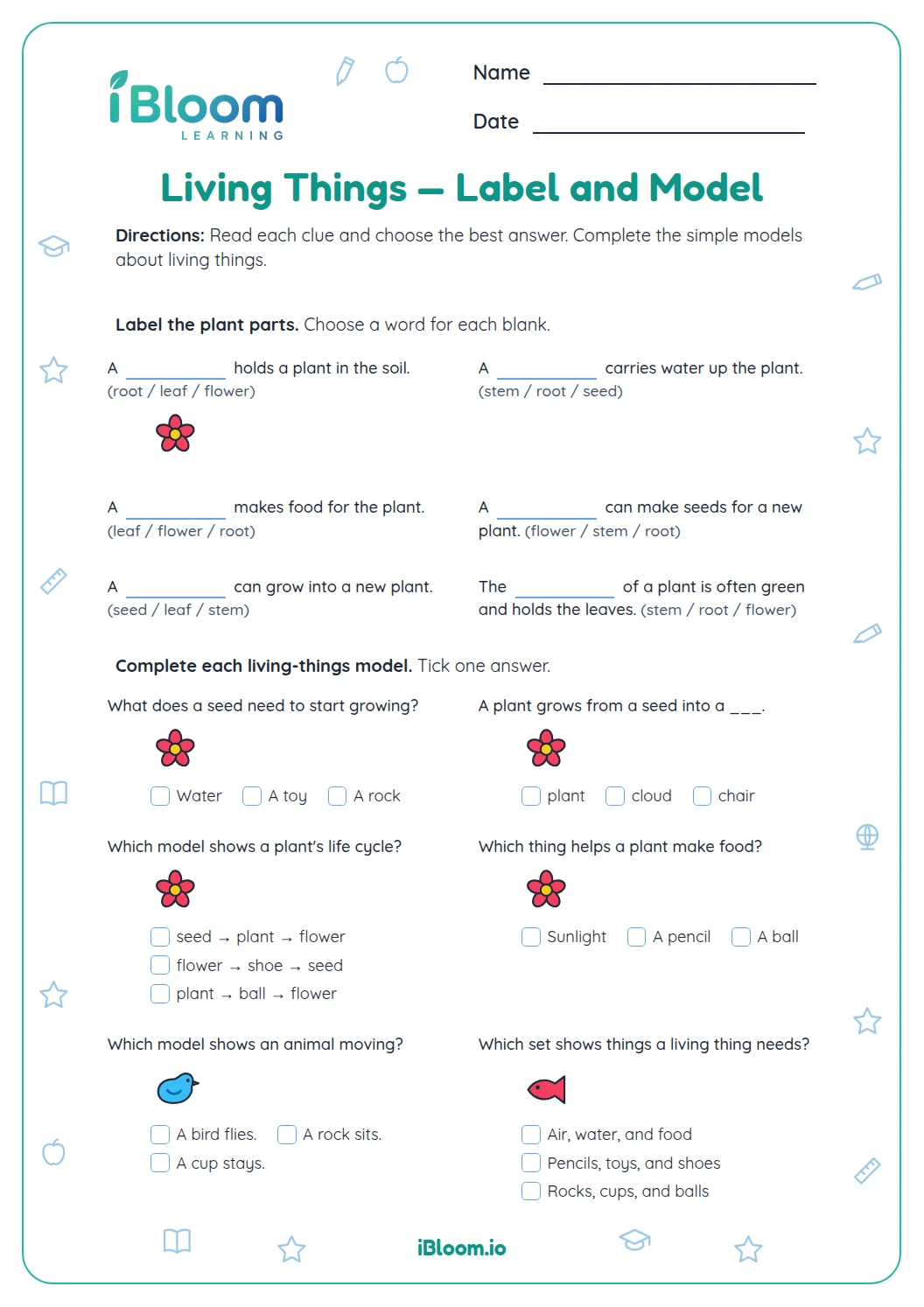
- 3Connect plant parts to their jobs: roots take in water, and stems hold leaves up.
- 4Think about what a flowering plant can make and how seeds begin the cycle again.
- 5Choose the answer that fits the stage or plant part named in each question.
Common slips and how to fix them
The mistake
Putting a flower before the seed or sprout.
The fix
Say the sequence aloud: seed, sprout, young plant, then a mature flowering plant.
The mistake
Thinking roots make sunlight for the plant.
The fix
Remember roots take in water; leaves use light as the plant grows.
The mistake
Thinking a seed becomes a flower all at once.
The fix
Place the sprout and young plant between the seed and a mature flowering plant.
What to practice next
Make more practice
Questions parents and teachers ask
What stages does this worksheet cover?
Questions follow a bean plant from seed to sprout and young plant, then to flowering and new seeds. Children use stage clues to reason about what may happen next and how the cycle can begin again. Use the same reasoning on the other questions in this section.
What helps a bean seed sprout?
Water and warmth can help a bean seed begin to grow. A root may appear first while a shoot grows toward light. The worksheet asks children to connect those clues with the seed’s early growth. Use the same reasoning on the other questions in this section.
Why does a plant need roots?
Roots take in water from the soil and help anchor a plant. One question asks what roots do, while another uses the appearance of a tiny root as evidence that a seed has started to sprout. Use the same reasoning on the other questions in this section.
How can the life cycle begin again?
A flowering bean plant can make seeds. A seed may sprout and grow into another plant, which can later flower and make seeds too. Children identify this repeating sequence in several question formats. Use the same reasoning on the other questions in this section.
Does the page include an answer key?
Yes. The answer key follows the 14 questions and identifies the best choice for each one. For questions about what may happen, the key uses the likely outcome described by the clues, such as a watered, warm seed beginning to sprout.